On this page
- What Is Sump Capacity and Why Does It Matter?
- How Much Water Does a Household Need per Day?
- How Do You Do a Sump Capacity Calculation?
- Which Sump Shape Should You Choose?
- How Do You Measure a Sump for Capacity in Litres?
- What Are Standard Sump Sizes in India?
- What Should You Do After Calculating Sump Capacity?
- A sump capacity calculation = people × litres per day × days of storage.
- Convert litres to size: 1 m³ = 1,000 litres, 1 ft³ = 28.317 litres.
- If you buy tankers, make sure one full load fits in the sump.
- Precast sumps come in 1,000–6,000 L sizes.
A sump capacity calculation tells you how many litres your underground sump must store. Multiply household size by daily use per person, then by the days of storage you need.
In Bengaluru, where supply is often intermittent, the sump is your buffer between supply days.
What Is Sump Capacity and Why Does It Matter?
Sump capacity is the litres of water an underground tank holds. The sump takes municipal or tanker water, and a pump lifts it to the overhead tank.
A sump stores clean water; a septic tank treats sewage. See our septic tank design guide for that calculation.
How Much Water Does a Household Need per Day?
A household in a metro city needs about 150 litres per person per day. That is the CPHEEO (Central Public Health and Environmental Engineering Organisation) norm of 150 lpcd (litres per capita per day) for metros.
IS 1172:1993, the Indian code of basic requirements for water supply, drainage and sanitation, gives 150–200 lpcd for cities above 1 lakh people. It allows 135 lpcd for low-income housing.
How Do You Do a Sump Capacity Calculation?
You do a sump capacity calculation in two steps: find the litres, then the dimensions that hold them.
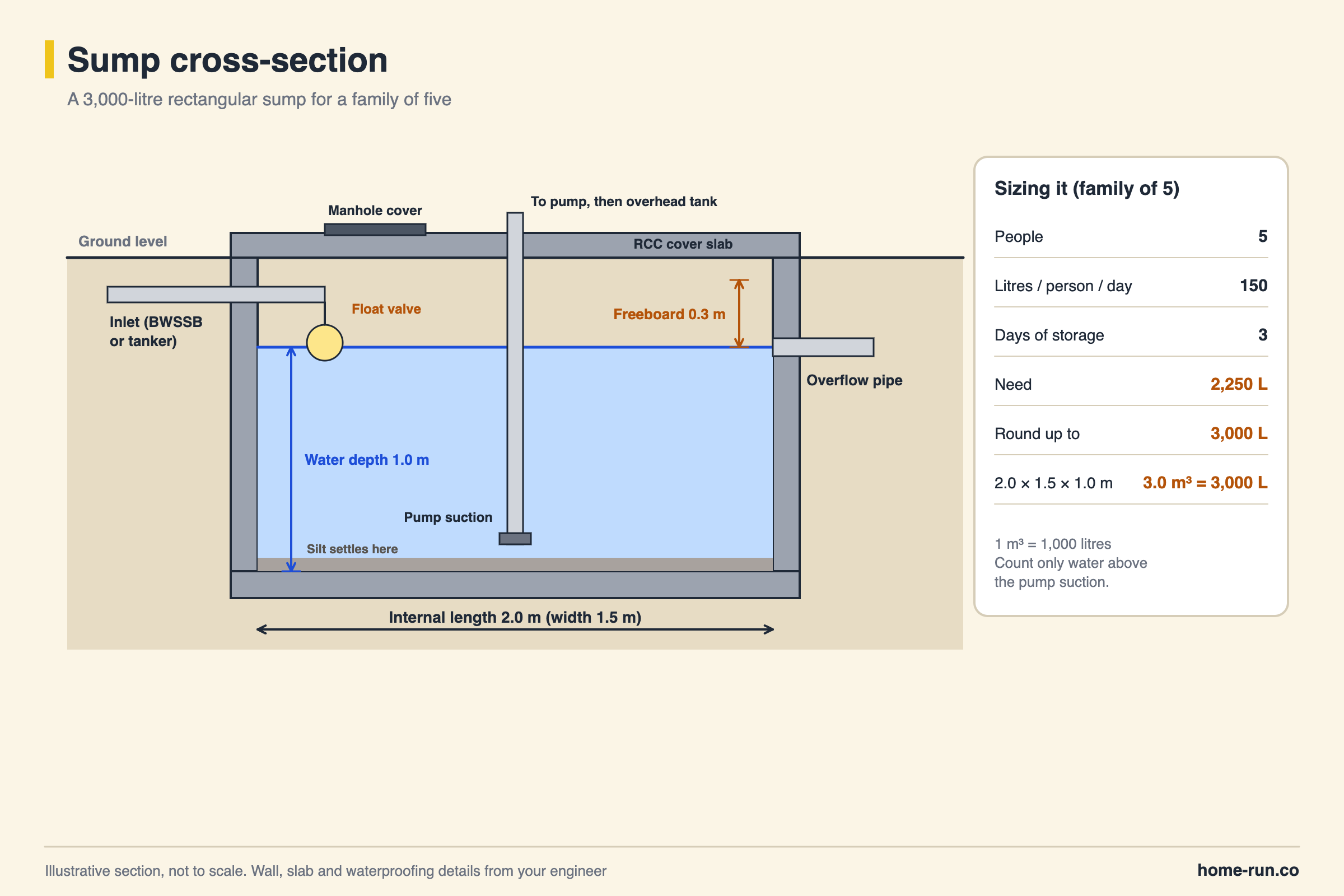
Store water for the longest gap between supplies, plus one day. If you buy tankers, fit a full load: 2024 Bengaluru reports quoted 6,000-litre tankers.
Which Sump Shape Should You Choose?
Choose a rectangular sump for custom sizes and a round plastic sump for a quick install.
Rectangular (RCC or brick)
Most homesPoints
- Built on site to any size
- Fits narrow plots
- Needs waterproofing and curing
- Volume = L × B × H
Round (precast plastic)
Smaller loadsPoints
- Sintex sumps come in 1,000–6,000 L
- Sealed one-piece body
- Fixed sizes only
- Volume = 3.1416 × r² × H
How Do You Measure a Sump for Capacity in Litres?
Measure inside the sump and use one unit throughout.
- Measure internal length and width at water level.
- Measure water depth from the floor to the overflow pipe.
- Multiply L × B × H, then × 1,000 for metres or × 28.317 for feet.
A 6 × 6 × 6 ft tank holds 216 ft³ × 28.317 = 6,116 litres.
- Mixing units: feet with centimetres gives nonsense.
- Counting the slab gap: water stops at the overflow.
What Are Standard Sump Sizes in India?
Standard precast sumps in India run from 1,000 to 6,000 litres; site-built sumps can be any size.
Sump sizes and example internal dimensions
At 150 L per person, 2 days of storage| Capacity | L × B × water depth (m) | Serves up to |
|---|---|---|
| 1,000 L | 1.0 × 1.0 × 1.0 | 3 people |
| 2,000 L | 2.0 × 1.0 × 1.0 | 6 people |
| 3,000 L | 2.0 × 1.5 × 1.0 | 10 people |
| 5,000 L | 2.0 × 2.0 × 1.25 | 16 people |
| 6,000 L Holds a tanker | 2.0 × 1.5 × 2.0 | 20 people |
What Should You Do After Calculating Sump Capacity?
After the sump capacity calculation, confirm the size with your engineer.
- Fit a float valve on the inlet. See our guide to types of water valves.
- Plan a rooftop recharge link. BWSSB requires rainwater harvesting on qualifying plots.
Building a sump?
Cement, steel and plumbing delivered across Bengaluru.