On this page
- What Are the Types of Granite and How Are They Grouped?
- Which Are the Most Popular Types of Granite in India?
- How Do Granite Colours Change the Look of a Room?
- What Are the Types of Granite Finishes?
- Where Should You Use Each Type of Granite?
- How Much Do the Types of Granite Cost in India?
- How Do You Maintain Granite Surfaces?
- How Do You Source Good Granite in Bengaluru?
- How Do You Choose the Right Type of Granite for Your Project?
- The types of granite sold in India are named by colour and pattern: black, white, red, grey, brown, green and blue families.
- India's best-known varieties are Absolute Black, Black Galaxy, Kashmir White, Steel Grey, Tan Brown and Imperial Red.
- The finish changes both looks and grip: polished for kitchens and indoor floors, flamed or leathered for wet and outdoor areas.
- Many stones sold as "granite" are other hard igneous rocks, so judge a slab by its tested properties, not its name.
- Check the actual slab for cracks, resin fills and colour match before you pay.
The types of granite used in Indian homes are sorted by colour, pattern and surface finish. Common names include Absolute Black, Black Galaxy, Kashmir White, Steel Grey, Tan Brown and Imperial Red.
India has over 200 shades of granite, according to the Indian Bureau of Mines (IBM). This list covers the varieties you will see most often, what each suits, and how to buy a good slab.
What Are the Types of Granite and How Are They Grouped?
Granite is a hard, coarse-grained igneous rock that forms when molten magma cools slowly deep underground. Geologists define true granite as rock with 20% to 60% quartz by volume, plus a large share of feldspar.
The minerals inside the stone decide its colour and pattern:
- Quartz: a hard, glassy mineral that reads as clear, white or grey grains.
- Feldspar: the main mineral group, which gives white, pink, red or cream tones.
- Mica: flaky, shiny minerals. Biotite, a dark mica, adds black flecks.
- Amphibole: dark minerals such as hornblende that add black and green specks.
Shops group the types of granite in three ways: by colour family, by pattern (uniform, speckled or veined) and by finish.
The stone trade calls almost any hard, polishable igneous rock granite. Most black "granite" is really gabbro, and Blue Pearl is larvikite, a Norwegian rock called monzonite. These stones still perform well, so compare test results, not labels.
How granite goes from quarry to slab
Formation
Magma rich in silica cools slowly underground, so large crystals of quartz, feldspar and mica grow.
Exposure
Over millions of years, uplift and erosion bring the rock close to the surface.
Quarrying
Quarries cut large blocks from the rock bed with drills and diamond wire saws.
Slabbing
Factories saw each block into slabs or tiles of a set thickness.
Finishing
Slabs are polished, honed, leathered or flamed, then cut to size for your site.
Which Are the Most Popular Types of Granite in India?
The most popular types of granite in India are Absolute Black, Black Galaxy, Kashmir White, Steel Grey, Tan Brown and Imperial Red. Most are quarried in South India and Rajasthan. Karnataka and Rajasthan each hold about 20% of India's granite resources, according to IBM.
1. Absolute Black
Absolute Black is a deep, even black granite with almost no visible pattern. It suits kitchen counters, staircases and borders on floors. Sellers quote quarries in several South Indian states, including Karnataka and Telangana.
Do not confuse it with other black granites. Many "black" stones show small grey or white specks that Absolute Black lacks.
2. Black Galaxy
Black Galaxy is a black granite with golden-brown flecks that sparkle in light. It is quarried around Chimakurthy and Ongole in Prakasam district, Andhra Pradesh, which lists it as its "One District One Product" item.
The gold flecks set it apart from Absolute Black. It hides crumbs and water spots well on kitchen counters.
3. Kashmir White
Kashmir White is a light granite with a white to grey base, dark mica specks and small red garnet dots. Despite the name, it comes from near Madurai, Tamil Nadu, not Kashmir.
Our guide to Kashmir White granite covers its uses, finishes and care in detail.
4. Colonial White
Colonial White has a creamy white base with grey and brown speckles. The warmer, creamy tone sets it apart from cooler white granites such as Kashmir White.
5. Alaska White
Alaska White has a white background with grey and black specks and veins, which gives a modern, high-contrast look. Indian suppliers list it as a Rajasthan granite. Its veining sets it apart from the evenly speckled Kashmir White.
6. Imperial Red and New Imperial Red
Imperial Red is a bright red granite with black and white specks, used for facades, steps and feature floors. New Imperial Red is a closely related stone with a deeper red and its own pattern, so view both slabs side by side.
7. Steel Grey
Steel Grey is a consistent dark grey granite with small black and white specks. Its even pattern makes it easy to match across large floors and long counters. Sources place it in South India, citing Andhra Pradesh or Tamil Nadu.
8. Tan Brown and Tropic Brown
Tan Brown is a dark brown granite with black and reddish-brown flecks, quarried mainly in Telangana and Andhra Pradesh. Tropic Brown has a lighter brown base with black and white specks. Both hide stains well on kitchen counters.
9. Sira Grey
Sira Grey is a light-to-medium grey granite from Sira in Tumakuru district, Karnataka. Being quarried close to Bengaluru, it is a common choice for local floors, steps and paving.
10. Blue Pearl
Blue Pearl is a blue-grey stone with large crystals that flash silver and blue in light. It is imported from Larvik, Norway. The flash comes from layered feldspar, an effect called labradorescence.
Types of granite at a glance
Colour, pattern and best use| Granite | Base colour | Pattern | Best for |
|---|---|---|---|
| Absolute Black Kitchen favourite | Deep black | Uniform | Counters, stairs, borders |
| Black Galaxy | Black | Gold flecks | Counters, feature walls |
| Kashmir White | White to grey | Dark and red specks | Indoor floors, vanities |
| Colonial White | Creamy white | Grey and brown specks | Floors, counters |
| Alaska White | White | Grey and black veins | Modern kitchens, islands |
| Imperial Red | Red | Black and white specks | Facades, steps |
| Steel Grey | Dark grey | Fine, even specks | Large floors, counters |
| Tan Brown | Dark brown | Black and red flecks | Kitchen counters |
| Sira Grey Karnataka | Light to mid grey | Even grain | Floors, steps, paving |
| Blue Pearl Imported | Blue-grey | Large reflective crystals | Feature counters, cladding |
How Do Granite Colours Change the Look of a Room?
Granite colour sets the mood of a room. Light granites make small rooms feel larger and brighter, while dark granites add contrast and hide stains.
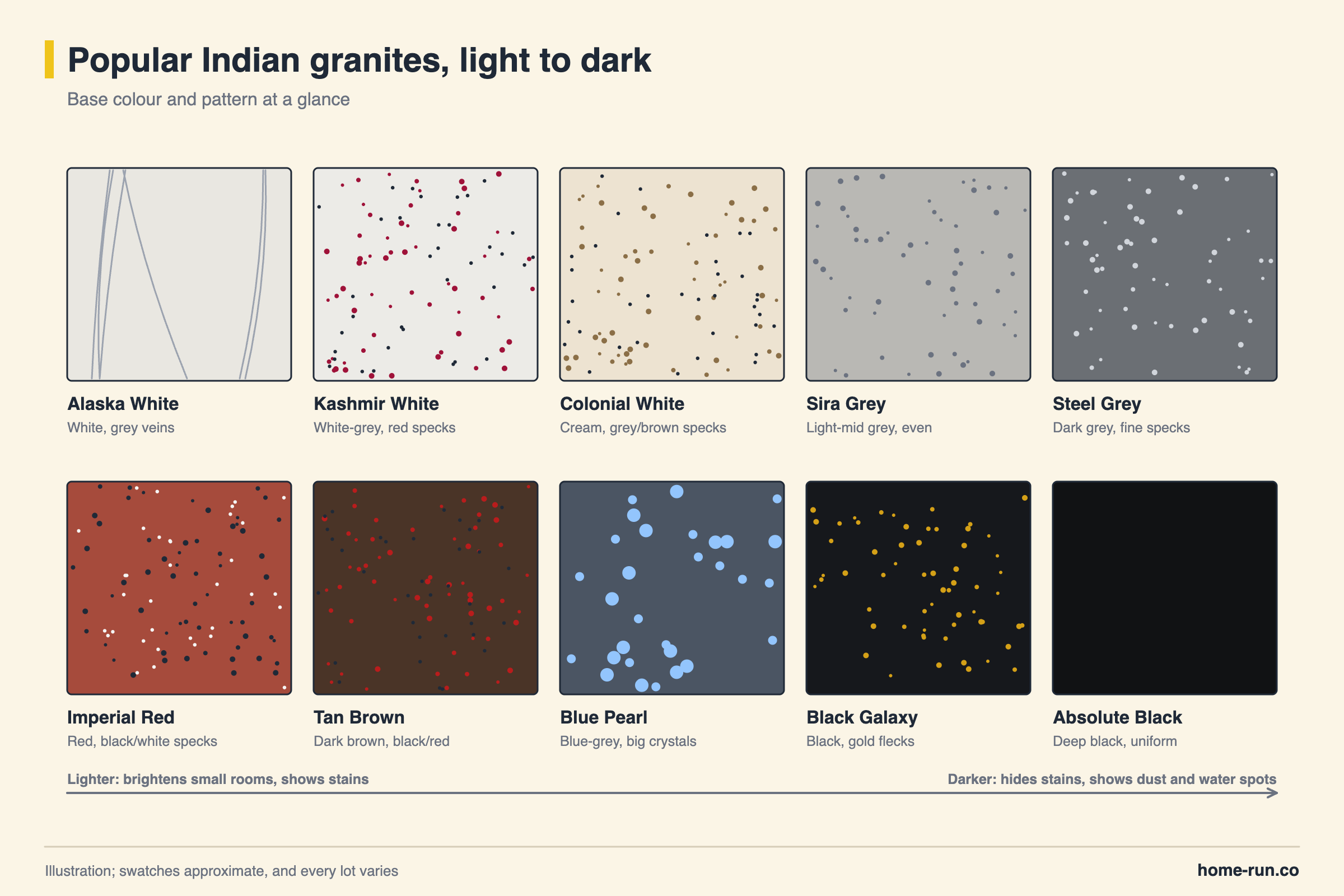
- White and cream (Kashmir White, Colonial White, Alaska White): bright and airy, but they show oil and turmeric stains if left unsealed.
- Grey (Steel Grey, Sira Grey): neutral and forgiving, and easy to match with most tiles and cabinets.
- Black (Absolute Black, Black Galaxy): dramatic and stain-hiding, though polished black shows dust and fingerprints.
- Red, brown and pink (Imperial Red, Tan Brown): warm tones suited to traditional homes, steps and facades.
- Green, blue and yellow: less common feature stones for islands, walls and accents.
Weighing granite against other floor stones? Our tiles vs marble comparison explains how tiles and marble differ on looks, price and durability.
What Are the Types of Granite Finishes?
The four common types of granite finishes are polished, honed, leathered and flamed. All four start from the same sawn slab; the finishing line stops at a different stage for each one.
Granite finishes compared
Look, grip and upkeep| Finish | How it is made | Look | Best for |
|---|---|---|---|
| Polished Most common | Buffed with fine polishing pads | Mirror shine, deeper colour | Kitchen counters, indoor floors |
| Honed | Ground smooth, not buffed | Matte or satin, lighter colour | Low-glare floors, modern interiors |
| Leathered | Diamond brushes over a honed surface | Soft sheen, textured feel | Dark counters, bathroom floors |
| Flamed Outdoor | High-temperature flame bursts surface crystals | Rough, slightly faded | Steps, driveways, pool decks |
Honing makes dark granites look lighter or greyer. Polishing does the opposite and deepens the colour.
Polished granite
Indoor defaultPoints
- High gloss that deepens the stone's colour
- Pores closed, so the best stain resistance
- Needs resealing less often
- Slippery when wet; avoid on outdoor steps
Honed granite
Low glarePoints
- Matte look that lightens dark colours
- More porous, so stains and grease marks show
- Reseal at least once a year, sometimes more often
- Better grip than polished on indoor floors
See our granite kitchen slab design guide for slab colours, edge profiles and thickness for counters.
Where Should You Use Each Type of Granite?
Use dark, speckled granite where stains and heavy use are likely, and lighter granite where you want brightness. Then match the finish to how wet the area gets.
- Kitchen counters: polished or leathered Absolute Black, Black Galaxy, Tan Brown or Steel Grey.
- Living and bedroom floors: polished Kashmir White, Colonial White, Sira Grey or Steel Grey.
- Bathroom floors: leathered or honed granite for better grip than polished.
- Staircases: polished treads indoors, flamed or grooved edges on outdoor steps.
- Driveways, porches and pool decks: flamed granite only.
- Facades and cladding: Imperial Red, Steel Grey or black stones, fixed with metal anchors.
Which granite is best for flooring?
The best granite for flooring in India is a medium-tone, evenly speckled stone such as Steel Grey, Sira Grey or Kashmir White. These hide dust and footprints better than plain black or bright white.
Choose polished granite for dry indoor floors and flamed granite for any floor that gets rain. Slabs are commonly sold in 16, 18, 20 and 30 mm thicknesses.
How Much Do the Types of Granite Cost in India?
Granite price in India depends on the variety, slab size, thickness, finish and grade. Rare colours, large slabs and premium finishes cost more, and transport adds to the bill.
Published rates vary widely. Stone Galleria, a granite supplier, listed Absolute Black at ₹250 per sq ft and Alaska White at ₹142 per sq ft when checked in November 2026. Both prices were for 18 mm polished slabs, ex-works, including 18% GST, with freight extra.
Other 2026 price guides quote figures many times higher for the same names. Before comparing quotes, check the thickness, finish, slab size, whether GST is included, and whether cutting, edging and fitting are extra.
Ask the fabricator to quote cutting, edge polishing, sink and hob cut-outs and fitting as separate lines. Those charges vary by shop.
Laying granite this month?
Adhesives, grout, cement and tools delivered across Bengaluru.
How Do You Maintain Granite Surfaces?
You maintain granite by wiping spills quickly, cleaning with mild pH-neutral soap and water, and resealing as the finish needs. Polished granite needs sealing less often; honed granite needs it at least once a year.
A quick test tells you when to reseal: drip a little water on the surface. If the spot darkens within a few minutes, the stone is absorbing water and needs a fresh coat of penetrating sealer.
Granite care mistakes to avoid
- Acidic cleaners: vinegar, lemon and harsh bathroom acids dull the polish and attack resin fills.
- Leaving oil and turmeric on white granite: light stones absorb stains if spills sit overnight.
- Steel wool and abrasive powders: they scratch the shine off polished granite.
- Hot vessels straight from the stove: sudden heat can stress resin-filled or cracked slabs.
- Skipping resealing on honed granite: grease marks and dark spots build up quickly.
How Do You Source Good Granite in Bengaluru?
Source granite by inspecting the actual slab at the yard, checking its test values and getting a written quote. In Bengaluru, local Karnataka stones such as Sira Grey travel a short distance, which keeps freight low.
IS 14223 (Part 1), the Bureau of Indian Standards (BIS) specification for polished granite building stones, sets limits such as water absorption of at most 0.50% by mass. Ask your supplier for test results against it, especially for floors and outdoor work.
- See the full slab in daylight, not a small sample tile.
- Check the back and edges for cracks, resin fills and mesh backing.
- Buy all slabs for one room from the same block so the colour matches.
- Confirm thickness with a tape at several points.
- Get a written quote that lists thickness, finish, GST, transport and fitting.
Rub a hidden edge of a very dark slab with a cloth and acetone. Black colour on the cloth points to a dyed or coated stone. Heavy resin on the face can also hide cracks.
How Do You Choose the Right Type of Granite for Your Project?
Choose granite in this order: where it goes, how much wear and water it faces, then colour, then finish. Looks come third, because the wrong finish in the wrong place fails first.
- Kitchen: a dark or speckled stone in polished or leathered finish.
- Indoor floors: an even medium tone, polished, from one block.
- Wet and outdoor areas: flamed or leathered, never high-gloss.
- Budget: local Karnataka stones usually travel less and cost less in freight than imported ones.
Laying granite tiles? Our guide to types of tiles helps when you mix granite with ceramic or vitrified tiles.