On this page
- What Is a Suspended Ceiling and How Does It Work?
- Which Types of Suspended Ceiling Suit Commercial Spaces?
- Which Tiles and Materials Should You Choose?
- How Do Ceiling Tiles Control Noise?
- What Does India's Fire Code Say About False Ceilings?
- How Is a Drop Ceiling Installed?
- How Much Does a Suspended Ceiling Cost in Bengaluru?
- Grid Ceiling or Gypsum Board: Which Fits Your Space?
- Are Grid Ceilings a Sustainable Choice?
- How Do You Pick the Right Ceiling for Each Room?
- A suspended ceiling hangs below the slab on wires or rods, with tiles or boards held by a metal grid.
- Lay-in grids let you lift a tile to reach ducts, cables and sprinkler pipes, which is why offices use them.
- Compare tiles on NRC (sound absorption), CAC (sound blocking between rooms) and light reflectance.
- NBC 2016 Part 4 requires the false ceiling and its suspension to be non-combustible, with wiring in metal conduit.
A suspended ceiling is a second ceiling hung from the concrete slab on wires or rods, with tiles or boards held by a light metal grid. In offices, shops and clinics, a suspended ceiling hides ducts, cables and sprinkler pipes but keeps them reachable.
The gap between the slab and the tiles is called the plenum (ceiling void). Lift one tile and a technician can reach the services above.
What Is a Suspended Ceiling and How Does It Work?
A suspended ceiling works like a hanging tray. Wires from the slab carry a metal grid, and tiles drop into its openings.
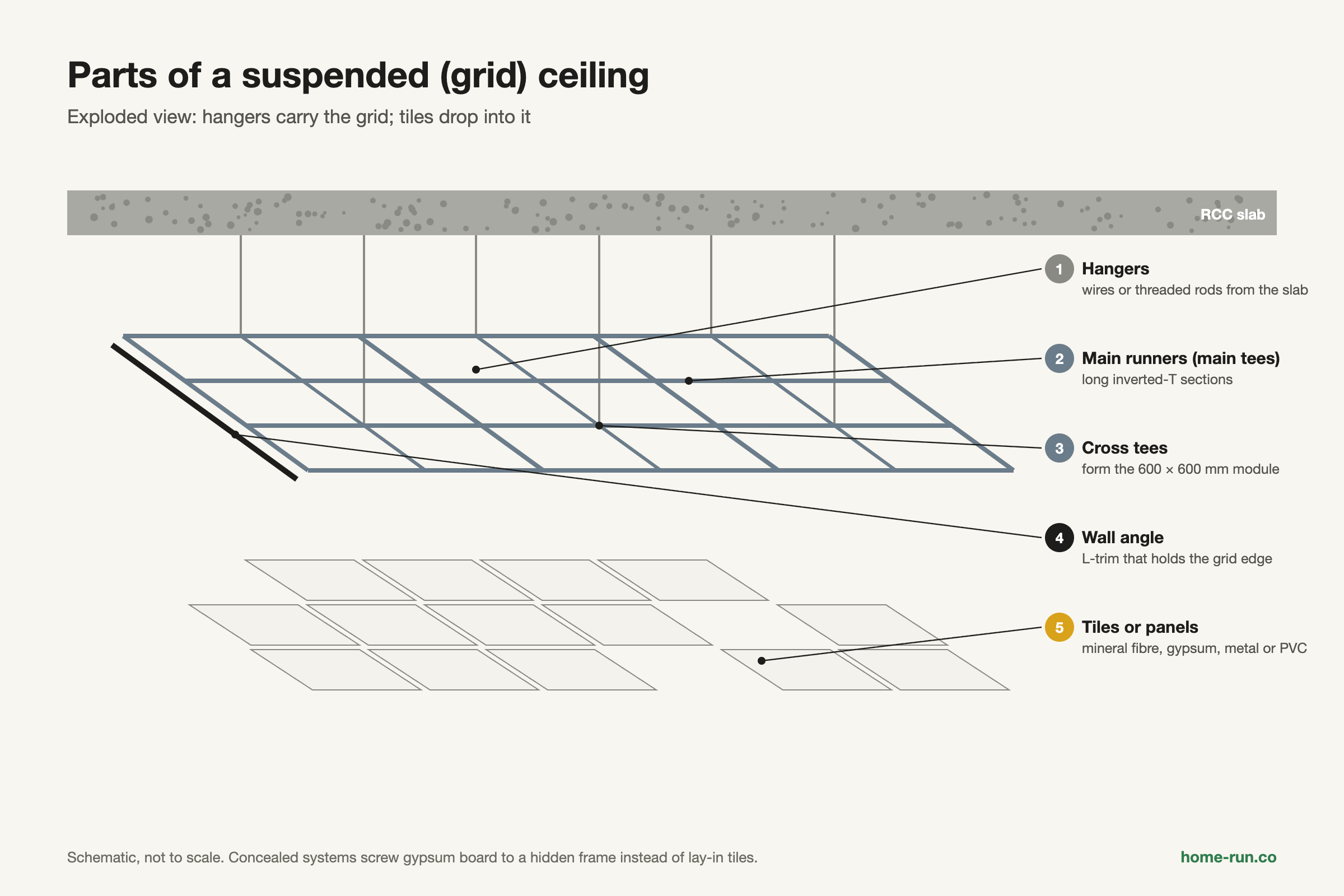
- Hangers: wires or threaded rods anchored to the slab.
- Main runners (main tees): long inverted-T sections the hangers carry.
- Cross tees: shorter sections that clip between mains to form the 600 × 600 mm module.
- Wall angle: an L-shaped trim fixed to the walls that supports the grid edge.
- Tiles or panels: mineral fibre, gypsum, metal or PVC, laid into the grid.
"False ceiling" is the umbrella term used in India. "Drop ceiling" usually means the exposed lay-in grid. "Suspended ceiling" covers both the lay-in grid and concealed systems, such as Knauf's MF (metal furring) system, where gypsum boards are screwed to a hidden frame.
Which Types of Suspended Ceiling Suit Commercial Spaces?
The main types of suspended ceiling are exposed lay-in grids, tegular grids, concealed gypsum systems, metal clip-in tiles and open slat or baffle ceilings.
Suspended ceiling systems compared
Qualitative guide for commercial interiors| System | Look | Plenum access | Best-fit space |
|---|---|---|---|
| Exposed lay-in grid Default pick | Flat tiles, visible grid | Any tile lifts out | Open offices, back offices |
| Tegular grid | Tile edge sits below the grid line | Any tile lifts out | Reception, meeting rooms |
| Concealed gypsum (metal furring) | Smooth, joint-free surface | Only through access panels | Lobbies, showrooms, cabins |
| Metal clip-in or perforated tiles | Crisp metal finish | Tiles unclip | Corridors, retail, airports |
| Open slats or baffles Feature | Wood or metal lines, open void | Open between slats | Cafés, breakout zones |
Which Tiles and Materials Should You Choose?
Mineral fibre tiles on a metal grid are the usual choice for offices, because they absorb sound and cost less than metal. Gypsum, metal, PVC and wood each fill a specific need.
Suspended ceiling materials and India rates
₹ per sq ft, Design Cafe, Sep 2026| Material | Strength | Rate |
|---|---|---|
| Grid with mineral fibre Default pick | Sound absorption, easy access | ₹85–150 |
| Gypsum board | Smooth, paintable finish | ₹78 |
| Metal (aluminium or GI) | Durable, washable, moisture-proof | ₹150–300 |
| PVC Wet zones | Water-resistant, light | ₹70–160 |
| Wood or wood finish Premium | Warm look for feature areas | ₹500–1,200 |
For fire, moisture and sound data on boards, read our explainer on gypsum board properties.
How Do Ceiling Tiles Control Noise?
A suspended acoustic ceiling controls noise in two ways: the tile face absorbs sound inside the room, and the tile mass blocks sound passing through the plenum to the next room.
- NRC (Noise Reduction Coefficient): how much sound the tile absorbs, tested to ASTM C423, the reverberation-room method.
- CAC (Ceiling Attenuation Class): how well the ceiling blocks sound between rooms that share a plenum, tested to ASTM E1414.
- LR (Light Reflectance): the share of light the tile reflects, measured to ASTM E1477.
Two mineral tiles sold in India
Manufacturer data, Knauf India| Property | Armstrong ULTIMA | Armstrong DUNE Max |
|---|---|---|
| NRC | 0.70 | 0.70 |
| CAC | 40 dB | 33 dB |
| Light reflectance | 88% | 85% |
| Humidity resistance | Not stated | RH 99% |
| Recycled content | 41% | Up to 78% |
| Fire classification | A2-s1, d0 (EN 13501-1) | Class 0/1 (BS 476 Parts 6, 7) |
Armstrong rates an NRC above 0.70 as high and below 0.50 as low. It rates a CAC above 35 as high and below 25 as low. Pick high NRC for open offices and high CAC for cabins and meeting rooms.
Sound attenuation batts, insulation blankets laid on the tiles, raise sound blocking for privacy. They are not thermal insulation.
What Does India's Fire Code Say About False Ceilings?
The National Building Code of India 2016, Part 4 (Fire and Life Safety), clause 3.3.4, says the false ceiling, including all fixtures used for its suspension, shall be of non-combustible material.
- Wiring in a false ceiling must run in metal conduit (clause 3.4.6.1).
- High, medium and low voltage wiring must run in separate conduits.
- The code's foreword warns that the space between ceiling and false ceiling can act like a flue, so it needs fire stopping.
See how metal conduit runs are laid in our explainer on conduit wiring.
PVC and untreated wood tiles are sold for ceilings, but clause 3.3.4 asks for non-combustible material. Ask your fire consultant before using them in a commercial building. Also confirm whether detectors or sprinklers are needed inside the plenum.
Fitting out an office ceiling?
Get boards, wires and fixings delivered across Bengaluru with a GST invoice.
How Is a Drop Ceiling Installed?
A suspended ceiling goes up in six stages, and the tiles always go in last. ASTM C636 is the US installation practice that most grid makers follow.
Set the level
Mark the ceiling line on every wall with a laser or water level.
Fix the wall angle
Screw the perimeter trim along the line. The UFGS 09 51 00 spec fixes it within 76 mm of each end and at 406 mm centres.
Hang the wires
Anchor hangers to the slab. Grid load tables are typically based on 1,200 mm hanger spacing.
Build the grid
Hang main runners, clip in cross tees, check square and level.
Fit the services
Place lights, AC diffusers, sprinklers and detectors. Where the grid carries a light, UFGS asks for 4 hangers within 152 mm of its corners.
Drop in the tiles
Lay tiles only after painting and wet work end.
- Hanging wires from ducts or pipes instead of the slab
- Letting heavy light fittings or AC units rest on the tiles
- Laying tiles before painting and floor work are done
- Leaving gaps in fire stopping above partitions
How Much Does a Suspended Ceiling Cost in Bengaluru?
A metal grid or mineral fibre suspended ceiling for an office in Bengaluru costs about ₹70–130 per sq ft, excluding lighting, GST and add-ons, according to NoBroker (May 2026). Design Cafe's India-wide guide (Sep 2026) puts grid and mineral fibre at ₹85–150.
Suspended ceiling rates, 2026
₹ per sq ft| Item | NoBroker, Bengaluru, May 2026 | Design Cafe, India, Sep 2026 |
|---|---|---|
| Grid or mineral fibre Default pick | ₹70–130 (excl. GST) | ₹85–150 |
| Gypsum, standard | ₹75–85 + GST | ₹78 |
| Gypsum, premium | ₹90–130 + GST | Not listed |
| Metal | Not listed | ₹150–300 |
| PVC | ₹160–185 + GST | ₹70–160 |
NoBroker prices PVC at ₹160–185; Design Cafe starts it at ₹70. Ask for itemised quotes showing tile brand, grid duty, labour and GST.
Order extra tiles for cuts at walls and columns. Lights, diffusers and electrical points are quoted separately.
Grid Ceiling or Gypsum Board: Which Fits Your Space?
A suspended grid ceiling suits spaces that need frequent service access, while a concealed gypsum ceiling suits spaces where looks come first.
Lay-in grid
OfficesTiles rest in an exposed metal grid.
- Any tile lifts out for service access
- Damaged tiles swap in minutes
- Acoustic tiles available off the shelf
- The grid lines stay visible
Concealed gypsum
LobbiesBoards screwed to a hidden frame.
- Smooth, joint-free look
- Easy to shape into coves and levels
- Access only through fixed panels
- Repairs need cutting, filling and painting
Are Grid Ceilings a Sustainable Choice?
A suspended ceiling can be a greener choice when you pick tiles with high recycled content and high light reflectance. Armstrong lists 41% recycled content for ULTIMA and up to 78% for DUNE Max.
Tiles with 85–88% light reflectance bounce more light back into the room. Standard 600 × 600 mm LED panels drop straight into the grid.
An office refit can often keep the grid and swap only damaged tiles. Ask your supplier about tile recycling.
How Do You Pick the Right Ceiling for Each Room?
Choose a suspended ceiling by matching the tile to each room's job, then checking fire rules, height and budget.
- Open office: mineral fibre with NRC 0.70 or more.
- Cabins and meeting rooms: CAC above 35, with batts above the tiles.
- Pantries and washrooms: humidity-rated mineral tiles or metal tiles.
- Retail and lobbies: metal or concealed gypsum for a cleaner look.
- Measure slab height and the deepest duct or beam
- Confirm non-combustible tiles and fixings with your fire consultant
- Pick grid duty to suit the loads the ceiling will carry
- Get two itemised quotes with brands, labour and GST shown