On this page
- What Is Prestressed Concrete?
- How Does Prestressed Concrete Work?
- What Is the Difference Between Pre-tensioning and Post-tensioning?
- Which Indian Structures Use Prestressing?
- Is Prestressing Better for the Environment?
- Prestressed vs Reinforced Concrete: What Is the Difference?
- How Are Prestressed Members Made, Step by Step?
- How Do You Plan a Prestressing Job?
- Prestressed concrete is concrete put into compression by tensioned steel before it carries any load.
- The built-in compression cancels the tension that cracks ordinary concrete, so beams span further and stay crack-free.
- Pre-tensioning stresses the steel before casting and suits factory items. Post-tensioning stresses it after the concrete hardens and suits site work.
- India designs it to IS 1343:2012, with higher concrete grades (M30 to M40 and up) than normal RCC.
- Prestress drops over time through losses such as creep, shrinkage and steel relaxation, and the design must allow for them.
Prestressed concrete is concrete in which high-strength steel tendons are stretched and locked so that they squeeze the concrete before it carries any load. That stored compression cancels the tension that loads would otherwise cause, so the member cracks far less and can span further.
Engineers use prestressed concrete for bridge girders, metro viaducts, railway sleepers, long-span slabs and water tanks. This glossary entry covers how it works, the two methods, Indian uses and when it beats normal RCC.
What Is Prestressed Concrete?
Prestressed concrete is a structural concrete that carries a permanent, deliberate compression from tensioned steel. The prestress is applied before service loads so that the final stresses stay within what the concrete can safely take.
- Prestress: the internal compression locked into the concrete by the steel.
- Tendon: the tensioned steel, as a wire, a seven-ply strand or a bar.
- Anchorage: the wedge or plate device that grips a tendon end and passes its force into the concrete.
- Transfer: the moment the tendon force is released onto, or locked against, the concrete.
P. H. Jackson in the USA (1886) and C. E. W. Doehring in Germany (1888) tried tensioned steel in concrete first, but low-strength steel lost its stretch. Eugène Freyssinet of France made it practical with high-tensile wire from 1926 and patented his system in 1928. E. Hoyer (Germany, 1938) developed long-line pre-tensioning, and Gustave Magnel (Belgium, 1940) a wedge anchorage for post-tensioning.
How Does Prestressed Concrete Work?
Prestressed concrete works by placing compression where the loads will later cause tension. Concrete is strong in compression but cracks at roughly one-tenth of that stress in tension.
A loaded beam sags, so its bottom fibres stretch. If tendons run low in the beam, below its centre, they push the bottom into compression and give the beam a slight upward camber. When the load arrives, it first has to cancel that compression before any tension can appear.
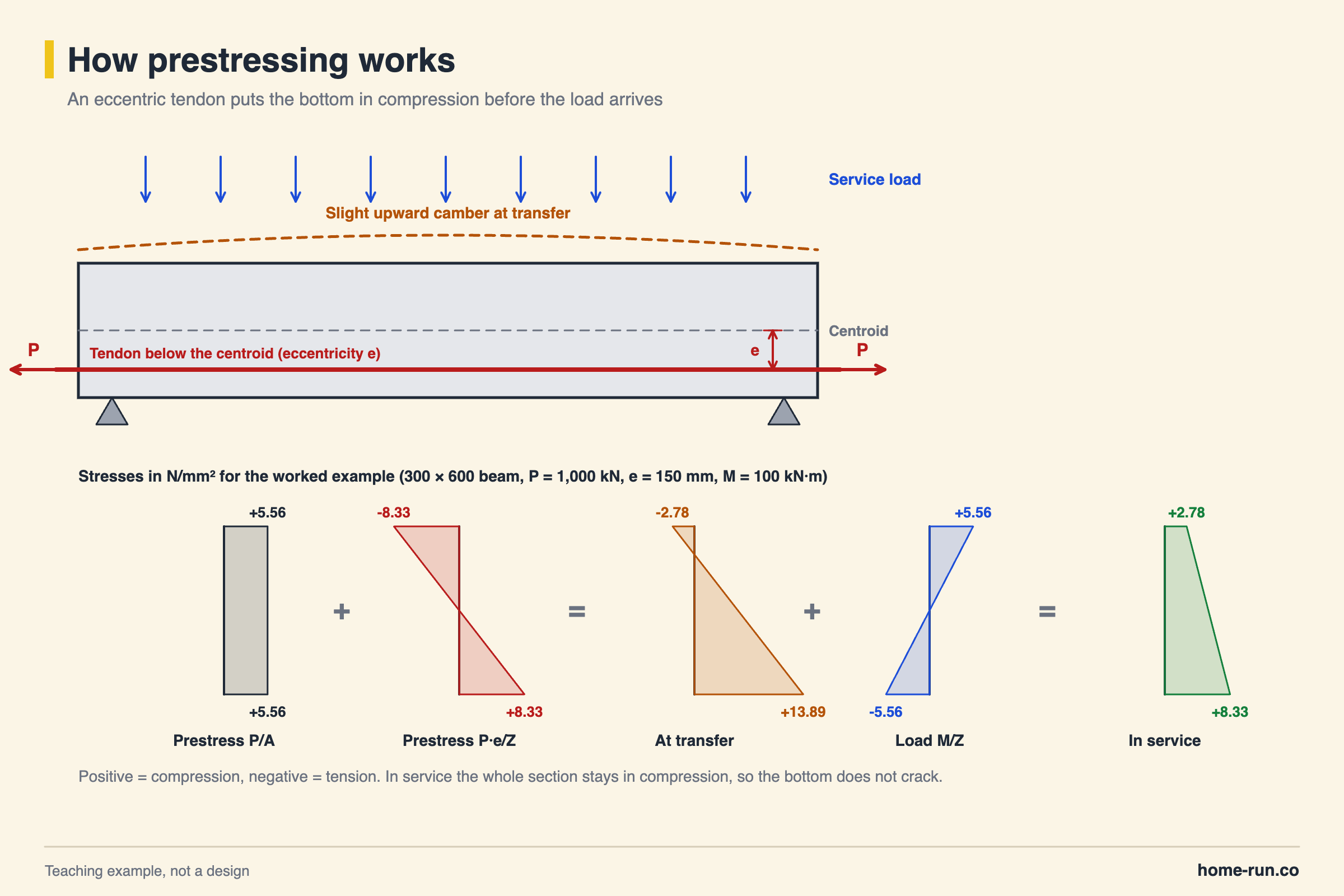
The small top tension at transfer (−2.78 N/mm²) appears because e = 150 mm sits outside the kern. The kern distance is Z ÷ A = 100 mm, or h ÷ 6. A tendon inside the kern gives no tension anywhere. This is a teaching example, not a design; IS 1343 sets the permissible stresses.
What Is the Difference Between Pre-tensioning and Post-tensioning?
The two main types of prestressed concrete are pre-tensioned and post-tensioned. The difference is when the steel is stressed: before the concrete is cast, or after it has hardened.
Pre-tensioned concrete
FactoryPoints
- Tendons stretched between fixed abutments, then concrete cast
- Force passes to concrete by bond once the tendons are cut
- Straight tendons, no ducts, anchorages or grout
- Best for sleepers, poles, hollow-core slabs, short girders
Post-tensioned concrete
Site and long spansPoints
- Concrete cast around empty ducts, tendons stressed later
- Force passes through end anchorages, ducts then grouted
- Tendons can follow a curved profile along the span
- Best for bridge girders, viaduct segments, PT floor slabs
Pre-tensioning vs post-tensioning in practice
As per IS 1343:2012 practice| Factor | Pre-tensioned | Post-tensioned |
|---|---|---|
| Minimum concrete grade | M40 | M30 |
| Minimum cover to tendons | 20 mm | 30 mm |
| Where it is made | Precast yard with a long-line bed | Precast yard or in place on site |
| Prestress losses | Elastic shortening, creep, shrinkage, relaxation | The same plus duct friction and anchorage slip |
| Size limit | What a truck or crane can carry | Very long spans built in segments |
Prestressed and precast are not the same thing. Precast describes where a member is cast; prestressing describes how it is stressed. Many precast concrete items are also pre-tensioned, but a post-tensioned slab can be cast fully in place.
Which Indian Structures Use Prestressing?
India uses prestressed concrete mostly in bridges, metro and rail structures, and large buildings. Most of these are post-tensioned girders or pre-tensioned precast units.
- Road bridges: the Annai Indira Gandhi (Pamban) road bridge at Rameswaram, opened in 1988, is 2,345 m long with a 115 m prestressed concrete box-girder main span.
- Metro viaducts: Indian metro projects use match-cast segments about 3 m long with internal post-tensioned tendons, for standard spans of up to about 35 m.
- Railway sleepers: pre-tensioned monoblock sleepers made on long-line beds; Indian Hume Pipe alone reports about 2.75 million in service on Indian Railways.
- Buildings: post-tensioned flat slabs in malls, offices and car parks, plus precast hollow-core slabs and double-T units.
Sources disagree on India's first prestressed concrete bridge. NPTEL course notes credit a 1948 bridge on the Assam Rail Link, while a Chennai report names the Napier Bridge, opened in 1944. Treat both as historical claims, not settled fact.
Is Prestressing Better for the Environment?
Prestressed concrete can use less material per span than RCC, but it is not automatically greener. Slimmer sections need less concrete and steel overall, while higher cement content and high-strength steel raise the carbon per tonne.
Tendons are thin and highly stressed, so corrosion is more serious than in normal rebar. In 1985 the Ynys-y-Gwas bridge in Wales collapsed after chlorides reached its post-tensioned tendons at the segment joints. Full grouting, correct cover and low-permeability concrete matter more to lifetime impact than the mix alone.
Prestressed vs Reinforced Concrete: What Is the Difference?
Reinforced concrete lets the concrete crack and relies on passive steel bars, while prestressed concrete uses active, pre-stretched steel to keep the concrete in compression. Reinforced concrete uses TMT bars of about 500 MPa; prestressing strand is roughly three to four times stronger.
Reinforced vs prestressed concrete
Typical values| Factor | Reinforced concrete (RCC) | Prestressed concrete (PSC) |
|---|---|---|
| Steel | TMT bars, Fe 500 / Fe 550 | Wires, strands or bars, about 1860 MPa strand |
| Cracking in service | Fine cracks expected | Limited or none |
| Usual concrete grade | M20 to M30 in homes | M30 to M50 and above |
| Depth for the same span | Deeper | Shallower |
| Skills and kit | Any good site crew | Specialist jacks, anchorages, grouting |
| Indian code | IS 456:2000 | IS 1343:2012 |
For a typical Bengaluru house with room spans of 3–5 m, RCC slabs and beams are simpler and cheaper. Prestressed concrete starts to pay off on long, column-free spans, heavy loads or crack-sensitive work, such as a deep cantilever beam or a large basement car park.
How Are Prestressed Members Made, Step by Step?
Prestressed concrete members are made by stressing the tendons, casting and curing the concrete, then transferring the tendon force. The order of the steps changes with the method.
Pre-tensioning process
- Set up the bed. Run the wires or strands between two fixed abutments on a long-line casting bed.
- Stress the tendons. Pull each tendon to its design force with a hydraulic jack and lock it at the abutment.
- Cast and cure. Place the concrete around the stressed tendons and cure it, often with steam, until it reaches transfer strength.
- Release. Cut or release the tendons so their force passes into the concrete by bond.
Post-tensioning process
- Fix ducts. Tie sheathing ducts to the planned tendon profile inside the formwork, with anchorage plates at the ends.
- Cast and cure. Pour the concrete and wait for the strength the designer specifies for stressing.
- Thread and stress. Push the strands through the ducts, jack them from the anchorages and lock them with wedges.
- Grout and seal. Fill the ducts with cement grout and seal the anchorage pockets to protect the steel.
How Do You Plan a Prestressing Job?
You plan a prestressed concrete job by getting a structural engineer to design it to IS 1343:2012 and hiring a specialist prestressing firm for the stressing. Site crews pour the concrete; specialists handle the tendons.
- Get a structural design to IS 1343:2012, with the stressing sequence and target elongations on the drawings.
- Specify the concrete grade, the strength needed at transfer and the curing method.
- Order tendons to the right standard, such as IS 14268 for low-relaxation seven-ply strand, with mill test certificates.
- Use a prestressing contractor with calibrated jacks and a written stressing record.
- Plan for duct grouting within the time the designer allows, and record each duct.
- For bridges and highway structures, check whether IRC:112, the Indian Roads Congress code, applies instead.
Building with concrete?
Cement, steel and aggregates delivered across Bengaluru.