On this page
- What Is PPC Cement and How Is It Made?
- What Does IS 1489 (Part 1) Require?
- What Is the Difference Between OPC and PPC Cement?
- Where Does Fly Ash Cement Work Best?
- How Should You Mix and Cure Blended Cement?
- How Do You Choose and Buy PPC Cement?
- PPC cement is clinker, gypsum and 15% to 35% fly ash, made to IS 1489 (Part 1).
- PPC has one strength class: at least 33 MPa at 28 days. It is not sold as 43 or 53 grade.
- PPC gains strength more slowly than OPC but gives lower heat and denser concrete over time.
- PPC suits plaster, masonry, foundations and house slabs, if you cure it for at least 10 days.
PPC cement, or Portland Pozzolana Cement, is a blended cement made by grinding clinker with gypsum and a pozzolana, usually fly ash. It is made to IS 1489, a Bureau of Indian Standards (BIS) code.
For every cement type side by side, see our Portland cement guide. For OPC grades, see OPC cement explained.
What Is PPC Cement and How Is It Made?
PPC cement is made by grinding clinker, a little gypsum and a pozzolana together. A pozzolana is a siliceous material that reacts with lime in wet cement to form extra binder.
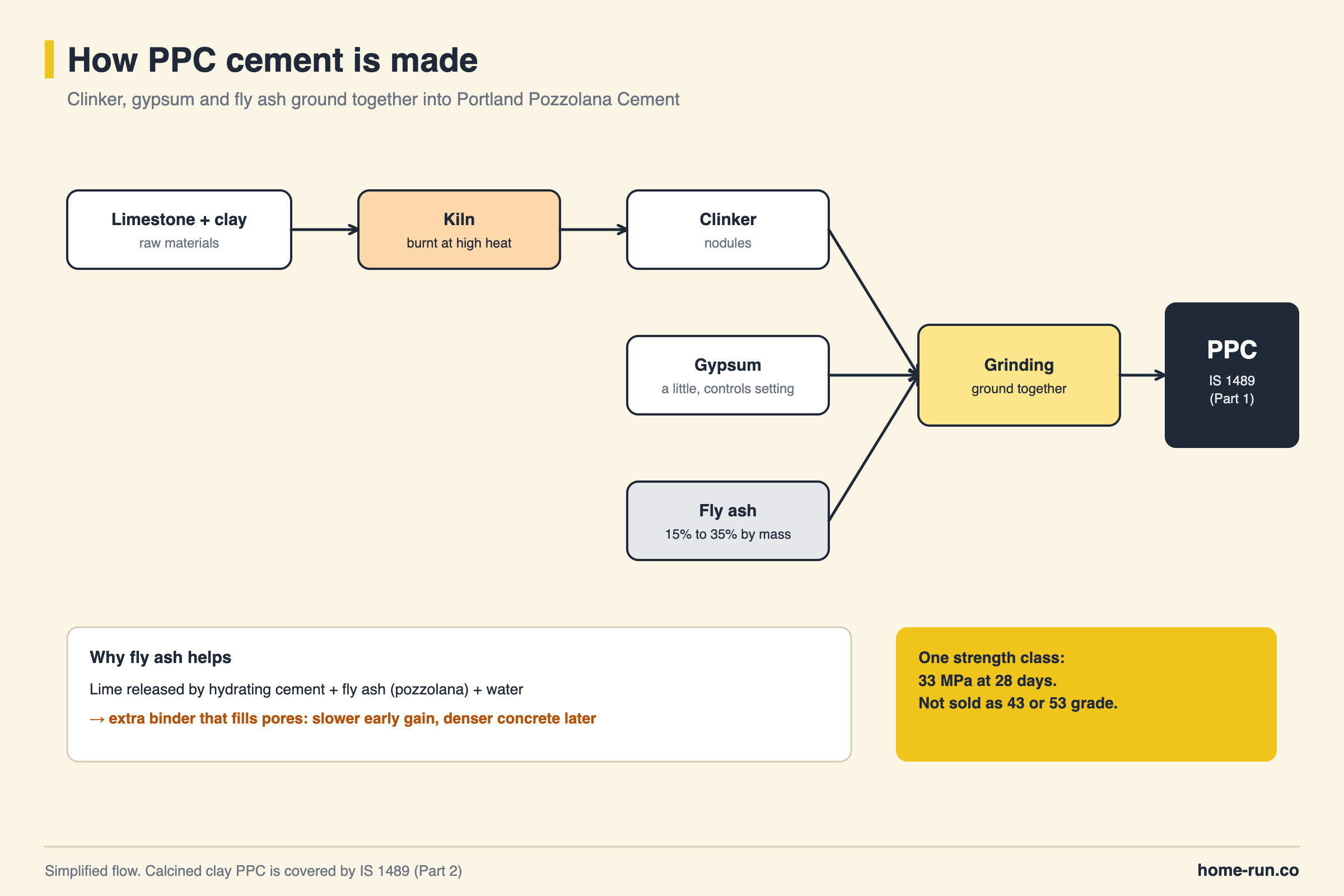
IS 1489 has two parts. Part 1 covers fly ash PPC, the common type; Part 2 covers calcined clay PPC.
Grades such as 43 or 53 describe OPC strength. PPC has a single requirement of 33 MPa at 28 days.
What Does IS 1489 (Part 1) Require?
PPC cement must meet the physical limits of IS 1489 (Part 1). These are pass limits, not typical brand results.
Key PPC cement requirements, IS 1489 (Part 1)
Mortar-cube tests in the lab, not site concrete| Property | Requirement |
|---|---|
| Fly ash content | 15% to 35% by mass |
| Initial setting time | At least 30 minutes |
| Final setting time | At most 600 minutes |
| Strength at 3 days | At least 16 MPa |
| Strength at 7 days | At least 22 MPa |
| Strength at 28 days Key figure | At least 33 MPa |
| Drying shrinkage | At most 0.15% |
What Is the Difference Between OPC and PPC Cement?
The main difference between OPC and PPC cement is fly ash: OPC is clinker and gypsum only, while PPC replaces 15% to 35% of the clinker with fly ash.
PPC cement
Durability- Clinker, gypsum and fly ash, IS 1489 (Part 1)
- Slower early strength, keeps gaining after 28 days
- Lower heat of hydration, fewer thermal cracks
- Needs at least 10 days of curing
OPC cement
Speed- Clinker and gypsum only, IS 269
- Faster early strength, sold as 33, 43 or 53 grade
- Higher heat, more risk in thick pours
- Needs at least 7 days of curing
Where Does Fly Ash Cement Work Best?
PPC cement works best where durability and low heat matter more than early strength. IS 456:2000, the Indian code for plain and reinforced concrete, permits PPC for structural concrete.
- Plaster and masonry mortar: fly ash improves workability.
- Foundations, rafts and thick pours: lower heat reduces thermal cracking.
- House slabs, beams and columns: if your engineer allows for slower early strength.
- Sumps, water tanks and wet areas: denser concrete resists water entry.
- Sulphate-rich soil or coastal sites: better chemical resistance.
Choose OPC when you need early strength: early formwork removal, precast work or urgent repairs.
PPC also carries less clinker, the most CO2-intensive part of cement. Blended cements made up about 73% of India's output in a 2022 GCCA India report.
How Should You Mix and Cure Blended Cement?
You mix PPC cement in the same ratios as OPC; the difference is longer curing. Take ratios from your engineer or our concrete mix ratio guide.
- Check the bag: ISI mark, IS 1489 and the week of packing.
- Dry-mix first to one even colour.
- Add water slowly to the specified water-cement ratio.
- Place each batch soon after mixing.
- Cure for at least 10 days by ponding, wet hessian or sprinkling.
How Do You Choose and Buy PPC Cement?
Check the BIS marking first and the brand second. Brands such as UltraTech, Ramco, Dalmia and ACC sell PPC in Bengaluru. Locally, Raichur Thermal Power Station sells most of its dry fly ash to cement makers.
- No ISI mark or IS 1489 on the bag: selling cement without the BIS mark is not allowed.
- Bag older than three months: BIS advises retesting cement used after three months.
- Lumps or a hard bag: moisture has started to set the cement.
Ordering PPC cement for your site?
Confirm the cement type with your engineer, then order cement, sand and aggregates delivered across Bengaluru.