On this page
- What Is a Jack Plane, and Why Is It Called That?
- What Are the Parts of a Jack Plane?
- Smoothing, Fore or Jointer: Which Bench Plane When?
- What Is It Used For in Carpentry?
- Wooden or Metal: Which Suits a Beginner?
- How Do You Set the Blade on a Jack Plane?
- How Do You Tune a New Budget Plane?
- How Do You Sharpen the Blade With Camber?
- How Does It Behave on Indian Timbers?
- How Much Is a Jack Plane in India?
- How Do You Stop Rust in the Monsoon?
- Hand Plane or Electric Planer: Which Should You Get?
- A jack plane is the general-purpose bench plane for the first flattening of rough timber.
- The standard is the Stanley No. 5: 14 in long with a 2 in blade.
- Its blade has a slight camber, so it removes wood fast without digging in.
- Budget Indian planes cost ₹300–1,200 and usually need an hour of tuning.
A jack plane is a mid-length hand plane that flattens, straightens and thins rough timber before finer planes take over. Carpenters treat it as the all-rounder of the bench plane family.
What Is a Jack Plane, and Why Is It Called That?
A jack plane is the bench plane you use first on sawn boards. Its name comes from "jack of all trades", used for rough-work tools since at least the 17th century.
Most jack planes had beech bodies until the late 19th century. Leonard Bailey patented his adjustable metal design in 1867, and Stanley bought his business by 1869.
Smoothing, jack, fore and jointer planes are all bench planes. A block plane is a small one-handed tool for end grain.
What Are the Parts of a Jack Plane?
A metal jack plane has ten main parts.
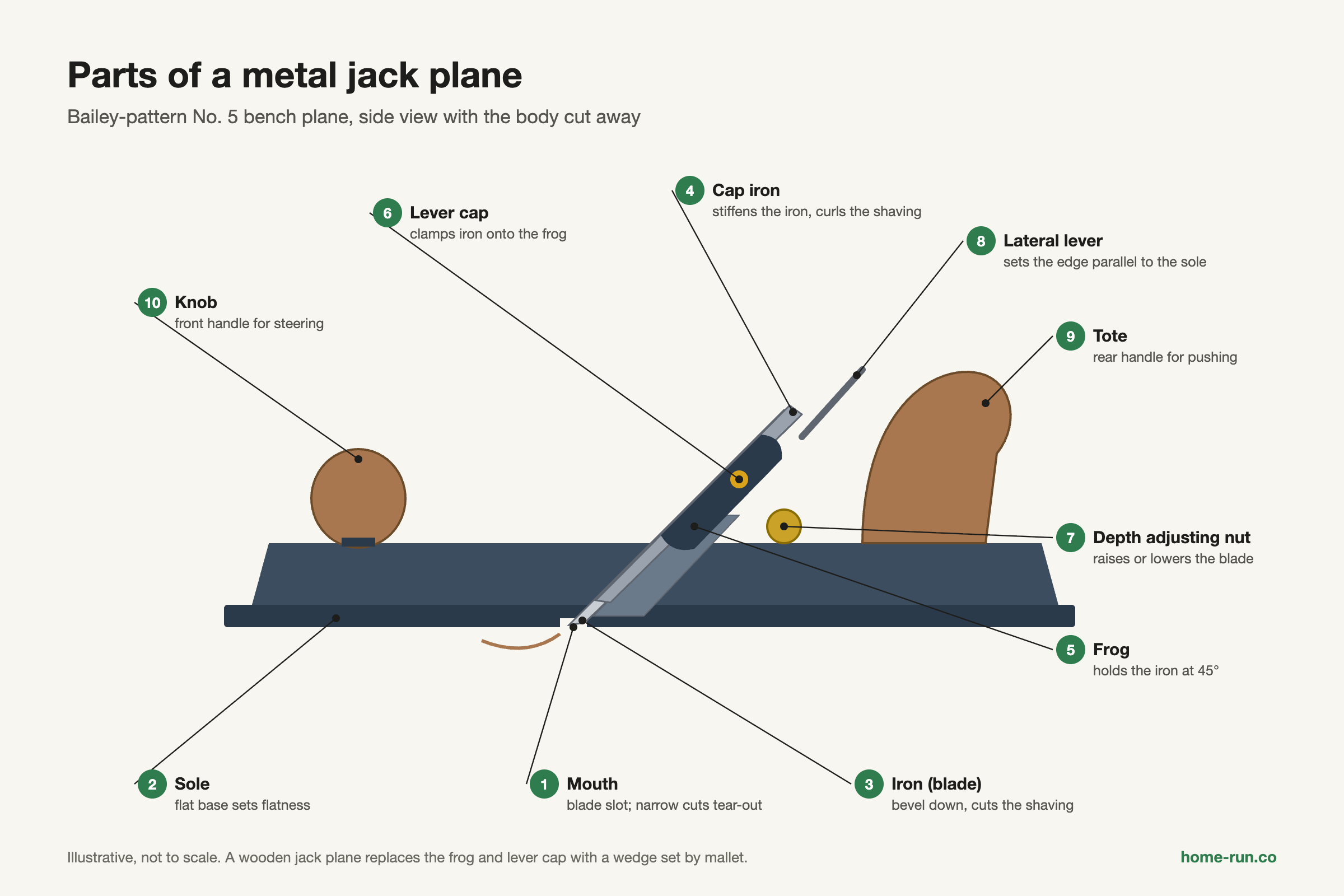
Jack plane parts and functions
Bailey-pattern metal plane| Part | What it does |
|---|---|
| Sole | Flat base; its flatness sets how flat the board gets |
| Mouth | Blade slot; a narrow mouth reduces tear-out |
| Iron (blade) | Cuts the shaving, bevel facing down |
| Cap iron (chipbreaker) | Stiffens the iron and curls the shaving |
| Frog | Holds the iron at 45° and sets the mouth width |
| Lever cap | Clamps iron and cap iron onto the frog |
| Depth adjusting nut | Raises or lowers the blade |
| Lateral lever | Sets the edge parallel to the sole |
| Tote and knob | Handles for pushing and steering |
Smoothing, Fore or Jointer: Which Bench Plane When?
The jack removes bulk wood and gets the board close to flat. Stanley numbers bench planes by size, No. 1 to No. 8.
Bailey bench planes by size and job
Stanley numbering| Plane | Length (in) | Blade (in) | Job |
|---|---|---|---|
| No. 4 smoothing | 9 | 2 | Final clean surface |
| No. 5 jack Default pick | 14 | 2 | Rough flattening, all-round use |
| No. 5½ jack | 15 | 2⅜ | Heavier jack work |
| No. 6 fore | 18 | 2⅜ | Flattening longer boards |
| No. 7 jointer | 22 | 2⅜ | Straight long edges |
Scrub plane for very rough boards, then jack plane, then jointer for long edges, then smoothing plane last.
What Is It Used For in Carpentry?
A jack plane removes saw marks, brings boards to thickness, flattens tabletops and shutters, and trues short edges.
It cannot make a 2 m door-frame edge dead straight; use a jointer. Factory-flat MDF boards rarely need planing.
Wooden or Metal: Which Suits a Beginner?
A metal jack plane suits most beginners: it adjusts with a wheel and lever, not a mallet.
Wooden (beech)
TraditionalPonits
- Blade set by tapping with a mallet
- Body moves with monsoon humidity
- Sole needs re-flattening over time
Metal (cast iron)
Beginner pickPonits
- Fine depth and lateral adjustment
- Stays flat but rusts in humid air
- Ordinary cast iron can crack if dropped
How Do You Set the Blade on a Jack Plane?
Fit the cap iron, centre the blade, then advance it until it takes a thin, even shaving.
- Fit the cap iron. Start with its edge about 1.5 mm (1/16 in) behind the cutting edge.
- Clamp it. Lock the lever cap over the frog.
- Set depth. Sight down the upturned sole and turn the nut until the blade shows as a thin line.
- Centre the edge. Move the lateral lever until the line is even across the mouth.
- Test on scrap. A good shaving is thick in the middle and feathers at the edges.
On tear-out-prone wood, move the cap iron to about 0.1 mm, a setting from Kato and Kawai's research.
How Do You Tune a New Budget Plane?
Most budget jack planes cut well after about an hour of tuning.
- Flatten the sole on wet-and-dry paper over granite or thick glass.
- Lap the iron's back flat just behind the edge.
- Chatter: loose lever cap or a rocking frog
- Lines on the board: a nicked edge or square corners
- Tear-out: blade too deep, mouth too wide or cap iron too far back
Return a plane with a cracked casting or twisted body.
How Do You Sharpen the Blade With Camber?
Sharpen the iron with a primary bevel near 25°, a micro-bevel near 30° and a slight curve across the edge. These are common practice, not rules.
- Hone the 25° bevel on a coarse stone, pressing harder on each corner to form the camber.
- Set a honing guide to 30° and hone a micro-bevel on finer stones.
- Remove the burr, then strop on leather.
Sources disagree on camber: Fine Woodworking suggests about 0.005 in (0.13 mm); a Lost Art Press author uses an 8 in radius.
How Does It Behave on Indian Timbers?
Jack plane on common Indian woods
Problem and fix| Timber | Common problem | Fix |
|---|---|---|
| Teak | Hard, abrasive wood dulls edges fast | Hone often; keep a spare iron |
| Sheesham | Grain is sometimes interlocked, causing tear-out | Close the cap iron, skew the plane |
| Deodar, rubberwood | Softer fibres crush under a dull blade | Keep the edge keen; take lighter cuts |
How Much Is a Jack Plane in India?
A jack plane costs about ₹300–1,200 in India; 23 of 26 priced IndiaMART listings fell in that range in November 2026.
Sample jack plane listings, India
₹, IndiaMART, Nov 2026| Listing | Size | Body | Price (₹) |
|---|---|---|---|
| Taparia half round | 8 in | Mild steel | 300 |
| Flat adjustable iron No. 5 Budget | 14 in | Iron | 499 |
| Taparia CSP | 16 in | Ductile iron | 1,070 |
| Anant adjustable iron | 14 in | Iron | 1,150 |
IS 15385:2003, the Indian standard for metal-bodied bench planes, cutters and cap irons, lists cutter widths of 44.5, 50.8 and 60.3 mm.
- Sole is flat against a straightedge or a spirit level
- No cracks or deep pits in the casting
- Frog sits without rocking
- Cap iron meets the iron with no gap
Starting a woodwork job?
Plywood, hardware and finishes delivered across Bengaluru.
How Do You Stop Rust in the Monsoon?
Wipe the sole and keep a thin coat of oil or paste wax on bare iron. Store it on its side, blade retracted, off damp floors.
Hand Plane or Electric Planer: Which Should You Get?
Choose an electric planer if you size many boards; it is faster but noisy and dusty. Otherwise, buy a metal No. 5 plus a stone and honing guide.