On this page
- What Is a Crowbar Tool and What Does It Do?
- What Are the Types of Crowbars?
- How Does a Crowbar Tool Work as a Lever?
- How Do You Choose the Right Crowbar?
- What Are Crowbar Applications in Demolition and Site Work?
- How Do You Use a Crowbar Safely?
- A crowbar tool is a steel bar used as a lever to force objects apart, lift loads and pull nails.
- The claw end works as a first-class lever, fulcrum between hand and load.
- Pick the length by job: 150–250 mm for tight spaces, 450 mm for general work, 900 mm+ for masonry.
- Forged chrome vanadium (CrV) steel bends less than plain carbon steel.
A crowbar tool is a steel bar with a curved claw at one end and a flat chisel tip at the other. It works as a lever: a small push on the long end becomes a large force at the tip.
For striking tools that pair with a crowbar, see our guide to types of hammer and their uses.
What Is a Crowbar Tool and What Does It Do?
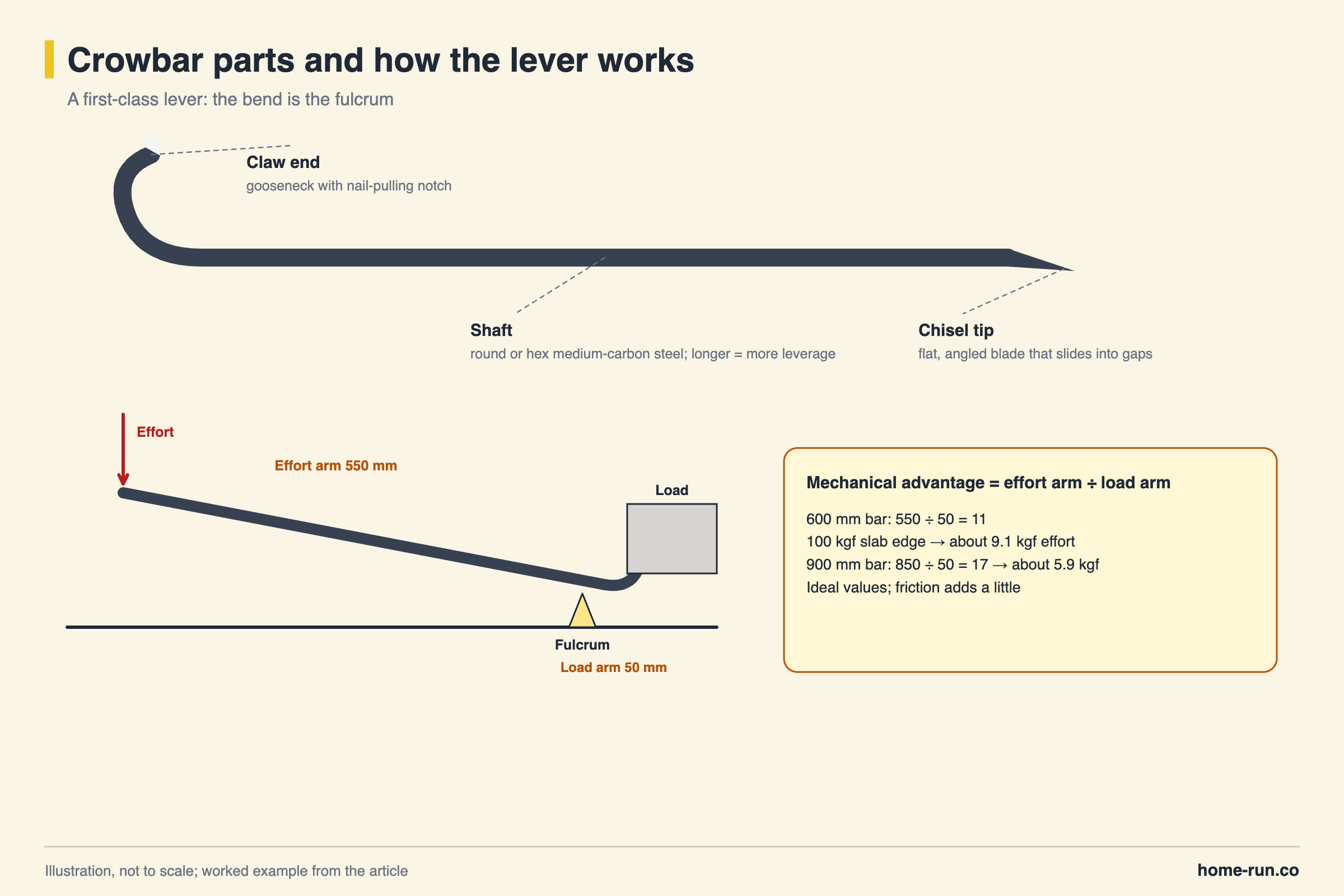
A crowbar tool is a hand lever for prying, lifting and demolition, usually forged from round or hex medium-carbon steel with hardened ends.
- Claw end: a curved gooseneck with a nail-pulling notch.
- Chisel tip: a flat, angled blade that slides into gaps.
- Shaft: more length gives more leverage.
Other names include wrecking bar, pry bar, iron crow and jemmy. In Hindi, a heavy crowbar is called a sabbal.
What Are the Types of Crowbars?
The main types of crowbar tools are the gooseneck (wrecking) bar, flat pry bar, ripping bar, digging bar and mini pry bar.
Crowbar types, sizes and best jobs
Lengths as sold by Indian tool brands| Type | Typical length | Best for |
|---|---|---|
| Gooseneck / wrecking bar Default pick | 450–600 mm | Demolition, skirting, large nails |
| Flat pry bar | 300–450 mm | Crates, panels, door frames |
| Ripping bar / nail puller | 450 mm | Flooring, pallets, furniture |
| Digging bar | 900 mm+ | Hard soil, concrete chipping, post holes |
| Mini pry bar | 150–250 mm | Electrical panels, tight corners |
Crowbar
Heavy work- Round or hex steel shaft
- Long, heavy bar with high leverage
- Demolition, lifting, digging
Pry bar
Precise work- Flat, thinner steel
- Short and light
- Trim, panels, small nails
How Does a Crowbar Tool Work as a Lever?
A crowbar tool multiplies your force by the effort arm (hand to fulcrum) divided by the load arm (fulcrum to tip).
At the claw end, the bend is the fulcrum, making a first-class lever. Used with the flat tip on the ground and the load between, it becomes a second-class lever.
How Do You Choose the Right Crowbar?
Choose a crowbar tool by matching its length and tip to the job, then check the steel and finish.
- Length: 450 mm for general use, 600 mm for flooring and light demolition, 900 mm+ for masonry.
- Steel: drop-forged chrome vanadium (CrV) steel resists bending and chipping; plain carbon steel suits occasional home use.
- Finish: powder coating resists rust better than plain paint.
- Special sites: near gas or fuel vapour, use a non-sparking bar made of aluminium bronze or beryllium copper.
What Are Crowbar Applications in Demolition and Site Work?
Crowbar applications in demolition centre on separating parts that are nailed, fixed or wedged together:
- Stripping timber or plywood shuttering after concrete sets.
- Lifting old floor tiles and skirting during renovation.
- Removing door and window frames from masonry.
- Loosening hard soil and rubble with a digging bar.
For large slabs, a power tool is faster; see our jackhammer guide. To clear the loosened soil, pair the bar with a tool from our spade tool guide.
How Do You Use a Crowbar Safely?
You use a crowbar tool safely with a firm fulcrum, a balanced stance and steady pressure.
- Wear gloves, safety glasses and safety shoes.
- Seat the tip fully in the gap before you push.
- Place a wood block under the bend to protect the surface and raise the fulcrum.
- Stand to one side, feet apart, in case the bar slips.
- Push steadily. Use a longer bar, never a pipe extension.
Before prying wall panels or skirting, switch off power and check for concealed wiring and pipes.
To maintain a crowbar, wipe off mud and cement, oil it lightly before the monsoon and store it dry. Retire a bar with a cracked claw or bent shaft; steel is fully recyclable, so send it for scrap.
Starting a renovation?
Hardware and building materials delivered across Bengaluru.