On this page
- What Is Cork Flooring and How Is It Made?
- What Formats Can You Buy: Tiles, Planks or Sheets?
- What Are the Benefits of Cork Flooring?
- What Are the Drawbacks of Cork?
- Which Rooms Suit Cork Best?
- Does Cork Suit Bengaluru's Humidity?
- How Is a Cork Floor Installed?
- How Do You Clean and Maintain a Cork Floor?
- How Much Does Cork Flooring Cost in India?
- Where Can You Buy Cork in India?
- Cork flooring is made from the bark of the cork oak (Quercus suber), which regrows after each harvest.
- Cork feels soft and warm underfoot and cuts footfall noise, so it suits bedrooms, studies and kids' rooms.
- Cork resists spills but is not waterproof; keep it out of bathrooms, balconies and wet utility areas.
- Bengaluru's average humidity is 70–79% from June to November, above the 35–65% install window in the Wicanders guide.
- Indian listings show ₹150–600 per sq ft for material (Nov 2026); labour and GST are extra.
Cork flooring is a floor covering made from the bark of the cork oak tree, sold as glue-down tiles or click-together floating planks. Cork flooring is soft, quiet and warm underfoot, and it is one of the few floor materials harvested without cutting down a tree.
For hard floor options, see our guide to types of tiles.
What Is Cork Flooring and How Is It Made?
Cork flooring is made from cork, the outer bark of the cork oak (Quercus suber), a tree that grows mainly around the western Mediterranean. Only this species gives commercial cork; ordinary oak does not.
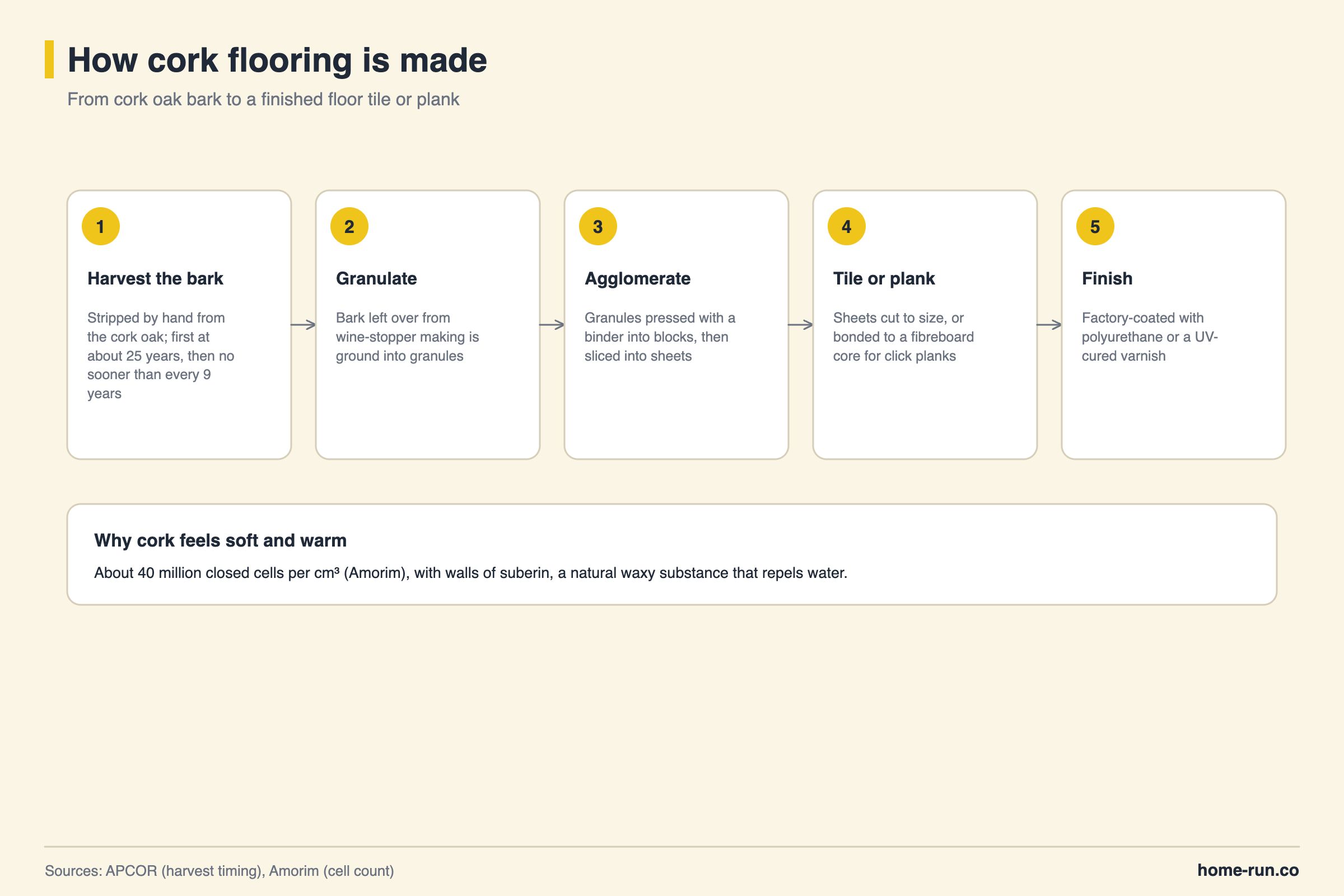
Harvesters strip the bark by hand and the tree regrows it. According to APCOR, the Portuguese Cork Association, a tree is first stripped at about 25 years, and Portuguese law forbids stripping it again in less than 9 years.
Cork holds about 40 million closed cells per cubic centimetre, according to cork maker Amorim. The cell walls are mainly suberin, a natural waxy substance that repels water.
- Granulate: bark left over from wine-stopper making is ground into granules.
- Agglomerate: granules are pressed with a binder into blocks, then sliced into sheets.
- Tile or plank: sheets are cut to size, or bonded to a fibreboard core for click planks.
- Finish: most floors are factory-coated with polyurethane or a UV-cured varnish. Polyurethane is a polymer built from urethane links; sellers often call it "urethane".
What Formats Can You Buy: Tiles, Planks or Sheets?
You can buy cork flooring in three forms: glue-down tiles, floating click planks, and sheets or rolls. Each form suits a different subfloor and budget.
Cork flooring types compared
Typical formats; check the maker's data sheet| Type | Build | Fixing | Best for |
|---|---|---|---|
| Cork tiles | Solid cork, thin square or rectangular tiles | Glued to a flat, dry subfloor | Studies, offices, kitchens away from the sink |
| Cork planks Default pick | Cork top and back on a fibreboard core | Click-lock, floating over underlay | Bedrooms, living rooms, apartments |
| Cork sheets and rolls | Thin cork in large sheets | Laid under another floor | Sound underlay below tiles, wood or vinyl |
Cork also comes as mosaic tiles and as printed cork with a wood or stone look.
What Are the Benefits of Cork Flooring?
The main benefits of cork flooring are comfort, quiet, warmth underfoot and a renewable source, all from its air-filled cells. Suberin also stops wiped spills soaking in.
- Comfort: cork compresses under weight and springs back, which is easier on feet and knees.
- Sound absorption: cork damps footfall noise. One European cork plank lists a 16 dB impact sound reduction (tested to ISO 140-8).
- Thermal insulation: trapped air slows heat flow, so cork feels warmer than stone or tile. The same plank lists 0.108 W/m·K thermal conductivity.
- Eco-friendly source: the tree lives on after each harvest, about 200 years on average, according to Amorim.
Cork flooring vs hardwood: which suits you?
Cork flooring
Quiet roomsPoints
- Soft, springy surface
- Cuts footfall noise well
- Dents under sharp loads
- Bark harvested without felling
Hardwood flooring
Classic lookPoints
- Hard, firm surface
- Louder without underlay
- Resists dents better
- Timber from felled trees
What Are the Drawbacks of Cork?
The main disadvantages of cork flooring are water damage, dents, sun fading and finish upkeep.
- Standing water: leaks and pooled water swell planks and lift joints. The Wicanders guide rules out bathrooms and persistently wet rooms.
- Dents: sharp furniture legs, heels and heavy appliances leave marks.
- Sun fading: direct sunlight through west-facing glass can fade natural cork.
- Finish upkeep: site-sealed floors need fresh coats every few years.
Which Rooms Suit Cork Best?
Use cork flooring in dry rooms where comfort and quiet matter most.
Cork flooring by room
For Indian homes| Room | Verdict | Why |
|---|---|---|
| Bedrooms and kids' rooms Best use | Good | Soft, quiet and warm underfoot |
| Study, home office, music room | Good | Absorbs footfall and chair noise |
| Living room | Good, with felt pads | Protect from sofa legs and direct sun |
| Kitchen Caution | Only if sealed and dry | Keep away from the sink zone; wipe spills fast |
| Bathroom, balcony, terrace Avoid | Not suitable | Standing water and rain swell cork |
Does Cork Suit Bengaluru's Humidity?
Cork flooring works in Bengaluru if you install it in the dry months and keep the slab dry.
Weather Atlas climate data puts Bengaluru's average humidity at 70–79% from June to November, peaking at 79% in August. January to April averages 45–60%.
The Wicanders installation guide asks for 35–65% relative humidity and 18–28°C during storage and fitting.
- Plan the install for January to April, or run air conditioning or a dehumidifier during fitting.
- Lay a polyethylene vapour barrier at least 0.2 mm thick over concrete; use two crossed layers on ground floors.
How Is a Cork Floor Installed?
Cork flooring is installed by one of two methods: glue-down, where tiles are bonded to the subfloor, or floating, where click planks lock together over an underlay without glue.
Glue-down suits solid tiles and needs a very flat, dry subfloor. Floating suits click planks, fits faster and needs an expansion gap at the walls.
- Test the slab. Wicanders sets two limits for concrete: in-situ relative humidity below 75%, or a calcium chloride test below 3 lb per 1,000 sq ft in 24 hours.
- Level the subfloor. Keep variation within 3 mm over 2 m. A self-levelling screed fixes uneven slabs.
- Acclimatise the boxes. Keep the cartons in the room for at least 48 hours at the humidity and temperature above.
- Lay the vapour barrier. Use polyethylene at least 0.2 mm thick over concrete, then the underlay for floating planks.
- Fit the floor. Leave a 5 mm gap at walls and fixed objects for floating planks, then cover the gap with skirting.
A calcium chloride test measures moisture leaving the slab surface; a relative humidity test probes moisture inside the slab. Neither reads room air, so check both.
How Do You Clean and Maintain a Cork Floor?
You clean cork flooring by sweeping often and damp-mopping with a mild, cork-safe cleaner.
- Sweep or vacuum grit daily in busy areas, since grit scratches the finish.
- Wipe spills straight away with a damp, well-wrung cloth.
- Put felt pads under chair and table legs.
- Recoat site-sealed floors when the finish looks dull or worn, as the maker advises.
This Old House reports that cork floors can last 40 years or more with careful care, and about 15–20 years without it.
How Much Does Cork Flooring Cost in India?
Cork flooring cost in India is about ₹150–600 per sq ft for material in IndiaMART listings checked in November 2026. Labour and GST are extra.
Cork flooring price in India
Material only, before GST| Item | Price per sq ft | Source |
|---|---|---|
| All cork floor listings | ₹150–600 | 6 priced IndiaMART listings, Nov 2026 |
| Glue-down cork tiles | ₹200–300 | Studio Matrx guide, June 2026 |
| Click floating planks Most homes | ₹300–500 | Studio Matrx guide, June 2026 |
| Glue-down labour | ₹35–70 | Studio Matrx guide, June 2026 |
| Floating labour | ₹25–50 | Studio Matrx guide, June 2026 |
Cork prices in India move with import batches. Get a written quote with thickness, box coverage, GST and delivery.
Where Can You Buy Cork in India?
You can buy cork flooring from specialist flooring dealers, distributors of makers such as Amorim, which owns the Wicanders brand, and online B2B marketplaces. IndiaMART lists sellers in Bengaluru, Delhi, Hyderabad and Pune.
- Get the thickness, finish type and wear warranty in writing.
- Order all boxes from one batch so the shade matches.
Preparing a floor?
Floor prep and finishing materials delivered across Bengaluru.