On this page
- What Is Construction Management?
- What Are the Phases of Construction Management?
- What Does a Construction Manager Do?
- Which Planning Tools Do Construction Managers Use?
- Construction Management vs Project Management: What Is the Difference?
- Which Contract Types Are Used for Construction in India?
- What Goes Wrong When a Build Is Not Managed?
- How Is Technology Changing Site Management in India?
- What Skills and Courses Lead to a Career in Construction Management?
- Construction management is the planning, coordination and control of a building project from idea to handover.
- Every project runs through 5 phases: initiating, planning, executing, monitoring and controlling, and closing.
- The construction manager owns the schedule, budget, quality checks, safety and site coordination.
- Core planning tools are the Gantt chart, the critical path method (CPM) and the bill of quantities (BOQ).
- In India, IS 15883 (Part 1):2009 gives BIS guidelines for construction project management.
Construction management is the planning, coordinating and controlling of a construction project so it finishes on time, within budget, to the agreed quality and safely. It covers people, materials, money and approvals from the first budget to the final handover.
On a Bengaluru house, it decides when materials arrive, who works when and what gets checked before each pour.
What Is Construction Management?
Construction management is a professional service that runs a building project for the owner, from planning through construction to handover. The Construction Management Association of America (CMAA), a US professional body, describes it as managing a project's schedule, cost, quality, safety, scope and function.
In India, the Bureau of Indian Standards (BIS) covers the subject in IS 15883 (Part 1):2009, Construction Project Management: Guidelines, Part 1: General. The standard lists 10 functions: scope, procurement, time, cost, quality, risk, communication, human resources, safety, health and environment, and integration.
The National Building Code of India 2016, Part 7 (Construction Management, Practices and Safety), adds site rules.
A civil engineer designs and checks the structure. A civil contractor builds it with labour and materials. A construction manager plans and controls the whole job, including the contractor's time, cost and quality.
What Are the Phases of Construction Management?
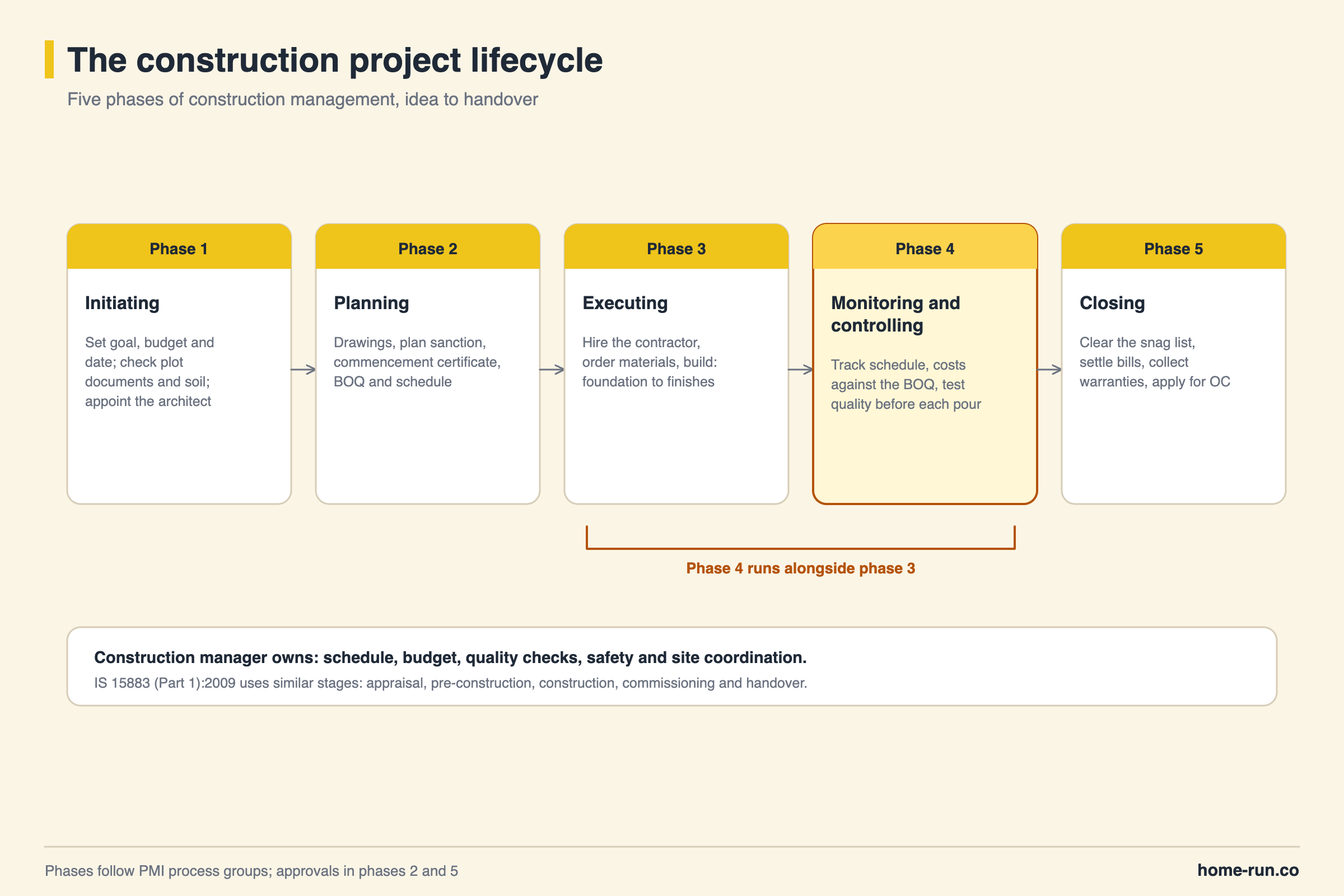
Construction management runs in 5 phases, matching the Project Management Institute's (PMI) process groups: initiating, planning, executing, monitoring and controlling, and closing. IS 15883 uses similar life-cycle stages: appraisal, pre-construction, construction, and commissioning and handover.
Initiating
Set the goal, budget and target date. Check plot documents and soil, and appoint the architect.
Planning
Finalise drawings, get plan sanction and the commencement certificate, prepare the BOQ and build the schedule.
Executing
Hire the contractor, order materials and build: foundation, structure, masonry, services and finishes.
Monitoring and controlling
Runs alongside execution. Track progress against the schedule, costs against the BOQ, and test quality before each pour.
Closing
Clear the snag list, settle final bills, collect warranties and apply for the occupancy certificate.
For the approvals in phases 2 and 5, see our commencement certificate guide and occupancy certificate guide.
What Does a Construction Manager Do?
A construction manager plans the work, coordinates everyone on site and controls time, cost, quality and safety until handover. On small homes, the architect, contractor or owner often plays this role.
- Prepare and update the master schedule and weekly work plan.
- Track spending against the BOQ and approve running bills.
- Order materials so cement, steel and bricks arrive before each stage.
- Coordinate the architect, structural engineer, contractor and specialist trades.
- Check quality at hold points: reinforcement before pours, slump tests, curing.
- Enforce site safety and keep daily records.
- Report progress and risks to the owner every week.
Which Planning Tools Do Construction Managers Use?
Construction managers use a Gantt chart to show the schedule, the critical path method (CPM) to find which tasks decide the finish date, and a bill of quantities (BOQ) to control cost.
Construction management planning tools
What each tool controls| Tool | What it shows | Best used for |
|---|---|---|
| Gantt chart Start here | Tasks as bars on a calendar | Owner updates, weekly planning |
| Critical path method (CPM) | Longest chain of dependent tasks and float | Finding tasks that cannot slip |
| PERT | Durations from optimistic, likely and pessimistic estimates | Uncertain or new work |
| Bill of quantities (BOQ) | Every item with quantity and rate | Quotes, bills, cost control |
| S-curve | Planned vs actual cumulative cost or progress | Spotting drift early |
| Daily progress report | Labour, materials, work done, issues | Site record and disputes |
Construction Management vs Project Management: What Is the Difference?
Project management is the general discipline of delivering any project. Construction management applies it to building work, adding site supervision, materials, workmanship and safety.
Project management
Any industryPoints
- Covers IT, events, product launches and construction
- Focuses on scope, schedule, budget and stakeholders
- Often works from an office, across several projects
- Common credential: PMI's PMP certification
Construction management
Building sitesPoints
- Covers buildings, roads and infrastructure only
- Adds drawings, materials, workmanship and site safety
- Spends much of the day on site with trades
- Needs codes such as NBC 2016 and IS standards
Which Contract Types Are Used for Construction in India?
Indian works contracts are mainly item rate, lump sum, percentage rate and EPC (design and build), as listed in the Ministry of Finance's Manual for Procurement of Works (2019). The contract type decides who carries the cost risk.
Common construction contract types in India
Per Ministry of Finance Manual for Procurement of Works| Contract type | How the contractor is paid | Who carries quantity risk |
|---|---|---|
| Item rate Common for houses | Rate per BOQ item × measured quantity | Owner |
| Lump sum | One fixed price, paid at milestones | Contractor |
| Percentage rate | % above or below the owner's estimate | Owner |
| EPC / design and build | Lump sum for design plus construction, paid by stage | Contractor |
Most Bengaluru homes are built on a per sq ft rate, either labour-only or with materials. Our civil contractor guide compares both, and the house construction cost in Bangalore guide gives current rates.
What Goes Wrong When a Build Is Not Managed?
Without construction management, projects usually overrun on cost and time. Government data shows the scale: MoSPI's July 2026 report put the overrun on 1,775 central projects at ₹3,40,504 crore, about 10% above original cost.
- No written schedule, so trades arrive in the wrong order
- No BOQ, so every running bill becomes an argument
- Materials ordered late, leaving labour idle for days
- Design changes made verbally, with no variation order or price
- No checks before pours, so mistakes get buried in concrete
- Approvals missed, delaying the occupancy certificate
How Is Technology Changing Site Management in India?
Technology is moving construction management from paper registers to shared apps. Site teams log progress photos, attendance and material receipts on phones, and owners see updates the same day.
- Scheduling software: Microsoft Project and Primavera P6 for Gantt and CPM.
- Site apps: daily reports, snag lists and photo logs.
- BIM (building information modelling): 3D models that catch clashes before construction.
What Skills and Courses Lead to a Career in Construction Management?
A construction management career needs civil engineering basics, planning and cost skills, and strong communication. Most managers start with a BE/BTech in civil engineering or a diploma, then add site experience and a postgraduate course.
- Technical: reading drawings, quantity estimation, IS codes.
- Planning: Gantt, CPM and scheduling software.
- People: leading crews, negotiating with contractors.
- Problem-solving: fixing delays without cutting quality.
The National Institute of Construction Management and Research (NICMAR), founded in 1982, has campuses in Pune and Hyderabad and became NICMAR University, Pune in 2022. Civil engineering departments at IIT Madras and IIT Roorkee (formerly the University of Roorkee) also teach construction management.
Get two to three years of site work before a postgraduate course.
Keeping your site on schedule?
Order cement, steel and bricks on time, delivered across Bengaluru.