On this page
- What Are MYK Laticrete 305, 315, 325 and 335?
- What Do C1, C2, T, E, S1 and IS 15477 Types Mean?
- MYK Laticrete 305 vs 315 vs 325 vs 335: How Do the Specs Compare?
- Which MYK Laticrete Adhesive Should You Choose?
- How Do You Apply MYK Laticrete Tile Adhesive?
- The four grades rise in bond strength and flexibility: 305 < 315 Plus < 325 < 335.
- 305 is for ceramic in dry rooms; 315 Plus for vitrified, but not external walls.
- 325 and 335 are IS 15477 Type 3, rated for exterior walls and wet areas.
- 335 adds S1 flexibility for large-format tiles and stone.
MYK Laticrete 305 vs 315 vs 325 vs 335 comes down to where the tile goes. 305 suits ceramic in dry rooms, 315 Plus suits vitrified tiles indoors, and 325 and 335 handle exterior walls, wet areas and large tiles.
What Are MYK Laticrete 305, 315, 325 and 335?
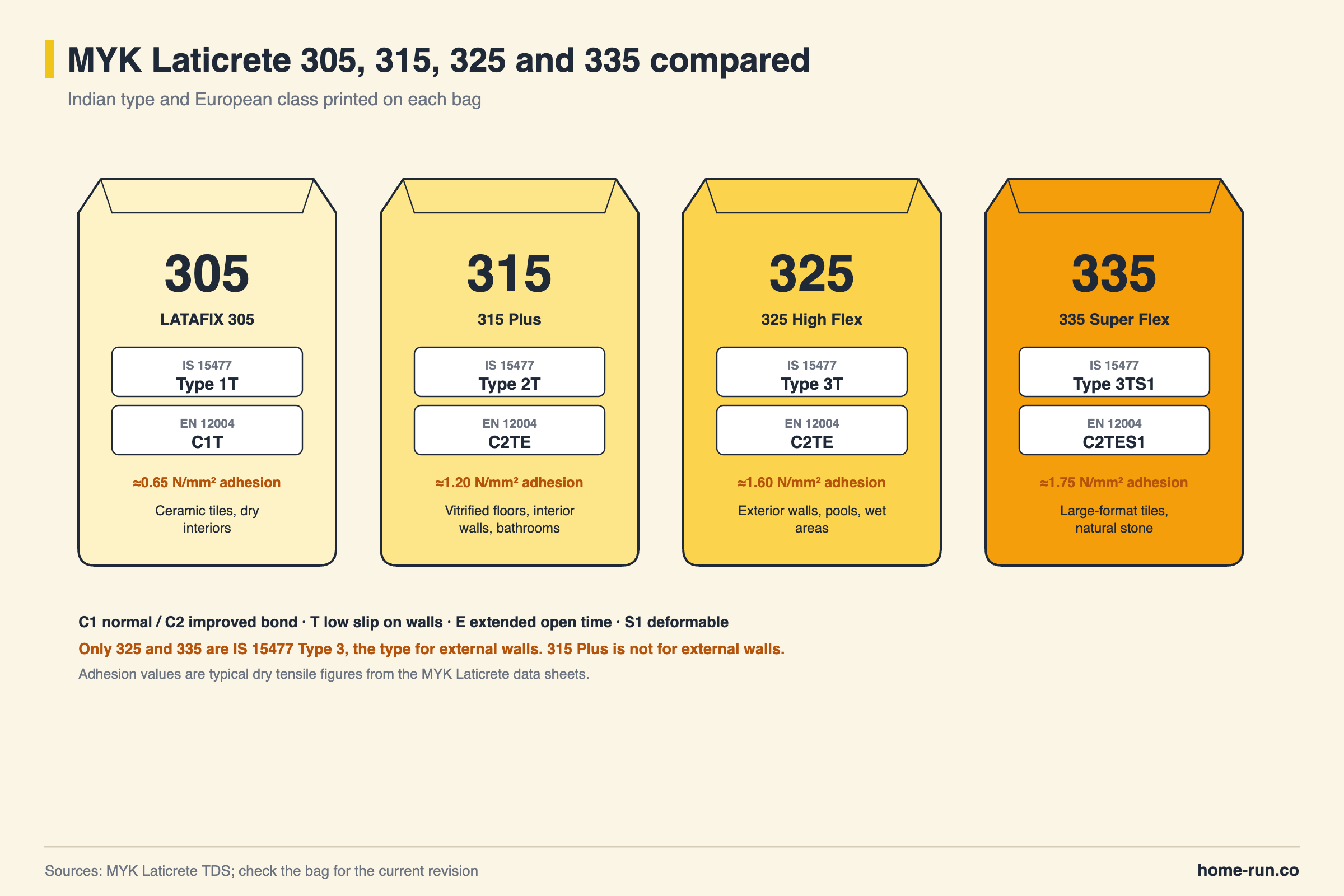
MYK Laticrete 305, 315, 325 and 335 are polymer-modified cement tile adhesives from Hyderabad-based MYK Laticrete. Bags read LATAFIX 305, 315 Plus, 325 High Flex and 335 Super Flex.
What Do C1, C2, T, E, S1 and IS 15477 Types Mean?
These are performance ratings: EN 12004 (European standard) gives the class, IS 15477:2019 (Indian standard) the type.
- C1: normal cement adhesive, tensile adhesion of at least 0.5 N/mm².
- C2: improved cement adhesive, tensile adhesion of at least 1.0 N/mm².
- T: slip of 0.5 mm or less on walls.
- E: extended open time of 30 minutes.
- S1: deformable, bending 2.5 mm to under 5 mm.
315 Plus and 325 are both C2TE. Only 325 is IS 15477 Type 3, the type that covers external walls.
MYK Laticrete 305 vs 315 vs 325 vs 335: How Do the Specs Compare?
Typical dry tensile adhesion climbs from about 0.65 N/mm² for 305 to about 1.75 N/mm² for 335.
MYK Laticrete tile adhesives compared
Typical values from MYK Laticrete India technical data sheets (TDS), at 21°C| Grade | IS 15477 type | EN 12004 class | Dry tensile (IS) | Open time | Pot life | Best for |
|---|---|---|---|---|---|---|
| LATAFIX 305 | Type 1T | C1T | 0.60–0.70 N/mm² | Not stated | 2–3 h | Ceramic tiles, dry interiors |
| 315 Plus | Type 2T | C2TE | 1.15–1.25 N/mm² | 30 min | 3–4 h | Vitrified floors, interior walls, bathrooms |
| 325 High Flex | Type 3T | C2TE | 1.55–1.65 N/mm² | 30 min | 4 h | Exterior walls, pools, wet areas |
| 335 Super Flex S1 flexible | Type 3TS1 | C2TES1 | 1.70–1.80 N/mm² | 30 min | 4 h | Large-format tiles, natural stone |
MYK Laticrete 315 vs 325: which is better?
325 is stronger; 315 Plus covers most indoor floors.
315 Plus
IndoorsPoints
- IS 15477 Type 2T, C2TE
- Dry shear 1.35–1.45 N/mm²
- Interior floors, walls and external floors
- Not for external walls
325 High Flex
Inside and outPoints
- IS 15477 Type 3T, C2TE
- Dry shear 1.60–1.70 N/mm²
- Interior and exterior floors and walls
- Rated for pools, saunas, washrooms
For MYK Laticrete 305 vs 315, vitrified tiles need 315 Plus. See our guides to ceramic tiles and porcelain tiles.
Which MYK Laticrete Adhesive Should You Choose?
Pick the lowest grade whose data sheet covers your tile and location.
- Ceramic wall tiles in a dry room: 305.
- Vitrified floor tiles, kitchen or bathroom walls: 315 Plus.
- Exterior elevation cladding, balconies, pools: 325 High Flex.
- Tiles above 600 × 600 mm, heavy stone, slabs with movement: 335 Super Flex.
Indoors: ceramic takes 305, vitrified takes 315 Plus. Exterior walls or wet areas: 325, or 335 for big tiles.
How Do You Apply MYK Laticrete Tile Adhesive?
All four grades go on the same way: prepare the surface, mix, comb and set within the open time.
- Prepare: concrete cured 28 days, flat within 6 mm over 3 m, at 4–40°C.
- Mix: about 4.4–4.8 L water per 20 kg for 305; 5.5–6 L for grey 315 Plus, 325 and 335.
- Comb: use a 6 mm square-notched trowel for a 3 mm bed.
- Back-butter: any tile over 12 × 12 in (about 300 × 300 mm).
- Grout: after at least 24 hours.
Scrape off skinned adhesive, never cover expansion joints, and remove mesh backing from stone.
For joints in wet areas, see our explainer on epoxy grout.
Tiling a floor or wall?
Tile adhesive, tiles and grout delivered across Bengaluru.