On this page
- Why Set Up Rainwater Harvesting at Home?
- What Parts Does a Home Rainwater Harvesting System Need?
- Which Type of Rainwater Harvesting System Suits Your Home?
- How Much Rainwater Can Your Roof Collect?
- What Should You Check Before Installing Rainwater Harvesting at Home?
- How to Set Up Rainwater Harvesting at Home, Step by Step
- How Much Does Rainwater Harvesting at Home Cost?
- Is Rainwater Harvesting at Home Mandatory in Bengaluru?
- How Do You Maintain a Home Rainwater Harvesting System?
- Where Can Bengaluru Homeowners Get Setup Help?
- Rainwater harvesting at home means sending roof rain to a tank, a recharge well, or both.
- Most Bengaluru homes fill the sump first and send the overflow to a recharge well.
- Size it from your roof: an 80 sq m roof collects about 62,700 litres in an average year.
- BWSSB makes harvesting mandatory for new homes on 30 × 40 ft sites and older homes on 60 × 40 ft sites.
Rainwater harvesting at home is a simple plumbing job: you collect rain from your roof, filter it, and either store it for use or send it into the ground. This guide is the homeowner's setup plan. For the science, methods and history, read our main guide to rainwater harvesting in India.
Why Set Up Rainwater Harvesting at Home?
Rainwater harvesting at home cuts tanker and borewell dependence and, in Bengaluru, avoids a water-bill penalty.
Recharge matters most in borewell-dependent cities like Bengaluru, where pumping outpaces natural refill in many areas.
Storage gives you water to use next week. Recharge refills the aquifer, the underground layer that feeds wells.
What Parts Does a Home Rainwater Harvesting System Need?
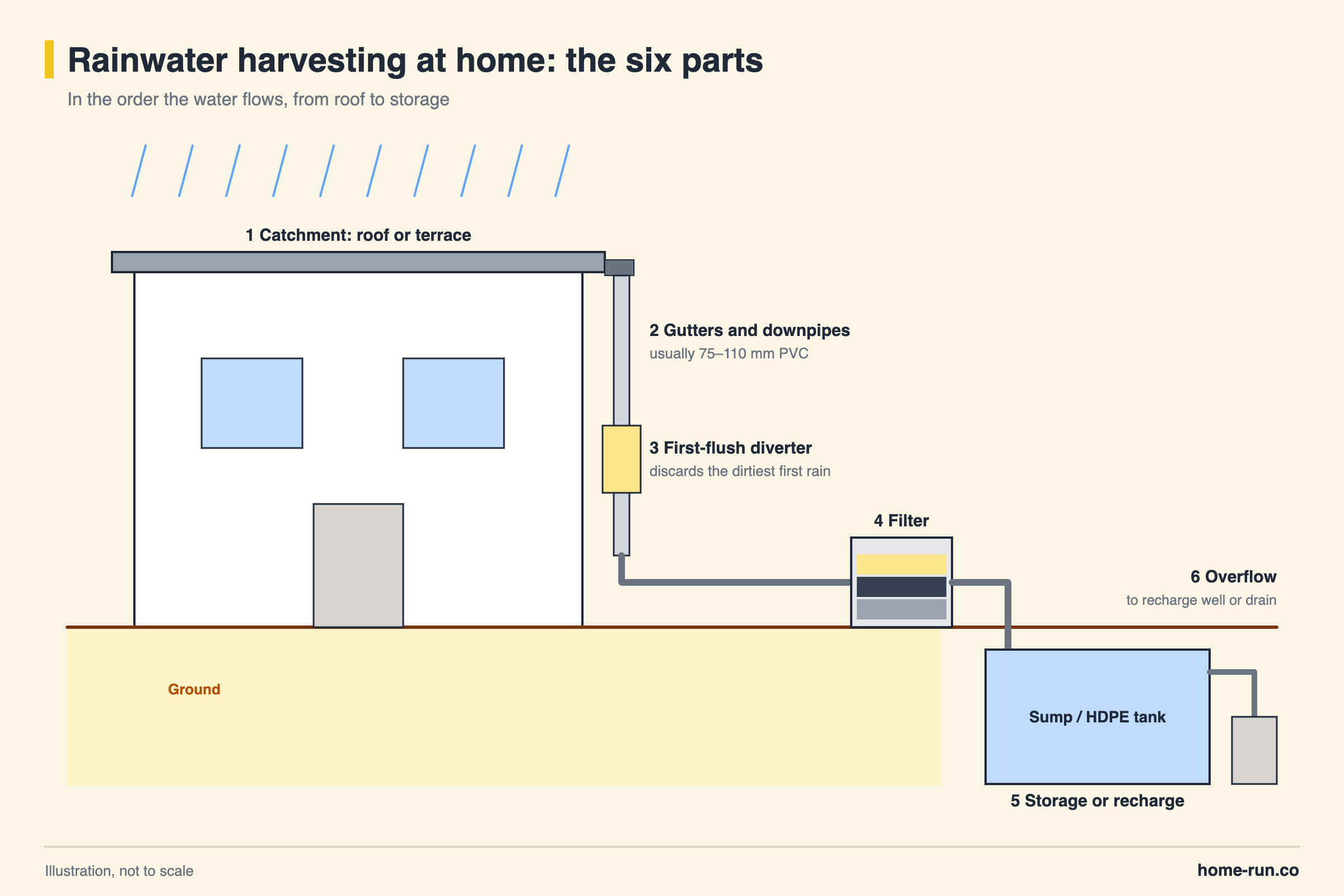
A home rainwater harvesting system needs six parts, in the order the water flows: catchment, gutters and downpipes, first-flush diverter, filter, storage or recharge structure, and an overflow.
- Catchment: your terrace or roof.
- Gutters and downpipes: usually 75–110 mm PVC.
- First-flush diverter: discards the dirtiest first rain.
- Filter: a mesh unit or a sand, charcoal and gravel bed.
- Storage or recharge: a sump, an HDPE (high-density polyethylene) tank, or a recharge well.
- Overflow: sends excess water to a recharge well or storm drain.
Which Type of Rainwater Harvesting System Suits Your Home?
The right system depends on your plot, soil and water source. A combined sump-plus-recharge system suits most independent houses in Bengaluru.
Rainwater harvesting system types for homes
Pick by plot and water source| System type | How it works | Best for | Watch out |
|---|---|---|---|
| Sump plus recharge well Default pick | Filtered water fills the sump; overflow goes to a recharge well | Independent houses with a sump | Needs open ground for the well |
| Storage only | Filtered water goes to a sump or HDPE tank | Rocky or high water-table plots | Overflow still needs a safe outlet |
| Recharge only Budget | Filtered water goes straight to a recharge well or pit | Borewell homes, small budgets | No stored water to use |
| Barrel or drum | One downpipe fills a covered drum | Rented homes, gardens, balconies | Too small to meet BWSSB rules alone |
For pit, trench and well options, see our recharge pit guide.
How Much Rainwater Can Your Roof Collect?
Your roof collects its area times annual rainfall times a runoff coefficient, the share of rain that reaches the pipes. The KUIDFC Rainwater Harvesting Trainers' Manual gives 0.8–0.9 for tiled roofs.
20 litres per sq m of roof holds roughly one 25 mm downpour at a 0.8 runoff coefficient. Size storage for that, and send everything above it to recharge.
To size the sump for daily use, follow our sump capacity calculation.
What Should You Check Before Installing Rainwater Harvesting at Home?
Before installing rainwater harvesting at home, confirm your roof, plot and paperwork are ready, so the plumber builds once.
- Terrace cleaned, cracks sealed and slope running to the outlets
- Roof area and paved area measured in sq m
- Sump location, depth and spare capacity known
- Open ground, clear of the foundation, for a recharge well
- Soil type checked: rocky ground or a very high water table rules out recharge
- Latest BWSSB water bill checked for a harvesting penalty
How to Set Up Rainwater Harvesting at Home, Step by Step
You set up rainwater harvesting at home in eight steps, from the roof down. A plumber or BWSSB-trained contractor usually does steps 3 to 8.
- Prepare the roof. Clear debris and fix leaks.
- Size the system. Check capacity against the BWSSB minimum using the formula above.
- Fit gutters and downpipes. Join all roof outlets into one PVC line, with mesh caps on outlets.
- Install the first-flush diverter. Keep it reachable, with a drain cap at the bottom.
- Mount the filter. Wall-mounted filters suit roofs up to 250 sq m; larger roofs need more units. Size it for downpours of 60 mm an hour.
- Connect the sump. Bring the filtered line in above top water level.
- Build the recharge well. Dig at least 3 m deep and 0.9 m wide, line it with perforated RCC rings, and leave it open inside. Cap it with an RCC slab and lockable manhole.
- Connect the overflow and test. Run sump overflow to the well and well overflow to the storm drain. Watch the first heavy shower.
Our guide to rooftop rainwater harvesting covers first-flush and filter choices in more detail.
Only filtered roof water should reach a borewell or recharge well. Road runoff and drain water can clog or contaminate the aquifer.
How Much Does Rainwater Harvesting at Home Cost?
Rainwater harvesting at home costs anywhere from a few thousand rupees for a drum-and-pit setup to much more for a full sump-plus-recharge-well system. The Better India (February 2026) describes a DIY recharge drum in a pit built for ₹2,500–5,000.
Your quote depends on pipe length and outlets, the number of filters, recharge well depth and rings, soil disposal, and whether you reuse the sump. Ask for two itemised quotes; building it in during construction costs less than a retrofit.
Setting up rainwater harvesting this month?
Pipes, fittings, tanks and cement delivered across Bengaluru.
Is Rainwater Harvesting at Home Mandatory in Bengaluru?
Yes. Rainwater harvesting is mandatory in Bengaluru under Section 72A of the Bangalore Water Supply and Sewerage Act, enforced by the Bangalore Water Supply and Sewerage Board (BWSSB) since 2009.
BWSSB rainwater harvesting rules at a glance
Confirm current figures with BWSSB| Rule | Requirement |
|---|---|
| Who must comply | Buildings after 2009 on 30 × 40 ft (1,200 sq ft) sites and above; older buildings on 60 × 40 ft (2,400 sq ft) sites and above |
| Minimum capacity Check | 20 litres per sq m of roof plus 10 litres per sq m of paved area, as storage, recharge or both |
| Recharge well | At least 3 m deep and 0.9 m in diameter, not filled with jelly or sand |
| Domestic penalty | 25% extra on water and sanitary charges for 3 months, then 50% until installed |
| Non-domestic penalty | 50% extra, rising to 100% |
Most reports give 20 litres per sq m of roof and 10 per sq m of paving; a 2024 MyGate summary of BWSSB guidelines gives 60 and 30. For the example above, that is 1,800 or 5,400 litres. Confirm with BWSSB.
Elsewhere, state laws and city bye-laws apply; Tamil Nadu and Delhi have their own. The Central Ground Water Authority (CGWA) regulates groundwater extraction nationally, not house-level harvesting.
How Do You Maintain a Home Rainwater Harvesting System?
You maintain a home system by cleaning the roof, gutters, diverter and filter before each monsoon.
- Empty the first-flush chamber after each shower
- Wash the filter mesh or top sand layer every few heavy rains
- Keep every tank, sump and well covered, with mesh on vents and overflows
- Remove silt from the recharge well bottom once a year
Filtered rainwater suits flushing, gardening and washing. Drinking needs treatment and testing against IS 10500, the Indian drinking water standard.
Red flags when buying parts or hiring a contractor
- A quote that fills the recharge well with jelly and sand, against BWSSB guidance
- No first-flush diverter or bypass in the design
- Uncovered tanks or open overflows that let mosquitoes in
- Overflow pointed at the foundation or a neighbour's plot
Where Can Bengaluru Homeowners Get Setup Help?
Measure your roof, then visit the RWH helpdesk run by the Karnataka State Council for Science and Technology (KSCST) with BWSSB. It works from the IISc campus and the Jayanagar Rainwater Harvesting Theme Park, which has 26 working models.
Then build before the monsoon and ask BWSSB how to record the system so any penalty stops.