On this page
- What Is Earthing and Why Does It Matter in a House?
- What Are the Warning Signs of Faulty Earthing?
- What Causes Earthing Problems in Indian Homes?
- How to Check Earthing Problem in House Wiring Safely
- How to Solve Earthing Problems in a House, Step by Step
- What Are the Common Fixes for Earthing Issues?
- How to Solve an Earthing Problem in an Apartment
- How Do You Prevent Earthing Problems Long Term?
- When Should You Call an Electrician for Earthing Issues?
- An earthing problem in a house means fault current has no safe, low-resistance path to the ground.
- Watch for shocks from appliances, a tingling tap, or an RCCB that trips often.
- Typical causes are a dry or corroded earth pit, a loose earth wire, or a missing earth pin connection.
- The fix is test first, then repair: a licensed electrician measures the pit and wiring before changing anything.
- Every home supply should run through a 30 mA RCD, as the CEA Safety Regulations 2023 require.
An earthing problem in a house is any fault that stops leakage current from flowing safely into the ground. The result is shocks from metal appliances, damaged electronics and a higher fire risk.
The fix is to find the weak point, usually the earth pit, earth wire or a socket, and have a licensed electrician repair it. For the full wiring picture, see our guide to electrical wiring for houses.
What Is Earthing and Why Does It Matter in a House?
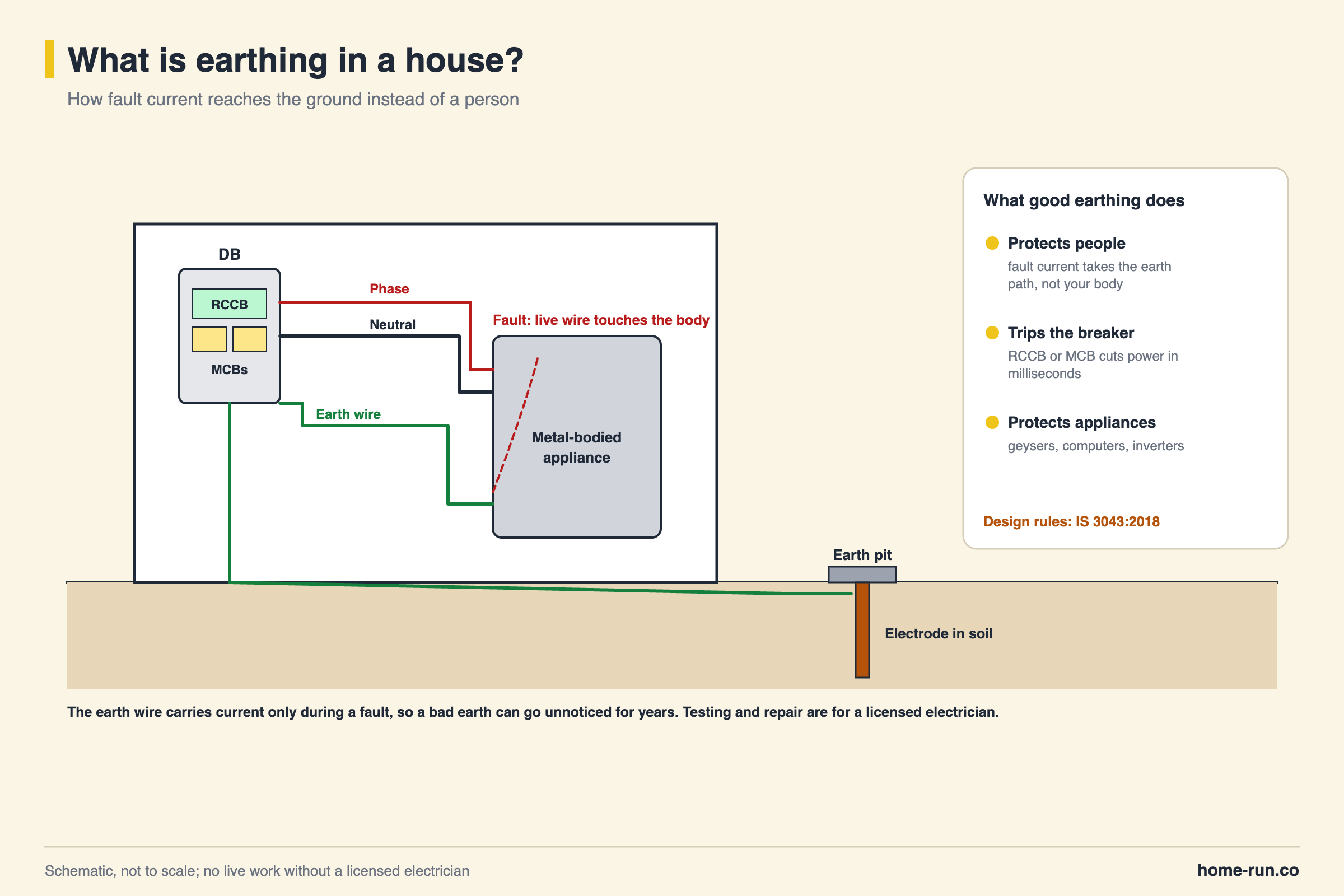
Earthing is a low-resistance connection from the metal parts of your wiring and appliances to the ground. When a live wire touches a metal body, the fault current flows down the earth wire instead of through a person.
Good earthing does three jobs:
- Protects people: fault current takes the earth path instead of your body.
- Trips the breaker: a clean earth path lets the RCCB (residual current circuit breaker) or MCB (miniature circuit breaker) cut power within milliseconds.
- Protects appliances: geysers, computers and inverters see fewer faults.
IS 3043:2018, the Bureau of Indian Standards (BIS) code of practice for earthing, sets the design rules in India.
The neutral carries current back to the supply whenever something is on. The earth wire carries current only during a fault, so a bad earth can go unnoticed for years.
What Are the Warning Signs of Faulty Earthing?
The clearest sign of an earthing problem in a house is a mild shock or tingle when you touch a metal appliance, tap or switch plate.
- Shocks or tingling: from a washing machine body, fridge handle, geyser pipe or steel tap.
- RCCB trips often: especially in the rains or when one appliance switches on.
- Electronics fail early: repeated failures of adapters, routers, TVs or computer power supplies.
- Burn marks: scorching or melting around a socket or plug top.
If an appliance gives a shock, switch it off, unplug it and stop using it. Never bypass a tripping RCCB; it is reporting leakage.
What Causes Earthing Problems in Indian Homes?
Most earthing problems in Indian homes come from a dry or corroded earth pit, a loose or broken earth wire, or wiring that never had a proper earth.
Common causes of an earthing problem in a house
What an electrician usually finds| Cause | What happens | Usual fix |
|---|---|---|
| Dry earth pit Very common | Earth resistance rises in dry months | Treat or rebuild the pit; add a second electrode |
| Corroded electrode or clamp | Rust breaks contact between wire and electrode | Replace the clamp, strip or electrode |
| Loose or cut earth wire | Earth path breaks at the board, socket or pit | Retighten or rerun the earth conductor |
| Old two-pin wiring High risk | Sockets have no earth wire behind them at all | Rewire with an earth conductor in the conduit |
| Water or gas pipe used as earth | Not allowed; pipes can be cut or replaced with plastic | Install a proper earth electrode |
IS 3043 notes that soil resistivity changes little above about 20% moisture but rises sharply below it. That is why a pit that tests fine after the monsoon can fail in the dry months before it.
How to Check Earthing Problem in House Wiring Safely
You can safely check for an earthing problem in a house with a plug-in socket tester and the RCCB test button. Measuring earth resistance or voltage needs a licensed electrician.
Earthing test methods and who should use them
Live-circuit tests are for licensed electricians only| Method | What it shows | Who |
|---|---|---|
| Plug-in socket tester | Lights show if the earth, phase and neutral are wired right | Homeowner |
| RCCB test button | The RCCB still trips when leakage occurs | Homeowner |
| Test light bulb | Only that voltage is present; not earth quality | Electrician |
| Multimeter | Voltage between neutral and earth; earth wire continuity | Electrician |
| Earth resistance tester Best test | The actual resistance of the earth pit in ohms | Electrician |
IS 3043 sets no single resistance figure for homes; the value must suit the protection needed. Puducherry's self-certification checklist caps LT domestic earthing at 5 ohms in any season, a useful benchmark.
How to Solve Earthing Problems in a House, Step by Step
To solve an earthing problem in a house, stop using the faulty point, get the system tested, then repair the pit, the wire or the socket that failed.
- Make it safe. Switch off and unplug any appliance that gave a shock.
- Note the symptoms. Which socket or appliance, when the RCCB trips, and whether rain makes it worse.
- Do the safe checks. Use a plug-in socket tester on the problem socket and press the RCCB test button.
- Call a licensed electrician. The electrician tests the earth pit, the earth continuity to each socket and the neutral-earth voltage.
- Inspect the earth pit. The electrician checks the electrode, clamp and earth strip for rust or breaks.
- Repair the weak point. Tighten or replace connections, rerun the earth wire, treat the pit, or add a new electrode.
- Retest and record. Measure again after the repair and keep the reading on file.
The CEA Safety Regulations 2023 restrict installation and repair work to authorised electrical contractors and certified workers. The exceptions are simple swaps such as lamps, fans and fuses. Never test with bare wires, and never link earth to neutral to stop shocks.
What Are the Common Fixes for Earthing Issues?
The common fixes are tightening or replacing earth connections, rerunning a broken earth wire, treating a dry pit, and installing a new earth electrode.
- Loose connection: retighten the earth bar and socket earth terminals.
- Missing earth wire: run insulated copper earth wire with phase and neutral; Puducherry's checklist asks for 2.5 mm² on power circuits.
- Dry pit: treat the soil or use an earthing compound.
- Corroded electrode: install a new electrode in a fresh pit.
- No RCD: add a 30 mA RCCB at the distribution board.
Earth electrode sizes in IS 3043
Minimums from the IS 3043 earthing code and its amendments| Electrode | Size | Notes |
|---|---|---|
| Pipe electrode Common in homes | 40 mm dia GI pipe | In a treated earth pit |
| Plate electrode, GI or steel | 600 × 600 × 6.3 mm | Placed deep enough that the soil stays damp |
| Plate electrode, copper | 600 × 600 × 3.15 mm | Costlier, lasts longer |
| Driven rod | 13–19 mm dia, 1.22–2.44 m | Copper, copper-bonded steel or GI |
How to Solve an Earthing Problem in an Apartment
To solve an earthing problem in an apartment, first check the wiring inside your flat, then ask the residents' association to test the building's earth pits.
Most flats connect to common earth pits shared by the block. If several flats report shocks or RCCB trips, the association's electrician should test and service those pits.
In Bengaluru, report supply-side faults, such as a broken neutral on the service line, to the BESCOM helpline, 1912.
How Do You Prevent Earthing Problems Long Term?
You prevent earthing problems by testing the earth pit at least once a year and keeping every connection clean, tight and dry.
- Get the earth pit resistance tested yearly, ideally in the dry months before the monsoon.
- Press the RCCB test button as often as the maker's manual advises.
- Use three-pin plugs for every metal-bodied appliance; never cut off the earth pin.
- Ask for a separate earth check whenever you renovate, add a floor or install solar panels.
- Book a full inspection at least every 5 years, the longest gap the CEA 2023 regulations allow.
Building new? See house wiring in India for earthing at the build stage, and types of electrical wiring to compare systems.
When Should You Call an Electrician for Earthing Issues?
Call a licensed electrician as soon as anyone gets a shock, the RCCB keeps tripping, or a socket tester shows an earth fault.
Safe homeowner checks
No tools opened- Plug-in socket tester on each socket
- RCCB test button, as the maker advises
- Look for scorch marks and loose plugs
- Keep the earth pit cover clear
Licensed electrician
Any real fault- Shocks, tingling or burning smells
- RCCB trips that keep coming back
- Earth resistance and voltage tests
- New earth pit or rewiring
Fixing your earthing?
Wires, switchgear and electrical supplies delivered across Bengaluru.