On this page
- Why Does the Type of Glass Matter in Construction?
- What Are the 13 Types of Glass Used in Construction?
- Which Types of Glass Count as Safety Glass in India?
- Toughened vs Laminated Glass: Which Type Should You Use?
- How Do Glass Types Compare on Cost and Availability in India?
- Which Types of Glass Save Energy in Bengaluru Homes?
- How Do You Choose the Right Type of Glass for Each Opening?
- Almost every type of building glass starts as float glass and is then toughened, laminated, coated or combined.
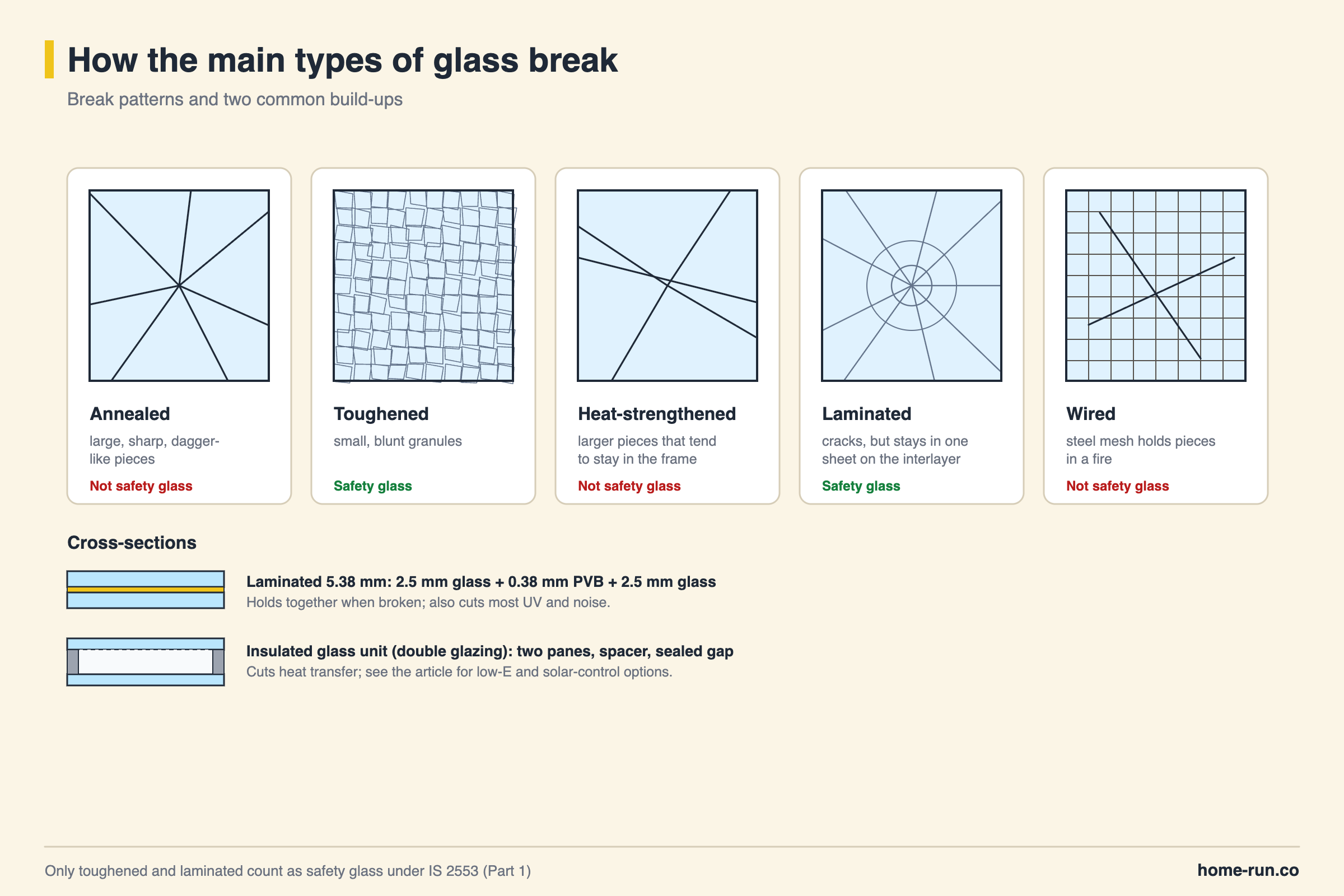
- Toughened glass is about 4× stronger than annealed glass and breaks into small blunt granules.
- Laminated glass cracks but stays bonded to its plastic interlayer, so it suits railings and overhead glass.
- Heat-strengthened and wired glass are not safety glass, even though both look tougher than plain glass.
- In India, safety glass for buildings must carry the ISI mark under the Safety Glass (Quality Control) Order, 2020.
The types of glass in construction fall into three families: base glass (float and annealed), processed safety glass (toughened and laminated), and performance or decorative glass (double glazing, tinted, low-E, frosted, fire-resistant and smart glass).
This listicle goes through each type in detail. For what glass is made of, its physical properties and the history of the float process, see our explainer on glass as a building material.
Why Does the Type of Glass Matter in Construction?
The type of glass decides how a pane breaks, how much sun heat it lets in and whether it is legal in a given location. Two panes can look identical in the frame and behave very differently when struck.
Toughened, laminated, tinted and coated glass are not different materials. They are the same soda-lime float glass after a heat, bonding or coating step.
What Are the 13 Types of Glass Used in Construction?
The 13 types of glass used in building construction are listed below, from the base sheet to specialist products.
1. Float glass
Float glass is flat sheet glass made by floating molten glass on a bath of molten tin, which gives it smooth, parallel faces. It is the base sheet for nearly every other type on this list.
Asahi India Glass (AIS) publishes clear float data from 2 mm to 12 mm. Its 6 mm clear float passes 86.6% of visible light but also has a solar factor of 81%, so it lets in most of the sun's heat.
Best for: small fixed windows and as raw stock for processing. Watch out: plain float glass is not safety glass.
2. Annealed glass
Annealed glass is float glass that is cooled slowly after forming to remove internal stress. Most ordinary window glass sold off the shelf is annealed.
Annealed glass is easy to cut and drill on site, but it breaks into large, sharp, dagger-like pieces, so it is the wrong choice in doors, low windows, railings and showers.
Best for: small windows above waist height, cabinet fronts, picture frames and mirrors.
3. Toughened (tempered) glass
Toughened glass, also called tempered glass, is annealed glass heated to about 650 °C and then cooled fast with air jets. The quick cooling locks the surface into compression, which makes the pane about 4 times stronger in bending than annealed glass.
ASTM C1048, the US specification for heat-treated flat glass, sets a minimum surface compression of 10,000 psi (69 MPa) for fully tempered glass. It shatters into small, blunt granules.
Best for: glass doors, shower screens, frameless partitions and table tops. Watch out: toughened glass cannot be cut or drilled afterwards, so every hole and notch must be made before toughening.
4. Heat-strengthened glass
Heat-strengthened glass is heated like toughened glass but cooled more slowly, so it ends up about 2 times stronger than annealed glass. ASTM C1048 sets its surface compression at 3,500–7,500 psi (24–52 MPa).
When heat-strengthened glass breaks, the cracks run in larger pieces that tend to stay in the frame. The Glass Association of North America (GANA) states plainly that heat-strengthened glass is not a safety glazing material unless it is laminated.
Best for: facade panels and the plies inside laminated glass, where resistance to thermal stress matters.
5. Laminated glass
Laminated glass is two or more glass layers bonded with a plastic interlayer, usually PVB (polyvinyl butyral). When the glass cracks, the pieces stick to the interlayer and the pane stays in one sheet.
A typical thin build-up is 2.5 mm glass, a 0.38 mm interlayer and 2.5 mm glass, sold as 5.38 mm laminated glass. EVA (ethylene-vinyl acetate) and stiffer ionoplast interlayers are also used. It also cuts most UV light and noise.
Best for: balcony and stair railings, skylights, glass floors and street-facing bedrooms.
6. Wired glass
Wired glass has a steel wire mesh rolled into it. The mesh holds broken pieces in place during a fire, so it was once the standard fire-rated door glass.
Wired glass is not safety glass. Building Design + Construction reports that the wires weaken the pane to roughly half the strength of ordinary glass, and the broken edges can trap a hand or arm.
Best for: older fire doors and industrial roof lights. For new homes, choose a tested fire-resistant glass instead.
7. Insulated glass units (double glazing)
An insulated glass unit (IGU), also called a DGU (double-glazed unit), is two panes held apart by a spacer bar and sealed around the edge. The gap is filled with dry air or argon gas.
The gap slows heat flow. Single glazing has a U-value of about 4.8–5.8 W/m²·K, while double glazing ranges from about 1.2 to 3.7 W/m²·K, depending on the gap, gas and coating.
Best for: air-conditioned bedrooms, homes on noisy roads and large west-facing windows. Watch out: mist between the panes means the edge seal has failed.
8. Tinted glass
Tinted glass, also called body-tinted glass, has colouring metal oxides added to the melt, so the colour runs through the full thickness. Iron oxide gives green tones, cobalt gives blue, chromium gives deeper greens, and sulphur with iron gives amber or bronze.
Tinted glass absorbs part of the sun's heat and cuts glare, but it also cuts daylight and grows warm itself.
Best for: glare control on south and west faces, and car-park or stair-core facades.
9. Reflective and low-E coated glass
Coated glass has a thin metal or metal-oxide layer on one face to control heat and light. Reflective (solar control) glass bounces part of the sun's heat and gives a mirror-like outer look. Low-E (low-emissivity) glass reflects infrared heat while letting most visible light through.
Low-E coatings often sit inside a DGU, protected from dust. Tints absorb heat; coatings reflect it.
Best for: sunny facades, large living-room windows and air-conditioned offices. Ask for the data sheet with VLT (visible light transmittance) and SHGC (solar heat gain coefficient) before you buy.
10. Patterned, frosted and back-painted glass
Decorative glass changes the surface to give privacy or colour. Patterned glass is rolled with a texture, frosted glass is acid-etched or sandblasted, and back-painted (lacquered) glass has an opaque paint layer on the rear face.
Best for: bathroom windows, wardrobe shutters, kitchen backsplashes and office partitions. Use a toughened version anywhere people may knock into the glass.
11. Fire-resistant glass
Fire-resistant glass is glass tested to hold back flames, smoke and, in some types, radiant heat for a rated time, such as 30, 60 or 120 minutes. Common types use special ceramic glass or laminated layers with a clear gel that foams in a fire.
The rating applies to the full tested assembly, including frame and seals, not the pane alone.
Best for: fire exit doors, staircase enclosures and lobby partitions in apartment buildings.
12. Smart (switchable and chromatic) glass
Smart glass changes its tint or clarity when triggered. Chromatic glass covers three kinds: photochromic glass darkens in sunlight, thermochromic glass tints as it warms, and electrochromic glass tints at the press of a switch.
PDLC (polymer-dispersed liquid crystal) glass is the switchable privacy glass most sold in India. It is laminated glass with a liquid-crystal film that turns from frosted to clear when current flows. One June 2026 Indian price guide quotes about ₹800–1,800 per sq ft before 18% GST.
Best for: conference rooms, bathroom partitions in premium homes and clinics.
13. Glass blocks
Glass blocks are hollow, thick glass bricks laid in mortar or a frame system to build a wall that passes light. Each block is made from two pressed glass halves fused together.
Glass block walls give privacy and daylight but are non-load-bearing, so they need a proper frame or reinforcement.
Best for: bathroom walls, staircase lighting and dark internal corridors.
Types of glass in construction at a glance
Relative cost: ₹ lowest to ₹₹₹₹ highest| Type | How it breaks | Safety glass? | Relative cost | Typical home use |
|---|---|---|---|---|
| Float / annealed Not near people | Long, sharp shards | No | ₹ | High, small windows |
| Toughened Default pick | Small blunt granules | Yes | ₹₹ | Doors, showers, partitions |
| Heat-strengthened | Larger pieces, stays in frame | No, unless laminated | ₹₹ | Facades, laminate plies |
| Laminated Holds together | Cracks, stays bonded | Yes | ₹₹–₹₹₹ | Railings, skylights |
| Wired | Cracks, wire holds pieces | No | ₹₹ | Older fire doors |
| Double glazed (IGU) | As per the panes used | If panes are safety glass | ₹₹₹ | AC rooms, noisy roads |
| Tinted | As per base glass | If toughened or laminated | ₹–₹₹ | Glare control |
| Reflective / low-E | As per base glass | If toughened or laminated | ₹₹–₹₹₹ | Sunny windows, facades |
| Patterned / frosted / painted | As per base glass | If toughened | ₹–₹₹ | Bathrooms, wardrobes |
| Fire-resistant | Holds as a tested assembly | Depends on product | ₹₹₹₹ | Fire exits, stair cores |
| Smart / PDLC | As laminated glass | Laminated build | ₹₹₹₹ | Privacy partitions |
| Glass blocks | Single block cracks | Not applicable | ₹₹ | Light-passing walls |
Which Types of Glass Count as Safety Glass in India?
Only toughened glass and laminated glass count as safety glass in India. IS 2553 (Part 1): 2018, the Bureau of Indian Standards (BIS) specification for safety glass for architectural, building and general uses, covers both types and their impact and fragment tests.
The Safety Glass (Quality Control) Order, 2020 made IS 2553 (Part 1) compulsory from 16 September 2020. Safety glass for buildings sold in India must now carry the ISI mark.
Where to use safety glass is set by IS 16231 (Part 4), the BIS code of practice on glass safety related to human impact. Doors, panels beside doors, low glazing, railings, shower screens and overhead glass are the high-risk locations.
Toughened glass can shatter without impact because of tiny nickel sulphide (NiS) inclusions, about 80–500 µm across, that grow slowly after toughening. A heat soak test in a furnace breaks most affected panes at the factory. Ask for heat-soaked glass for large facade and overhead panes, or use laminated glass there.
Toughened vs Laminated Glass: Which Type Should You Use?
Toughened glass is the better pick where impact strength matters and the glass is vertical; laminated glass is the better pick where a broken pane must stay in place.
Toughened glass
Impact strength- About 4× stronger than annealed
- Breaks into small blunt granules
- Pane can fall out once broken
- Cannot be cut after toughening
Laminated glass
Stays in place- Strength set by the plies used
- Cracks but stays bonded to PVB
- Keeps the opening closed after a break
- Cuts noise and most UV light
If a broken pane could fall on someone or leave a drop open, use laminated glass, ideally with toughened or heat-strengthened plies. That covers skylights, glass roofs and balcony railings. Our skylight roof guide covers roof glazing in more detail.
How Do Glass Types Compare on Cost and Availability in India?
Plain float and annealed glass are the cheapest and most widely stocked types of glass in India; each extra process, such as toughening, laminating, coating or double glazing, adds cost and lead time.
- Stocked locally: clear, tinted, frosted and patterned float glass, cut to size by most Bengaluru dealers.
- Made to order: toughened and laminated glass, since sizes and cut-outs must be fixed first.
- Specialist supply: DGUs, low-E, fire-resistant and PDLC glass, from fewer processors.
Thickness, pane size and the frame often matter more than the glass type. For a full list of cost drivers, see the cost section of our guide to glass as a building material.
Which Types of Glass Save Energy in Bengaluru Homes?
Low-E, reflective and tinted glass save the most energy in Bengaluru homes because they cut solar heat, which adds more cooling load than heat conducted through the glass. Double glazing adds insulation but pays back mainly in air-conditioned rooms.
Bengaluru falls in the temperate climate zone of Eco Niwas Samhita 2024, the residential energy code from India's Bureau of Energy Efficiency (BEE). Mild temperatures mean shading and low SHGC glass on west and south faces matter more than a low U-value.
Compare clear 6 mm float (solar factor 81%) against the SHGC on a coated product's data sheet; lower means less heat.
How Do You Choose the Right Type of Glass for Each Opening?
Choose glass opening by opening: match the type to the safety risk first, then to heat, privacy and noise. The table gives sensible starting points for an Indian home.
Which type of glass goes where
Starting points; your fabricator sizes the thickness| Location | Recommended glass | Why |
|---|---|---|
| Sliding and swing glass doors | Toughened | High impact risk |
| Shower screens | Toughened, clear or frosted | Wet floors, falls |
| Balcony and stair railings | Laminated toughened | Must hold after breaking |
| Skylights and glass roofs | Laminated, often in a DGU | Overhead risk and heat |
| West-facing living-room windows | Low-E or reflective, toughened if low | Afternoon sun |
| Bedrooms on a main road | Laminated or DGU | Noise |
| Bathroom windows | Frosted or patterned | Privacy with daylight |
| Kitchen backsplash | Back-painted toughened | Heat near the hob, easy cleaning |
The frame matters as much as the glass. Compare frame options in our guide to aluminium window advantages, and see layouts for each room in our window designs for home guide.
- "Toughened" glass with no permanent mark: you cannot confirm the type or the ISI certification.
- Holes drilled after delivery: toughened glass cannot be drilled, so the pane was not toughened.
- Wired glass offered as safety glass: wired glass does not meet safety glazing tests.
Fitting glass doors or windows?
Hardware, sealants, adhesives and tools delivered across Bengaluru.