On this page
- What Is Foam Wall Insulation?
- What Are the Benefits of Foam Wall Insulation?
- Which Types of Foam Are Used for Wall Insulation?
- How Are Foam Boards and Spray Foam Installed?
- How Much Heat Does 50 mm of Foam Stop on a Brick Wall?
- What Should You Check Before Installing?
- How Long Does Wall Foam Last?
- What Are the Pros and Cons of Foam Insulation?
- Does a Bengaluru Home Need Wall Insulation?
- Foam conducts heat at 0.02–0.04 W/m·K, roughly 20 times less than brick.
- Rigid boards (EPS, XPS, PUF/PIR) suit flat walls; spray foam fills gaps and cavities.
- Foam burns, so it must be covered.
- In Bengaluru's temperate climate, insulate the roof and west wall first.
Foam wall insulation is a layer of plastic foam, fixed as boards or sprayed in place, that slows the flow of heat through a wall. It keeps rooms cooler and cuts AC load.
For factory-made sandwich panels and their prices, see PUF panel price and types. For ceiling-side options, see false ceiling materials.
What Is Foam Wall Insulation?
Foam wall insulation is any foamed plastic used to raise a wall's thermal resistance. Gas trapped in its cells conducts heat poorly.
Thermal conductivity (k, W/m·K) is how easily heat passes through; lower is better. R-value is resistance, so higher is better.
India's Eco-Niwas Samhita lists burnt clay brick at 0.62–0.98 W/m·K and EPS at 0.035–0.038 W/m·K.
What Are the Benefits of Foam Wall Insulation?
The main benefit of foam wall insulation is lower heat gain, so rooms stay cooler for less AC.
- Comfort and energy: cooler inner wall surfaces, less AC running time.
- Air sealing: spray foam closes gaps around pipes and frames.
- Sound: open-cell foam absorbs some noise.
- Existing homes: boards fix to either face without rebuilding.
Which Types of Foam Are Used for Wall Insulation?
Five foams cover most wall insulation work: three rigid boards and two spray foams.
Foam wall insulation types compared
Typical k values · check product datasheet| Type | Moisture | Typical wall use | k (W/m·K) |
|---|---|---|---|
| Expanded polystyrene (EPS) Budget | Absorbs some water | Inside lining, external systems | 0.030–0.038 |
| Extruded polystyrene (XPS) | High resistance | Below ground, damp-prone walls | 0.028–0.038 |
| PUF / Polyiso (PIR) board Best k | Good with facing | Thin, high-performance lining | 0.020–0.026 |
| Open-cell spray foam | Lets vapour through | Interior cavities, sound control | about 0.038 |
| Closed-cell spray foam | Vapour barrier at 38 mm+ | Cavities, block walls, exterior | 0.022 or lower |
Spray foam comes in two kinds:
Closed-cell spray foam
Damp walls- Rigid, about 32 kg/m³ (2 lb/ft³)
- More than R-6.5 per inch
- Air and vapour barrier at 38 mm or more
Open-cell spray foam
Quiet rooms- Soft, about 8 kg/m³ (0.5 lb/ft³)
- About R-3.8 per inch
- Air barrier only at 89 mm or more
How Are Foam Boards and Spray Foam Installed?
Foam wall insulation goes on in five steps, from damp repair to covering.
- Fix damp first. Foam over a wet wall traps moisture.
- Clean and level. Remove loose plaster and dust.
- Fix boards or spray. Bond boards with adhesive plus mechanical fixings, joints staggered. A trained applicator sprays foam in thin passes.
- Seal joints. Tape or foam every gap.
- Cover the foam. Inside, use gypsum board or plaster on mesh. Outside, use a rated render system.
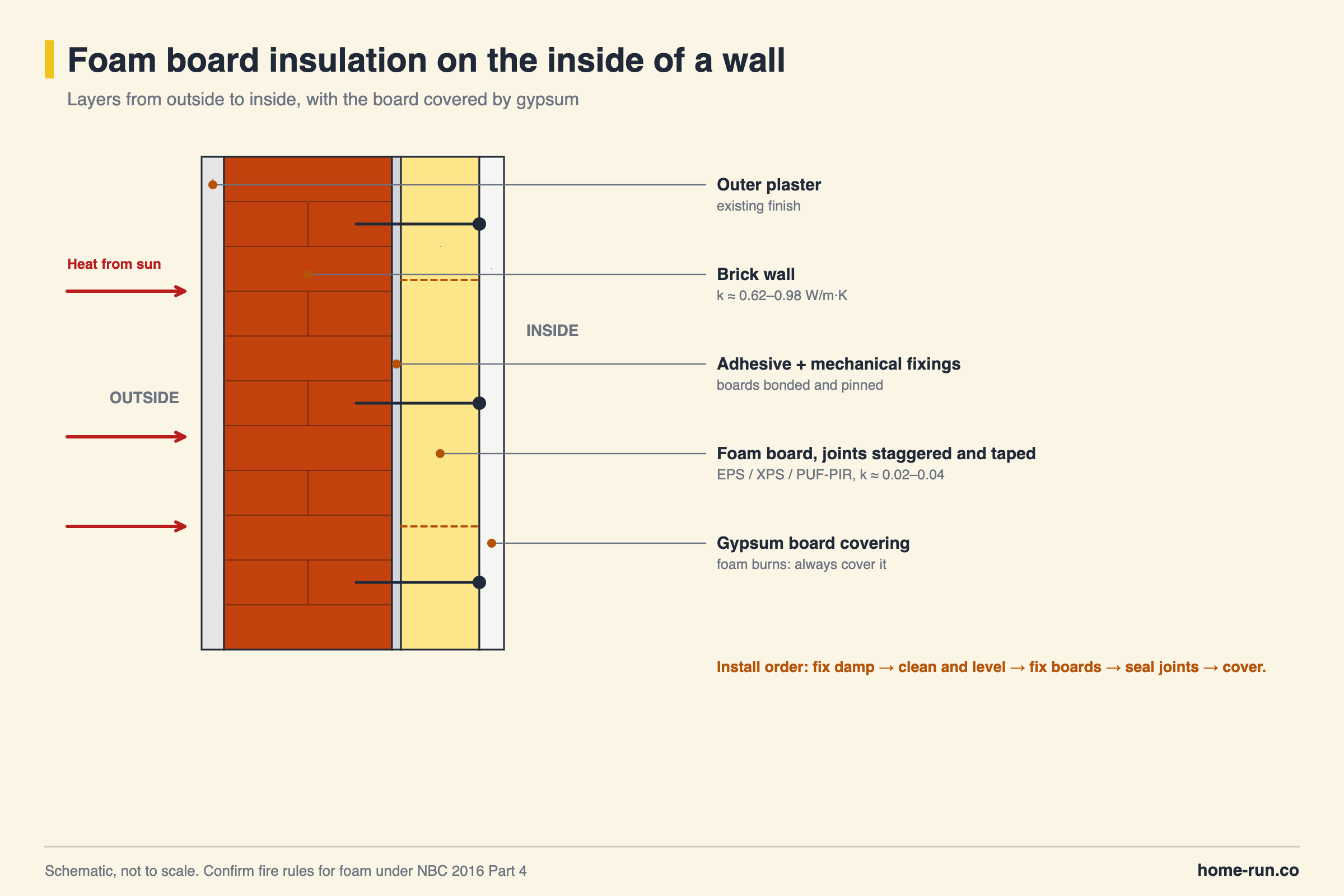
Foam burns. US codes require a thermal barrier such as 12.7 mm gypsum board over interior foam. In India, confirm fire rules under the National Building Code 2016, Part 4.
How Much Heat Does 50 mm of Foam Stop on a Brick Wall?
A 50 mm EPS layer cuts steady heat flow through a plastered 230 mm brick wall by about 75%. Add each layer's resistance (thickness ÷ k), then take U = 1 ÷ total.
This is a steady-state estimate; brick also stores heat and releases it after sunset. Brick k is the Eco-Niwas Samhita 1,760 kg/m³ value. Confirm board sizes with your supplier.
What Should You Check Before Installing?
Check that the wall is dry, the foam suits the spot and the finish is fire-safe.
- No leaks, efflorescence or rising damp
- Which walls get afternoon sun
- Inside or outside fixing (inside lining costs room depth)
- Datasheet with k value, density and BIS standard
- Fire-safe covering agreed with your architect
How Long Does Wall Foam Last?
Covered foam wall insulation lasts as long as its finish stays intact, because the foam itself does not rot.
What Are the Pros and Cons of Foam Insulation?
Foam insulates best per millimetre, but watch these risks:
- Combustible: unprotected foam spreads flame and smoke.
- Trapped moisture: foam over a damp wall hides and worsens the damp.
- Permanent: sprayed foam bonds to masonry.
- Cost: foam plus lining costs more than reflective paint.
- Environment: oil-based and hard to recycle.
Does a Bengaluru Home Need Wall Insulation?
Most Bengaluru homes need foam insulation only where the sun hits hardest. Eco-Niwas Samhita, the Bureau of Energy Efficiency's residential energy code, places Bengaluru in the temperate zone.
It caps heat gain through walls and windows together (RETV 15 W/m²) and roof U-value at 1.2 W/m²·K, with no separate wall U-value.
Start with the roof, then west bedroom walls. Compare quotes per m² at the same thickness.
Lining an insulated wall?
Gypsum boards, adhesives and finishes, delivered across Bengaluru.