


 Pay on Delivery
0 items
Rs. 0.00

Please enter Pincode to check delivery time & serviceability
ನಿಮ್ಮ ಕಾರ್ಟ್ಗೆ ಐಟಂ ಸೇರಿಸಲಾಗಿದೆ
 Free Delivery
on first 5 orders
Free Delivery
on first 5 orders
ಉಪಲಬ್ದವಿದೆ

ಪಿಕಪ್ ಲಭ್ಯತೆಯನ್ನು ಲೋಡ್ ಮಾಡಲು ಸಾಧ್ಯವಾಗಲಿಲ್ಲ
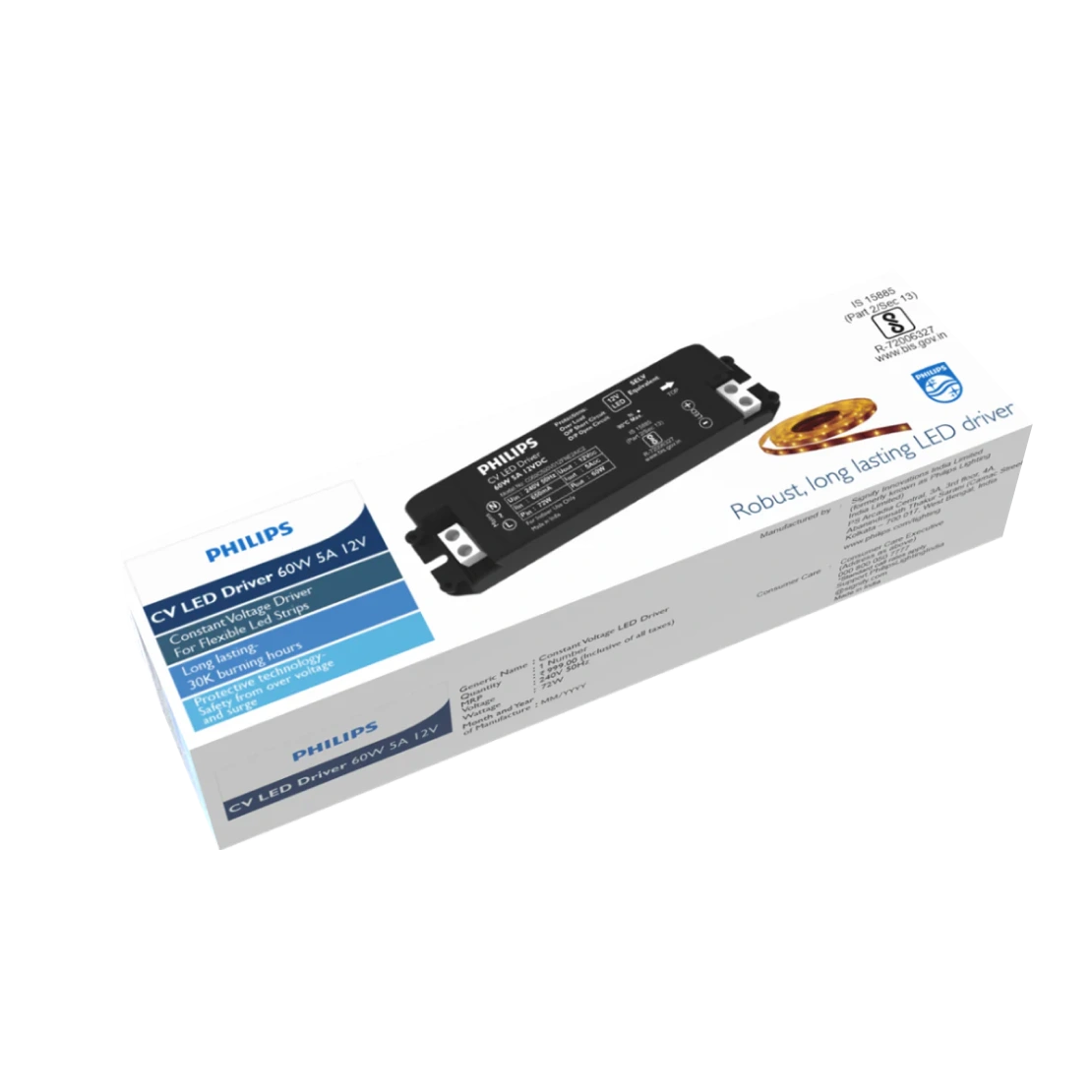
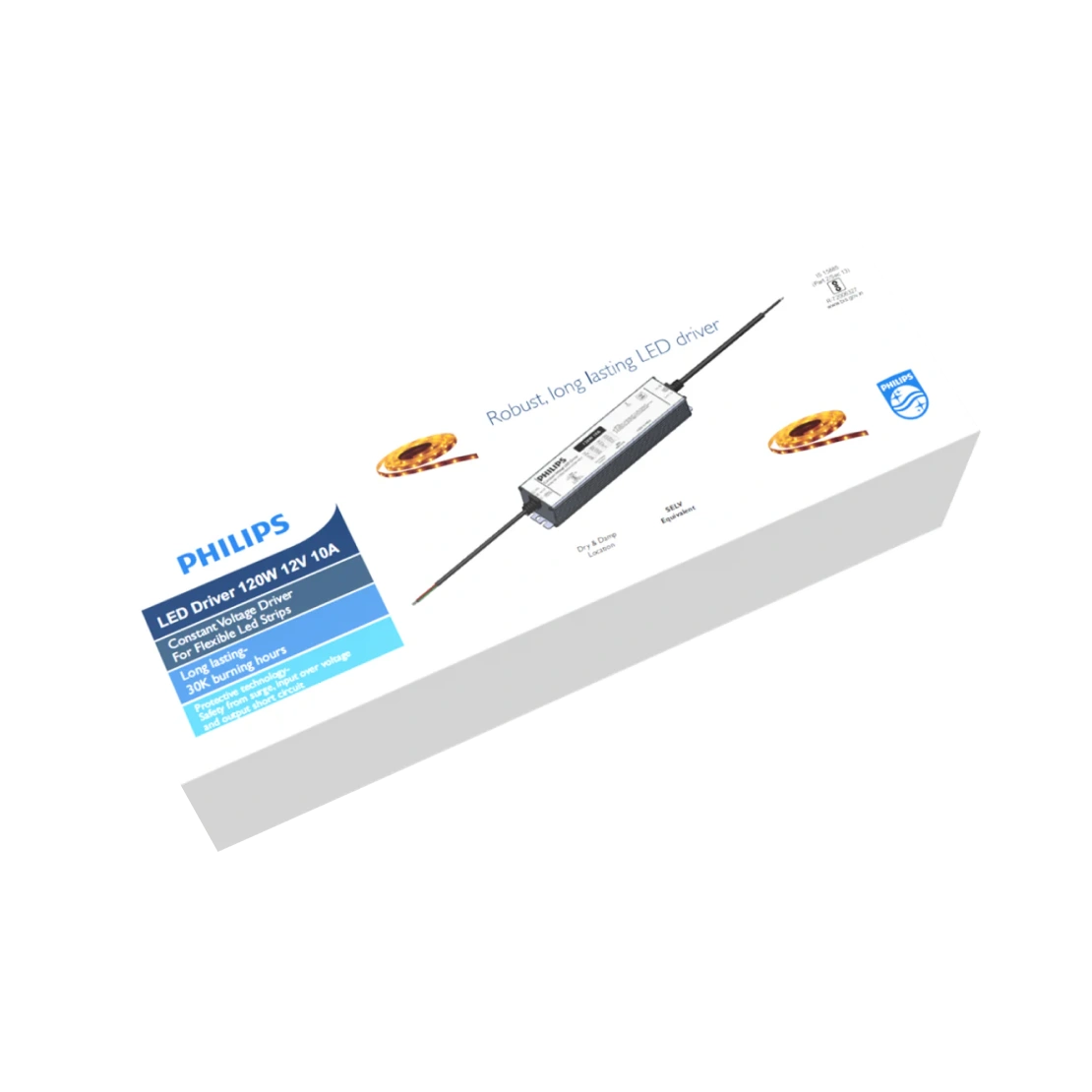
Upgrade your architectural, profile, or ambient accent lighting setups with the professional-grade Philips Constant Voltage LED Strip Light Driver. Engineered by Signify, this high-efficiency Switched-Mode Power Supply (SMPS) safely transforms fluctuating standard AC household current into ultra-stable, flicker-free 12V DC power.
Whether you are illuminating residential ceiling coves, commercial glass cabinets, or complex retail backdrop displays, these drivers guarantee uncompromised robustness, maximum energy savings, and a prolonged operational life for your delicate LED tape lights. Equipped with a slim, space-saving profile, it easily conceals within standard false ceiling gaps, valances, and wooden cabinetry.
| Technical Feature | 60W Variant | 120W Variant |
|---|---|---|
| Variant Selection | 60W (5 Amps) | 120W (10 Amps) |
| Output Voltage | 12V DC | 12V DC |
| Input Voltage Range | 220V–240V AC (Nominal) | 220V–240V AC (Nominal) |
| Input Operating Window | 140V to 300V AC (Wide-range protective) | 140V to 300V AC (Wide-range protective) |
| Rated Lifespan | ~30,000 Burning Hours | ~30,000 Burning Hours |
| Power Efficiency | High Energy Efficiency (>82%) | High Energy Efficiency (>85%) |
| Enclosure Rating | IP20 (Indoor potted application) | IP20 (Indoor potted application) |
| Housing Material | Heat-Resistant Durable Polycarbonate / Metal | Heat-Resistant Durable Polycarbonate / Metal |
| Dimming Support | Non-Dimmable (Fixed output) | Non-Dimmable (Fixed output) |
To ensure a safe, long-lasting installation, we highly recommend following the 80% Power Load Rule — never run the driver at maximum capacity continuously.
Variant 1: 60W (5A) Selection
Best Suited For: Small to mid-scale accent setups.
LED Strip Compatibility Examples:
Ideal Applications: TV back panels, kitchen under-cabinets, small wardrobe drawers, and floating vanity mirrors.
Variant 2: 120W (10A) Selection
Best Suited For: Large-scale residential coves and heavy-duty commercial projects.
LED Strip Compatibility Examples:
Ideal Applications: Main false-ceiling living room coves, entire office linear profile lighting, storefront perimeter borders, and restaurant bar counter setups.
Both variants output a fixed 12V DC — the choice is based on your total LED strip load, not voltage. Following the 80% Power Load Rule: the 60W (5A) variant suits up to 5 metres of heavy-density strip (12W/m) or up to 10 metres of low-power accent strip (5–6W/m) — ideal for TV panels, under-cabinet lighting, and vanity mirrors. The 120W (10A) variant suits up to 10 metres of high-density strip (10–12W/m) or up to 20 metres of lower-wattage runs (5W/m) — ideal for living room coves, office lighting, and storefront borders.
No, both variants are non-dimmable with a fixed 12V DC output. If you need dimming control, you will need a separate dimmable driver and compatible dimmer switch.
Yes — the driver is SELV (Safety Extra-Low Voltage) compliant and BIS approved under IS 15885, meeting Indian safety standards for indoor electrical equipment. It also carries an IP20 enclosure rating, meaning it is suitable for indoor, dry, potted applications only — not for exposed outdoor or wet locations.
The driver has a wide input operating window of 140V to 300V AC, giving it protective tolerance against voltage fluctuations common on Indian mains supply, well beyond its nominal 220–240V AC rating. It also includes built-in protection against short circuits, overload, over-voltage, and over-heating, automatically shutting down to prevent damage under fault conditions.
Both variants carry a rated lifespan of approximately 30,000 burning hours. Actual lifespan depends on correct sizing (following the 80% Power Load Rule), adequate ventilation, and installation in a dry, indoor location within the rated operating conditions.
0 items
Rs. 0.00
