


 Pay on Delivery
0 items
Rs. 0.00

Please enter Pincode to check delivery time & serviceability
ನಿಮ್ಮ ಕಾರ್ಟ್ಗೆ ಐಟಂ ಸೇರಿಸಲಾಗಿದೆ

 Free Delivery
above ₹1000
Free Delivery
above ₹1000
ಉಪಲಬ್ದವಿದೆ

ಪಿಕಪ್ ಲಭ್ಯತೆಯನ್ನು ಲೋಡ್ ಮಾಡಲು ಸಾಧ್ಯವಾಗಲಿಲ್ಲ
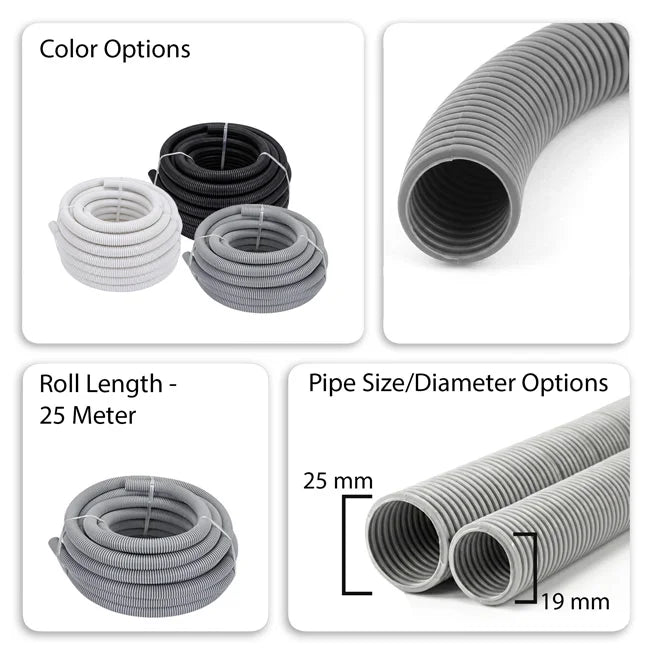
Flexible PVC Electrical Conduit Pipe protects and routes electrical wires along walls, ceilings, and floors. Unlike rigid conduit which needs elbow fittings at every bend, it bends around corners by hand - faster to install on complex routes and in renovation work. Available in 19mm and 25mm inner diameters, each in 25-metre rolls.
Secure the tube with conduit clips at 300-500mm intervals, then pull wires through. Use appropriate connectors at junction box entry and termination points for a complete installation.
| Specification | Details |
|---|---|
| Material | PVC (Polyvinyl Chloride) |
| Variants | 19mm and 25mm inner diameter, available in Black, White, and Grey |
| Roll Length | 25 metres per roll (82 ft) |
| Application | Indoor electrical wire protection and routing |
| Size | Best For |
|---|---|
| 19mm | Light point wiring, single circuits, 2-3 cables - suited for residential room circuits and light commercial runs |
| 25mm | Higher cable count, thicker cables, or runs where future additions are expected - residential, commercial, and industrial wiring |
Rigid conduit holds its shape and requires elbow fittings at every change of direction - it is faster to install on straight runs but needs careful planning and more fittings for complex routes. Flexible conduit bends by hand around corners and obstacles without any additional fittings - it is slower to lay on long straight runs but significantly faster in renovation work, complex routes, and anywhere the path changes direction frequently. Many installations use both: rigid conduit for long straight runs and flexible conduit at bends, entry points, and connections to equipment.
Choose based on how many cables you need to route and their combined diameter. The 19mm tube suits 2-3 standard cables for light point wiring and single circuits. The 25mm tube suits higher cable counts, thicker cables (such as 4mm or 6mm power cables), or runs where future cable additions are likely. In both cases, keep the total cable fill below 40% of the tube's cross-section - if your cable bundle fills more than that, move up to the larger size.
This standard flexible PVC electrical conduit pipe is rated for indoor use. For outdoor or underground applications, use conduit specifically rated for those conditions - UV-stabilised conduit for exposed outdoor use, and heavy-duty rigid or armoured conduit for underground burial. Using standard indoor-rated PVC conduit outdoors or underground will cause it to degrade prematurely and compromise the protection of the cables inside.
Use a fish tape or pull wire - insert it from one end of the tube, navigate it through to the exit point, attach the cables securely to the pull end, and draw them back through. For long or complex runs with multiple bends, apply a small amount of cable-pulling lubricant to reduce friction and prevent insulation damage during the pull. Secure the tube fully with clips before pulling wires - an unsecured tube will move and kink during the pull.
Use PVC conduit clips or saddle clamps fixed to the wall or ceiling at intervals of 300-500mm. Closer spacing (300mm) is recommended on vertical runs and anywhere the tube is likely to sag under its own weight or the weight of cables inside. At corners and bends, add a clip close to each side of the bend to hold the curve shape. For embedded installations in walls or floors, the surrounding plaster or screed holds the tube in position without clips.


0 items
Rs. 0.00
