


On this page
- What Is an Indemnity Bond and What Does It Do?
- Who Are the Parties to an Indemnity Bond?
- When Do You Need an Indemnity Bond?
- Is Stamp Paper Required for an Indemnity Bond?
- What Should an Indemnity Bond Format Include?
- How Do You Get an Indemnity Bond Executed?
- What Is the Difference Between an Indemnity Bond and an Affidavit?
- Can an Indemnity Bond Be Challenged?
- An indemnity bond is a written, stamped promise to compensate someone for a loss from a stated event.
- It is defined by Section 124 of the Indian Contract Act, 1872.
- Stamp duty is set state by state; Karnataka revised its rates in February 2024.
- Notarisation is not a legal requirement, but many banks and authorities insist on it.
- Use the institution's own format and match every detail to your ID documents.
An indemnity bond is a written, stamped promise by one person to compensate another for any loss that arises from a stated event. In India it is most often asked for when you need a duplicate of a lost document, such as a share certificate, property paper or bank instrument. The issuer wants protection in case the original resurfaces and is misused.
This guide covers the legal basis, the parties, when you need one, stamp paper rules, a clause-by-clause format, and how to get it executed.
What Is an Indemnity Bond and What Does It Do?
An indemnity bond is a contract of indemnity put in writing on stamp paper. Section 124 of the Indian Contract Act, 1872 defines a contract of indemnity as one where a party promises to save the other from loss caused by the promisor's own conduct or by any other person.
Here is a common example. You lose an original share certificate and ask the company for a duplicate. The company asks you to sign an indemnity bond, so that if someone later uses the old certificate, you, not the company, bear the loss.
Institutions ask for an indemnity bond because it shifts the risk of their decision onto the person asking for the favour.
Who Are the Parties to an Indemnity Bond?
An indemnity bond has two main parties, and sometimes a third:
- Indemnifier: the person who gives the promise and pays if a loss occurs. Usually the person who lost the document.
- Indemnified party (indemnity-holder): the bank, company, utility or authority protected by the promise.
- Surety: a third person who guarantees the indemnifier's promise. Some institutions require one or two sureties for high-value claims.
When Do You Need an Indemnity Bond?
You need an indemnity bond when an institution agrees to act without a document or confirmation it would normally require. Common situations include:
- Lost share certificates and IEPF claims: before a company or the Investor Education and Protection Fund Authority issues duplicates or refunds shares.
- Lost property or bank documents: duplicate fixed deposit receipts, lost cheques or title-related paperwork.
- Home loans and property deals: lenders may ask for one where a title document is missing or a transfer is pending.
- Utility connections: electricity or water connections, for example with BESCOM, where ownership papers are incomplete.
- Claims on a deceased person's assets: where a legal heir claims funds without a full succession document.
Banks, registrars, IEPF and utilities often prescribe their own format, stamp value and number of sureties. Get their exact requirement in writing before you buy stamp paper.
Is Stamp Paper Required for an Indemnity Bond?
Yes, an indemnity bond must be stamped. The duty is set by the Indian Stamp Act, 1899, as amended by each state, so the amount differs between states and can depend on the bond's value.
- State rules apply: the Indian Stamp Act lists the indemnity bond in Schedule I, and each state sets its own rate. Karnataka follows the Karnataka Stamp Act, 1957, whose rates were revised by an amendment notified in February 2024.
- ₹100 and ₹500 stamp paper: you will often see bonds "on ₹100" or "on ₹500 stamp paper". That is the denomination a particular state or institution requires, not a national rule.
- E-stamp or judicial stamp paper: most states, including Karnataka, now issue e-stamp certificates through authorised centres.
An under-stamped document cannot be used as evidence until the shortfall and a penalty are paid, under Section 35 of the Indian Stamp Act and the matching state provisions. A bond on old Karnataka rates executed after February 2024 may be under-stamped. Confirm the current duty with the stamp vendor or the Karnataka Department of Stamps and Registration.
What Should an Indemnity Bond Format Include?
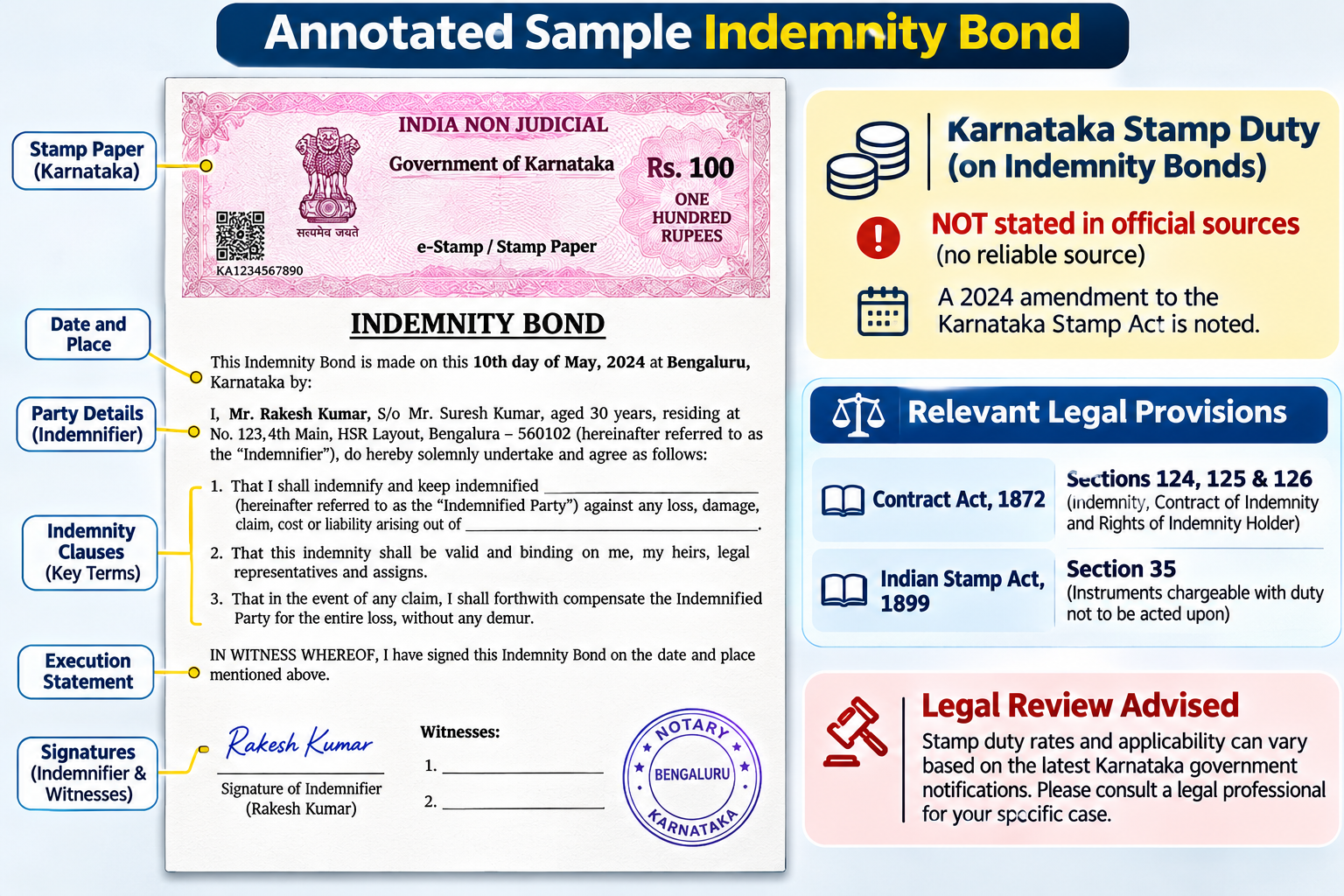
An indemnity bond format includes the parties, the facts, the promise to compensate and the signatures, in a fixed order. A typical bond has these clauses:
- Title and date: "Indemnity Bond", with the place and date of execution.
- Indemnifier's details: full name, parent's or spouse's name, age, address and ID number.
- Indemnified party: name and address of the bank, company or authority.
- Recitals: what happened, for example the lost certificate's number and how it was lost, with any police report reference.
- The request: what the indemnifier is asking for, such as a duplicate certificate.
- Undertaking to indemnify: the promise to compensate the indemnified party for any loss, cost or claim arising from the request.
- Amount or scope: the value of the bond or the limit of liability, if the institution requires one.
- Declaration: that the facts stated are true.
- Signatures: the indemnifier, any sureties and two witnesses, with names and addresses.
Common mistakes in filled indemnity bonds
- Blank fields left to be "filled later"
- Names or addresses that differ from the PAN or Aadhaar card
- Wrong stamp value for the state where it is signed
- Certificate or account numbers copied incorrectly
- Missing witness details or surety signatures
How Do You Get an Indemnity Bond Executed?
You get an indemnity bond executed in six steps:
- Confirm the requirement: format, stamp value, sureties and notarisation, from the institution.
- Buy the stamp paper: an e-stamp certificate of the right value, in the indemnifier's name.
- Draft or fill the bond: use the institution's format, or have an advocate or document writer draft it.
- Sign before witnesses: the indemnifier and any sureties sign in front of two witnesses.
- Notarise, if asked: a notary public attests the signatures.
- Submit with supporting papers: ID and address proof, the police report for lost documents, and any other form the institution lists.
Is an indemnity bond valid without a notary? The Indian Contract Act does not require notarisation for a contract of indemnity. Many banks, registrars and authorities still insist on it, so follow the institution's rule.
What Is the Difference Between an Indemnity Bond and an Affidavit?
An affidavit is a sworn statement of facts, while an indemnity bond is a promise to compensate for loss. For a lost document, institutions often ask for both: an affidavit stating how it was lost, and a bond covering the risk of issuing a duplicate.
Indemnity bond vs related documents
Who bears the risk| Document | What it does | Who bears the risk |
|---|---|---|
| Indemnity bond | Promise to compensate for a future loss | Indemnifier |
| Affidavit | Sworn statement of facts | Deponent, for false statements |
| Surety bond or guarantee | Third person backs another's obligation (Contract Act, Section 126) | Surety, if the principal defaults |
| Bank guarantee | Bank promises payment on a borrower's default | Bank, then the borrower |
Can an Indemnity Bond Be Challenged?
Yes. An indemnity bond is enforceable as a contract, so it can be challenged on the usual contract grounds:
- No free consent, such as coercion or misrepresentation
- Fraud by either party
- An unlawful object or consideration
- Improper stamping, until the duty and penalty are paid
Under Section 125 of the Contract Act, the indemnified party can recover damages, costs and sums paid in a settlement from the indemnifier. If the indemnifier cannot pay, the indemnified party can pursue any surety named in the bond.
An indemnity bond is a promise to pay for a risk you ask someone else to take. Sign it as carefully as a loan.
HomeRun Editorial Desk
This article is general information, not legal advice. For a specific transaction, consult an advocate.
Building after the paperwork is done?
Cement, steel, bricks and plumbing materials for your new home, delivered across Bengaluru. Genuine stock, GST invoice.