On this page
- What Is a Land Conversion Certificate and Why Is It Important?
- Does Your Property Need a Land Conversion Certificate?
- What Are the New Rules for Land Conversion in Karnataka?
- How Do You Get a Land Conversion Certificate Online in Karnataka?
- What Documents Are Required for Land Conversion in Karnataka?
- How Much Does a Land Conversion Certificate Cost in Karnataka?
- What Mistakes Should You Avoid During Land Conversion?
- How Does Land Conversion Affect Property Tax?
- What Should You Do After the Conversion Order Is Issued?
- A land conversion certificate is the official order that lets agricultural land be used for a non-agricultural purpose such as a house, layout or shop.
- In Karnataka, it is issued under Section 95 of the Karnataka Land Revenue Act, 1964, and is often called a DC conversion.
- Since the 2025 rule changes, land inside an approved master plan is converted through the planning authority, without a separate DC order.
- Outside master plans, the DC has 30 days to decide on an affidavit-based application before deemed conversion applies.
- Rules, fees and timelines change often. Confirm with the Tahsildar or DC office before you pay or file.
A land conversion certificate is the government order that changes the permitted use of a plot from agricultural to non-agricultural, so you can legally build a house, a layout or a commercial building on it. Without it, banks rarely lend, plans are not sanctioned and the property is hard to sell.
This guide covers the Karnataka process in detail. For the records you will file with it, see our guides to land survey records and what a title deed is.
What Is a Land Conversion Certificate and Why Is It Important?
A land conversion certificate, also called a conversion order or NA (non-agricultural) order, is the revenue authority's written permission to use agricultural land for another purpose. In Karnataka, it is commonly called a DC conversion because the Deputy Commissioner of the district traditionally grants it.
The certificate matters at three points in a property's life:
- Building approval: local bodies and planning authorities need proof that the land use permits construction.
- Home loans: lenders check conversion before funding a plot or house on former farmland.
- Sale and khata: buyers, sub-registrars and local bodies look for the order before treating a plot as a residential site.
A conversion order changes how land may be used. It does not prove who owns it. Check title separately through the sale deed, encumbrance certificate and RTC before you buy a converted plot.
Does Your Property Need a Land Conversion Certificate?
Your property needs a land conversion certificate if its revenue record still shows it as agricultural land and you plan to build, sell plots or run a business on it. Land already inside an approved layout, with a valid khata from a local body, has usually been converted earlier.
How to check if land is DC converted
- Download the current RTC (Record of Rights, Tenancy and Crops, also called pahani) from Bhoomi and check whether it records the land as converted.
- Ask the seller for the conversion order number and date, and verify the order on the Karnataka land conversion portal.
- Check the master plan land use for the survey number with the local planning authority.
- Look for a khata or e-khata from the city corporation, municipality or gram panchayat.
- Read the encumbrance certificate for any earlier conversion or cancellation entries.
What Are the New Rules for Land Conversion in Karnataka?
The new rules split land conversion in Karnataka into two routes: planning-authority conversion inside approved master plans and affidavit-based DC conversion everywhere else. They come from amendments to Section 95(2) of the Karnataka Land Revenue Act and new Rules 106B to 106F of the Karnataka Land Revenue Rules.
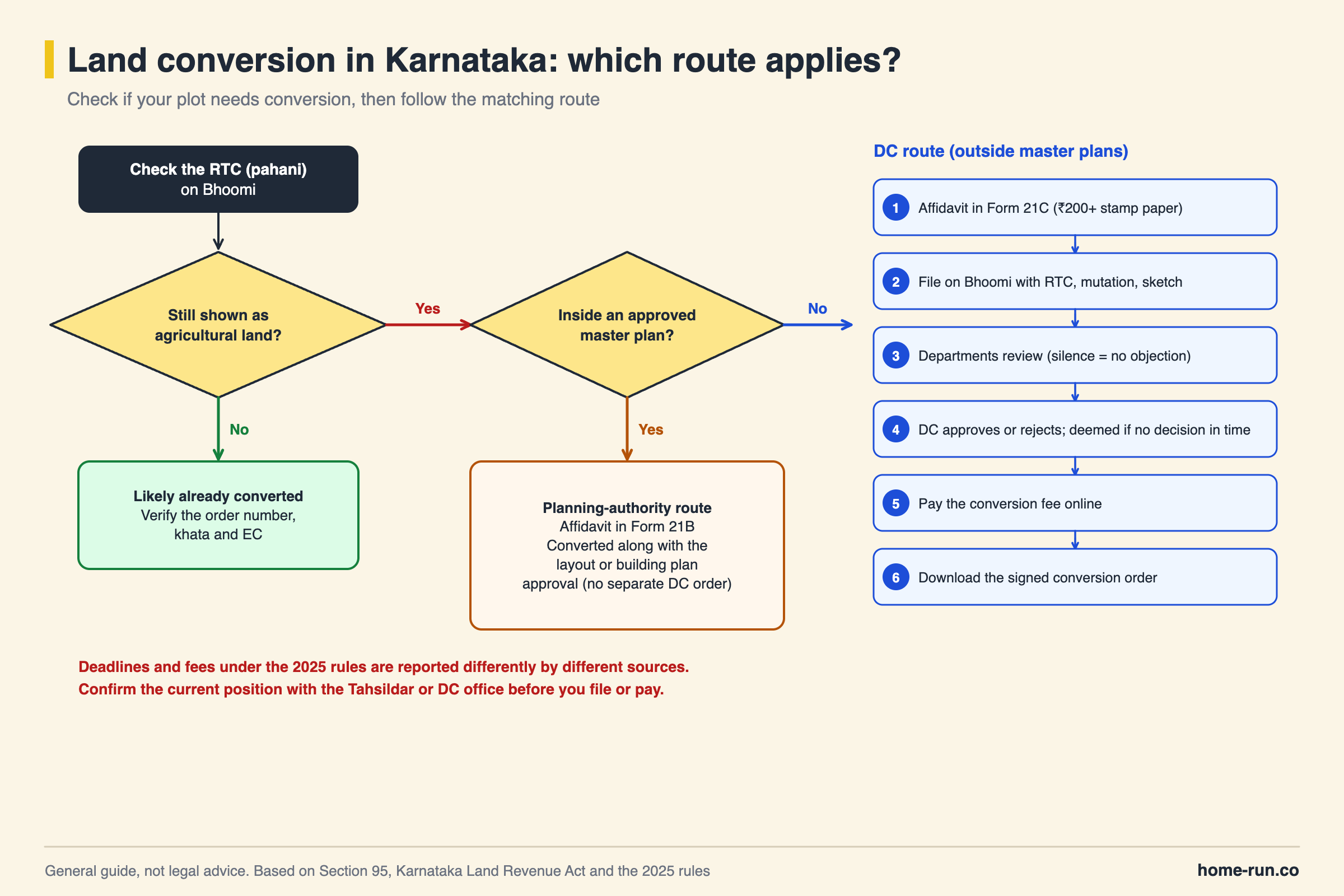
Inside an approved master plan
Bengaluru, cities- No separate DC permission if your use matches the zoning
- Fee under Section 95(7) paid to the planning authority
- Filed with the layout or building plan application
- Form 21B affidavit is mandatory
Outside master plan limits
Rural land- Online application to the Deputy Commissioner
- Departments give opinions within 15 days
- Deemed conversion if the DC misses the deadline
- Form 21C affidavit is mandatory
An Urban Development Department circular dated 18 February 2026 told planning authorities, including the Bangalore Development Authority and the Greater Bengaluru Authority, not to accept standalone conversion applications for master plan land. Conversion is processed along with the layout or plan approval.
Reports also say small industries on up to 2 acres and renewable energy projects get automatic conversion without DC approval.
One legal summary cites Gazette notification RD-LGP/6/2025 dated 17 September 2025. Others say the rules took effect on 23 December 2025. Some sources describe the DC deadline as 15 days with deemed approval after 30 days; others say 30 days, or 30 working days. Confirm the current position with the Tahsildar or DC office.
How Do You Get a Land Conversion Certificate Online in Karnataka?
You get a land conversion certificate online in Karnataka by filing an affidavit-based application with your land records, paying the fee and downloading the digitally signed order. The steps below follow the route outside master plan limits.
- Confirm the land use: check the RTC, the survey sketch and the master plan or zonal status of the survey number.
- Prepare the affidavit: Form 21C (or Form 21B for master plan land) on non-judicial stamp paper of at least ₹200, notarised.
- File online: apply through the Bhoomi land conversion service with the affidavit, RTC, mutation extract and sketch.
- Department review: the Tahsildar and other departments, such as Forest, give their opinion; silence within 15 days counts as no objection.
- DC decision: the Deputy Commissioner approves or rejects; if no decision comes in time, the file moves to your login for fee payment.
- Pay the conversion fee: pay online against the demand shown for your survey number.
- Download the order: the final conversion order is issued digitally and can be downloaded from the land conversion portal.
Application filed
Affidavit and records uploaded online.
Case worker check
The DC office case worker reviews the file.
Opinions due
Tahsildar and other departments respond, or are treated as having no objection.
Decision or deemed conversion
The DC decides; otherwise deemed conversion applies after fee payment.
These are the deadlines reported for the 2025 rules. Files with tenancy, title or land-grant issues can take longer.
What Documents Are Required for Land Conversion in Karnataka?
The documents required for a land conversion certificate in Karnataka are the affidavit, the current RTC, the mutation register extract, a survey sketch and proof of ownership. Extra papers apply to granted, tenanted or lake-side land.
Land conversion documents in Karnataka
Verify the current list with the Revenue Department| Document | Purpose | Where to get it |
|---|---|---|
| Affidavit (Form 21B or 21C) Mandatory | Declares ownership, purpose and legal compliance | Notary, ₹200+ stamp paper |
| RTC (pahani) | Shows owner, extent and current land use | Bhoomi |
| Mutation register extract | Shows how ownership changed hands | Bhoomi or Tahsildar office |
| Survey sketch (11E or pre-conversion sketch) | Marks the exact area to be converted | Survey Settlement and Land Records Department |
| Sale, partition or grant deed | Proves title | Sub-registrar office or Kaveri |
| Master plan or zonal extract | Confirms permitted land use | Local planning authority |
| NOCs If applicable | Forest, lake buffer, highway or land tribunal clearance | Concerned department |
How Much Does a Land Conversion Certificate Cost in Karnataka?
A land conversion certificate in Karnataka costs the conversion fee under Section 95(7), plus the affidavit and any professional charges. The Revenue Department sets the fee by location, district and end use, so residential use in rural areas pays least and commercial use near cities pays most.
Conversion fee figures quoted online
Indicative only, not an official schedule| Location | Residential (₹) | Commercial (₹) |
|---|---|---|
| Near a city corporation | 327 | 654 |
| Taluk centre | 218 | 327 |
| Rural area | 89 | 218 |
Land conversion fees in Tamil Nadu, Andhra Pradesh, Telangana, Kerala and West Bengal follow each state's own law. Check the state revenue portal for current rates.
What Mistakes Should You Avoid During Land Conversion?
The mistakes that most often delay or void a land conversion are mismatched records, wrong land use and building before the order is issued. Watch for these red flags.
- The name or extent on the RTC does not match the sale deed or sketch.
- The intended use, such as commercial, conflicts with master plan zoning.
- Construction starts before the conversion order is issued.
- The seller shows a paper order that cannot be verified on the portal.
- Granted, tenanted or lake-buffer land is filed without the required NOC.
- Converted land is used for a different purpose than the one approved.
Misuse can lead to cancellation, forfeiture of fees and fines. Reports on the 2025 rules cite fines of up to ₹1 lakh plus ₹2,500 per day for continuing violations, recorded as an encumbrance on the RTC.
How Does Land Conversion Affect Property Tax?
Land conversion moves a plot from agricultural land revenue to property tax charged by the local body, which is usually higher. The city corporation, municipality or gram panchayat assesses tax once it issues a khata for the converted site.
Converted land costs more to hold each year, but it can be mortgaged, built on and sold as a residential site. Conversion can also change how income tax treats a later sale, so ask a chartered accountant before you sell.
What Should You Do After the Conversion Order Is Issued?
After the conversion order is issued, update the revenue and local body records, then apply for building approvals. Keep certified copies of the order with your title papers.
- Check that the RTC now shows the land as converted for the approved purpose.
- Apply for a khata or e-khata with the city corporation, municipality or gram panchayat.
- Get layout or building plan sanction from the planning authority.
- Obtain a commencement certificate before work starts on site.
- Build only as sanctioned, then apply for an occupancy certificate on completion.
- Download and save the digitally signed order and fee receipt.
Plot approved and ready to build?
Order foundation materials delivered across Bengaluru.
Land conversion rules in Karnataka changed in 2025 and 2026 and may change again. Confirm the current procedure, fees and timelines with the Tahsildar or Deputy Commissioner's office, or a property lawyer, before you file or buy.