On this page
- What Causes a Chipped Marble Countertop?
- What Tools and Materials Do You Need for Marble Repair?
- How Do You Fix a Chipped Marble Countertop Step by Step?
- Which Adhesive Works Best on Marble Chips?
- How Much Does Chipped Marble Repair Cost in Bengaluru?
- How Do You Stop Marble Countertops From Chipping Again?
- When Should You Call a Professional for a Chipped Marble Countertop?
- Most small chips on a marble countertop can be fixed at home with a tinted two-part stone epoxy or, for tiny nicks, CA glue.
- Clean the chip with denatured alcohol, fill it slightly proud, let it harden, then level it with a razor blade held at 45°.
- Wait about 24 hours before polishing an epoxy patch, and do not work below 10°C.
- Through-cracks, loose or shifted slabs and cracks around the sink cutout need a stone restoration professional.
- Marble is calcium carbonate, so lemon, vinegar and acidic cleaners dull it; use a neutral cleaner.
Chipped marble repair means filling the missing piece of stone with a colour-matched adhesive, then levelling and polishing it flush with the slab. On a kitchen countertop, a small chip on the edge or near the hob is usually a one-afternoon fix, plus a day of curing.
What Causes a Chipped Marble Countertop?
A marble countertop chips when a hard, sudden impact breaks off a small piece of stone, usually at an edge, a corner or a sink cutout. Marble is a relatively soft stone, so heavy vessels knocked against the edge do most of the damage.
- Impact: a pressure cooker, kadai, grinder jar or tall steel tumbler hitting the slab edge.
- Weak edges: sharp, square edge profiles and thin overhangs chip more easily than rounded or bevelled ones.
- Poor support: a slab laid on an uneven platform or with hollow spots below can crack and chip under load.
- Heat and thermal movement: hot vessels placed straight on the stone stress it locally; the Natural Stone Institute recommends trivets or mats.
Find the cause first, or the same knock will chip the patch again. Repeat chips at one spot point to a support or edge problem.
A chip is a missing piece of stone. A crack is a line or split through the stone, which may run the full slab depth. An etch is a dull, rough mark left by acid, such as lemon juice, and needs polishing, not filling.
What Tools and Materials Do You Need for Marble Repair?
For a chipped marble repair you need a stone-grade adhesive, a way to tint it, a blade to level it and fine abrasives to polish it. A ready marble repair kit bundles most of these, but contents vary, so check the list below against the kit.
- Two-part epoxy made for stone (clear or white), or thin CA (cyanoacrylate) glue with activator spray for tiny nicks
- Colour tints for stone adhesive, or fine marble dust from the same stone
- Denatured alcohol and a lint-free microfibre cloth
- Masking tape to protect the polished stone around the chip
- Mixing stick, small spatula or putty knife, and a disposable plate
- Single-edge razor blade for levelling
- Fine wet sandpaper or diamond polishing pads, plus a marble polish
- Protective gloves and safety glasses
Read the safety data sheet of your adhesive before you open it.
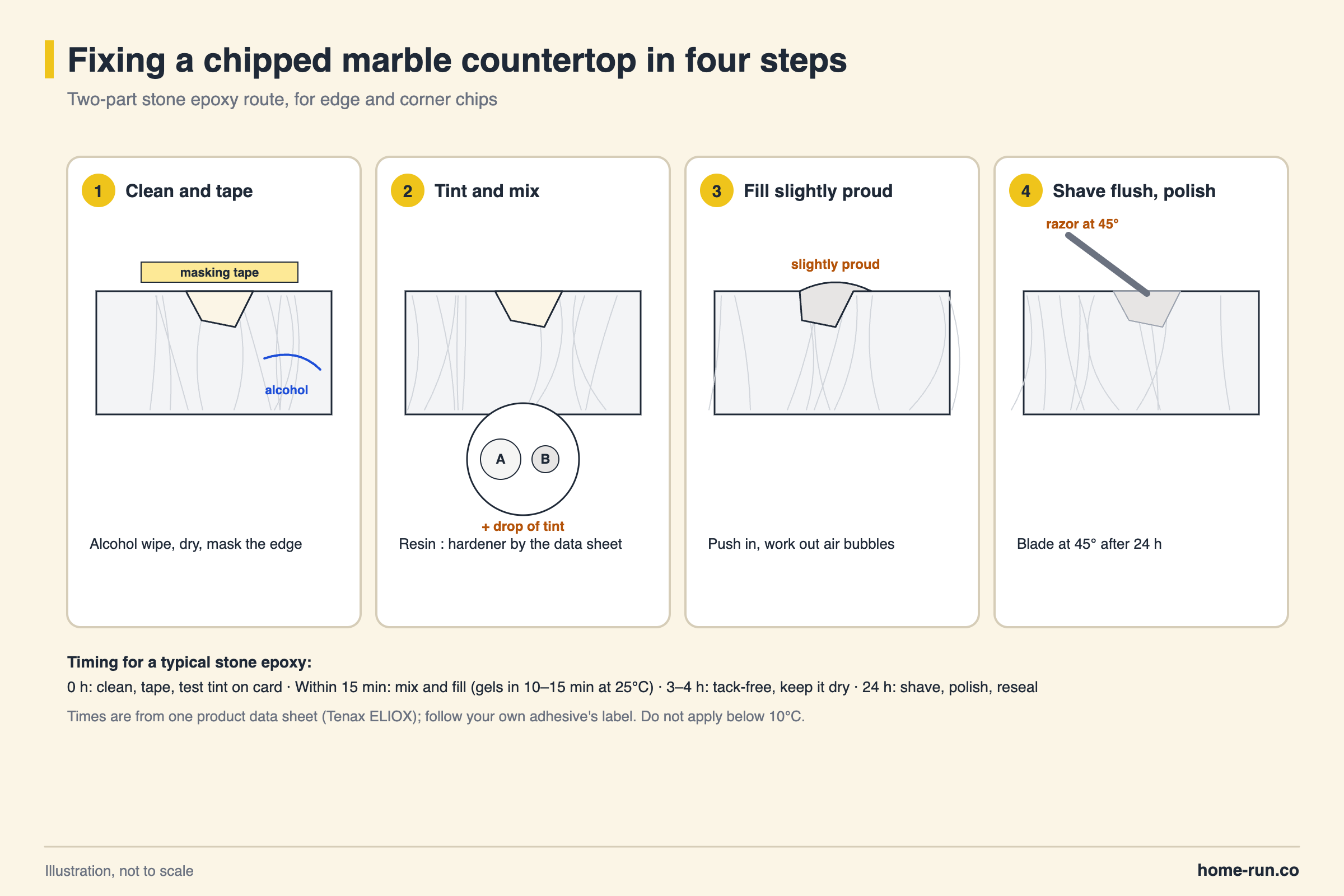
How Do You Fix a Chipped Marble Countertop Step by Step?
To fix a chipped marble countertop, clean and dry the chip, fill it with tinted stone epoxy slightly above the surface, let it harden, shave it flush with a razor blade and polish it. Each step below uses a two-part epoxy; the CA glue route follows after.
- Assess the damage. Confirm it is a chip and not a crack running through the slab. If the broken piece is intact, keep it; you can glue it back with clear stone epoxy instead of filling.
- Clean and dry the chip. Brush out loose fragments, then wipe with denatured alcohol on a microfibre cloth. The chip must be dry, dust-free and grease-free, which matters in a kitchen with cooking oil in the air.
- Protect the surround. Run masking tape around the chip so the blade and pads touch only the patch.
- Colour-match the filler. Add tint to the resin part in very small amounts, mixing for 20–30 seconds each time, and test on scrap card. The US General Services Administration's method mixes ground marble dust from the same stone into the epoxy instead.
- Mix the two parts. Use the ratio on the data sheet. Tenax ELIOX A+B, for example, uses 100 parts resin to 50 parts hardener by weight. Mix only what you can use, because this epoxy gels in 10–15 minutes at 25°C.
- Fill the chip. Push the mix in with the stick, working it back and forth to remove air bubbles. Leave it slightly proud of the surface.
- Let it cure. ELIOX becomes tack-free in about 3–3.5 hours at 25°C, and its data sheet allows 24 hours before cutting or polishing. Do not apply it below 10°C.
- Level the patch. Hold a clean razor blade at 45° and shave the excess until the patch is flush. Finish with fine wet sandpaper or polishing pads, staying on the patch.
- Polish and seal. Remove the tape, polish the area with marble polish and buff with a microfibre cloth. Reapply sealer to the spot if the countertop was sealed.
For a pinhead nick or a fine scratch, CA glue is faster. Overfill the nick with thin CA glue, spray the activator 3–4 times from about 10–15 cm away and wait 1–2 minutes until it hardens. Then scrape it level with a razor blade and buff it with polish.
Clean, tape and tint
Alcohol wipe, masking tape, colour test on card.
Mix and fill
Work fast; stone epoxy gels in 10–15 minutes at 25°C.
Tack-free
Keep the area dry and untouched; no cooking on it.
Level and polish
After 24 hours, shave flush, polish and reseal.
Which Adhesive Works Best on Marble Chips?
A two-part epoxy made for stone is the best all-round adhesive for chipped marble repair, because it fills depth, bonds strongly and can be tinted. CA glue suits only shallow nicks and scratches.
Two-part stone epoxy
Most chipsPoints
- Fills deeper chips and re-bonds broken edge pieces
- Tenax ELIOX lists 12 MPa adhesion on marble after 24 hours
- Takes tints or marble dust for colour matching
- Needs weighing, mixing and a day of curing
CA (super) glue
Tiny nicksPoints
- Thin liquid that flows into pinholes and fine scratches
- Hardens in about 1–2 minutes with activator spray
- Too runny to build up a deep or edge chip
- Clear, so it shows the dark base of a deep chip
Marble repair fillers compared
Pick by chip size and location| Filler | Best for | Sets in | Watch out |
|---|---|---|---|
| Two-part stone epoxy Default pick | Edge and corner chips, glued-back pieces | Tack-free in 3–3.5 h; polish after 24 h | Weigh both parts; no curing below 10°C |
| CA glue + activator Quick fix | Pinholes, fine scratches, tiny nicks | 1–2 min with activator | Cannot fill depth; low colour control |
White Indian marble is usually repaired with clear epoxy plus white tint. Darker or veined stone needs tints mixed to the background colour. Check whether your slab is really marble first; our granite kitchen slab design guide compares granite, quartz and marble.
How Much Does Chipped Marble Repair Cost in Bengaluru?
A DIY chipped marble repair costs only the price of a small epoxy or CA glue kit. A professional visit in Bengaluru is priced by area and inspection; HomeTriangle lists marble restoration from ₹50 per sq ft (checked November 2026).
Marble service starting rates in Bengaluru
Starting prices; final quote after inspection| Service | From (₹ per sq ft) |
|---|---|
| Basic marble care | 20 |
| Indian marble polishing | 30 |
| Advanced restoration (grinding damaged marble) | 50 |
| Italian marble polishing | 60 |
Buy one small two-part stone epoxy and a white tint instead of a large kit. Save offcuts from the original slab or ask your stone supplier for one; ground offcut dust gives the closest colour match.
Fixing a kitchen slab this week?
Adhesives, tools and hardware delivered across Bengaluru.
How Do You Stop Marble Countertops From Chipping Again?
You stop marble chipping by protecting the edges from impact, keeping hot vessels and acids off the stone, and cleaning only with neutral products.
Set heavy vessels down, never slide or knock them onto the edge. Use a trivet for anything straight off the flame, and a chopping board for cutting.
- Clean with a neutral cleaner, stone soap or mild dishwashing liquid and warm water
- Keep lemon, vinegar, tamarind and tomato off the stone; wipe spills at once
- Use coasters under glasses, especially citrus drinks
- Avoid scouring powders, which scratch marble
- Reseal as your sealer's label says; sealing makes stone stain resistant, not stain proof
- Ask for a rounded or bevelled edge profile when replacing a slab
Marble is calcium carbonate, which the Natural Stone Institute warns is sensitive to acidic solutions. Our kitchen slab design and planning guide covers edge profiles, thickness and support for a new countertop.
When Should You Call a Professional for a Chipped Marble Countertop?
Call a stone restoration professional when the damage is structural, large or in a spot where a visible patch would bother you. The Natural Stone Institute advises that deeper nicks be repaired and repolished by a professional.
- A crack running through the slab, or wider than about 3 mm
- A hole or missing piece larger than about 50 mm across
- Slabs that have shifted apart at a joint, or cracks around the sink cutout
- A slab that rocks, sounds hollow or sits on a damaged platform
- Many chips, or etching across a large area that needs repolishing
Even a skilled repair may not be fully invisible. Share photos before a site visit for a more accurate quote.