On this page
- What Are Vastu Plants for Home and Why Do They Matter?
- Which Plants Are Good for Home According to Vastu?
- Where Should You Place Vastu Plants for Home?
- Which Plants Are Not Good for Home as per Vastu?
- Should Vastu Plants Go Indoors or Outdoors?
- How Do You Care for Vastu Plants?
- How Do You Start Adding Vastu Plants at Home?
- The most common Vastu plants for home are tulsi, money plant, jade, lucky bamboo, snake plant, areca palm and aloe vera.
- Vastu guidance puts tulsi in the north-east and money and jade plants in the south-east.
- It keeps cactus, thorny plants, bonsai and dead plants out of the house.
- Vastu sources disagree on some directions, so treat them as tradition, not fixed rules.
Vastu plants for home are plants that Vastu Shastra, the traditional Indian system of building layout, links with good energy, health or prosperity. Tulsi, money plant and jade top most lists.
These placements are traditional beliefs, not proven effects. Below: what Vastu sources say, where they disagree, and how to keep each plant alive.
What Are Vastu Plants for Home and Why Do They Matter?
Vastu plants are species that Vastu practitioners recommend for particular directions of a house. Each direction carries an element and a purpose, and the right plant is believed to support it.
Tulsi holds a special place because of its role in Hindu worship.
Vastu effects on luck or money are matters of faith. "Air-purifying" claims are weak too: a 2019 Drexel University review of 12 studies found potted plants clean air far more slowly than normal ventilation.
For the wider rules on room directions, see our guide to Vastu for home. For the full direction grid, use the Vastu Shastra chart.
Which Plants Are Good for Home According to Vastu?
The plants most Vastu sources call good for home are tulsi, money plant, jade, lucky bamboo, snake plant, areca palm and aloe vera.
Best Vastu plants for home and their suggested directions
Traditional guidance; pet safety from ASPCA and Clemson HGIC| Plant | Vastu association | Suggested direction | Safe for pets? |
|---|---|---|---|
| Tulsi (holy basil) Most favoured | Purity, worship | North-east, north or east | No data in our sources |
| Money plant (pothos) | Wealth | South-east | No, toxic |
| Jade plant | Cash flow, luck | South-east or east | No, toxic |
| Lucky bamboo | Luck, growth | East or south-east | No, a toxic dracaena |
| Snake plant | Protection | South-east, east or south | No, toxic |
| Areca palm Pet friendly | Calm, freshness | East or south-east | Yes, ASPCA non-toxic list |
| Aloe vera | Health | Not fixed | No, toxic |
| Banana (garden) | Health, peace | North-east of the garden | Not covered |
| Neem (garden) | Purifying | North-west of the garden | Not covered |
Money plant and jade plant are the usual answers to "which Vastu plants attract money". Lucky bamboo is not a true bamboo; it is a dracaena.
Where Should You Place Vastu Plants for Home?
Vastu guidance places small, light plants in the north, east and north-east, and heavier plants and trees in the south and west. The north-east stays open and light, with tulsi as the main exception.
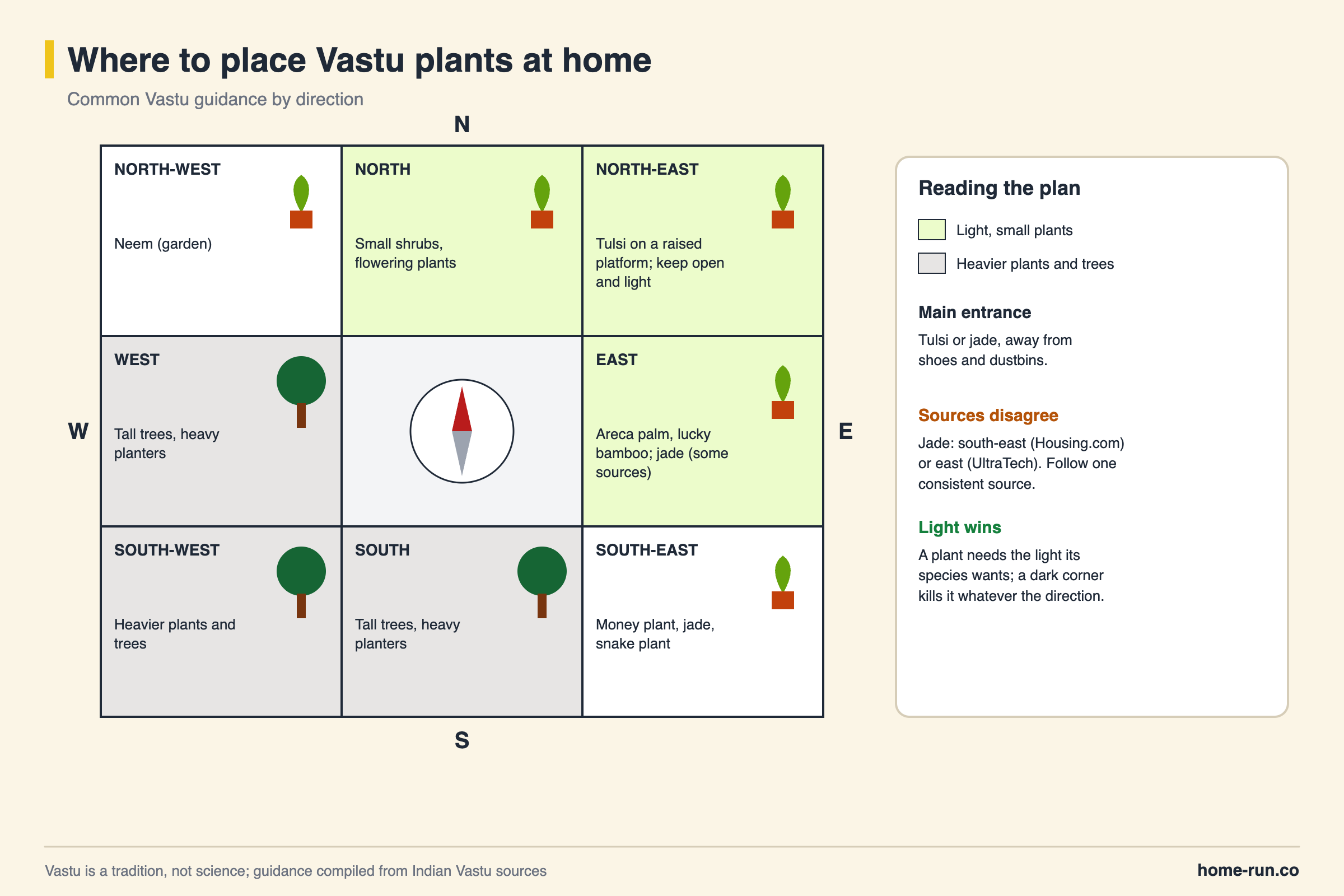
- North-east: tulsi, kept in an odd number of pots (1, 3 or 5) on a raised platform.
- East and north: small shrubs, flowering plants, areca palm and lucky bamboo.
- South-east: money plant and jade plant, often in the living room.
- South and west: tall trees and heavy planters, so the house does not lose morning light.
- Main entrance: tulsi or jade, away from shoes and dustbins.
Housing.com puts jade in the south-east; UltraTech Cement puts it in the east. Housing.com also names the north-east for banana while warning against trees in that corner. Follow one consistent source.
When a Vastu direction gets too little light, light wins. A tulsi in a dark north-east corner will die; one on an east-facing balcony will thrive.
Which Plants Are Not Good for Home as per Vastu?
Vastu guidance keeps thorny, stunted, milky-sap and dead plants out of the house. Some large trees are also kept away from the building.
- Cactus and thorny plants: linked with conflict; if kept, place them outside in the south-west.
- Bonsai: seen as a sign of stunted growth, so not kept indoors.
- Plants with milky sap: avoided indoors.
- Tamarind, myrtle and babul (acacia): avoided near the house.
- Cotton and silk-cotton trees: linked with money and health trouble.
- Dried or dead plants: removed at once.
Housing.com also advises against artificial flowers.
Should Vastu Plants Go Indoors or Outdoors?
Vastu plants work in both places: indoor plants are chosen for low light and size, outdoor plants by the plot's directions.
Indoor Vastu plants
Flats and small homesPoints
- Money plant, snake plant, peace lily, areca palm
- Tolerate filtered light near windows
- Placed by room direction: south-east, east, north
- Check pet toxicity before you buy
Outdoor Vastu plants
Independent housesPoints
- Tulsi, banana, neem, flowering shrubs
- Need direct sun for most of the day
- Tall trees go south and west, small ones north and east
- Keep large trees clear of walls and foundations
How Do You Care for Vastu Plants?
Vastu plants stay healthy when light and water match the species and every pot drains. West Virginia University Extension names improper watering as a top cause of houseplant decline.
- Tulsi: 6 or more hours of direct sun, moist but well-drained soil; it does poorly when waterlogged.
- Money plant (pothos): filtered light; soak, then let the soil dry between waterings.
- Snake plant: filtered to bright light; let the soil dry completely before watering again.
- Peace lily: handles the lowest light; keep the soil evenly moist, not soggy.
- Jade and aloe: succulents; bright light and full drying between waterings.
The ASPCA (American Society for the Prevention of Cruelty to Animals) lists golden pothos and snake plant as toxic to cats and dogs. Clemson University's HGIC adds aloe, jade, dracaena and peace lily. Areca palm is on the ASPCA non-toxic list.
Setting up a balcony garden?
Waterproofing, tiles and fittings delivered across Bengaluru.
How Do You Start Adding Vastu Plants at Home?
Start with one or two plants that suit your light, place them by Vastu direction, and add more once they settle.
- Find true north with a compass app before you assign directions.
- Check how many hours of sun each corner gets.
- Choose a pot with a drainage hole and a saucer.
- Confirm the plant is safe if you have pets or small children.
Planning other Vastu details too? See our guide to kitchen colour as per Vastu.