On this page
- What Are Fibreglass Windows?
- What Makes a Fibreglass Frame Different?
- How Does Fibreglass Compare With uPVC, Aluminium and Wood?
- What Are the Disadvantages of Fibreglass Windows?
- Are Fibreglass Windows Suitable for Indian Homes?
- What Affects the Cost in India?
- How Should You Install and Care for These Windows?
- Fibreglass windows have frames made of glass fibres set in a hard thermoset resin.
- The frame moves with heat almost exactly like the glass, so seals and glazing stay tight.
- They cost more than uPVC and aluminium and few Indian fabricators make them.
- Fibreglass suits coastal or premium builds; most Bengaluru homes do fine with uPVC or aluminium.
Fibreglass windows are windows whose frames and sashes are made of glass fibres bonded in a thermoset resin. The frames are strong, do not rot or corrode, and expand with heat almost exactly like window glass.
They are common in North America, where makers such as Marvin and Pella sell fibreglass lines, but still rare in India.
What Are Fibreglass Windows?
A fibreglass window is a window with a frame made from fibre-reinforced plastic, where glass fibres carry the load and resin holds them together. Fibreglass is a composite material: two materials combined to get properties neither has alone.
Most window frames are made by pultrusion. Continuous glass fibres are soaked in resin and pulled through a heated steel die, which sets the profile into its final shape. Frames are hollow or foam-filled, with a UV-resistant finish.
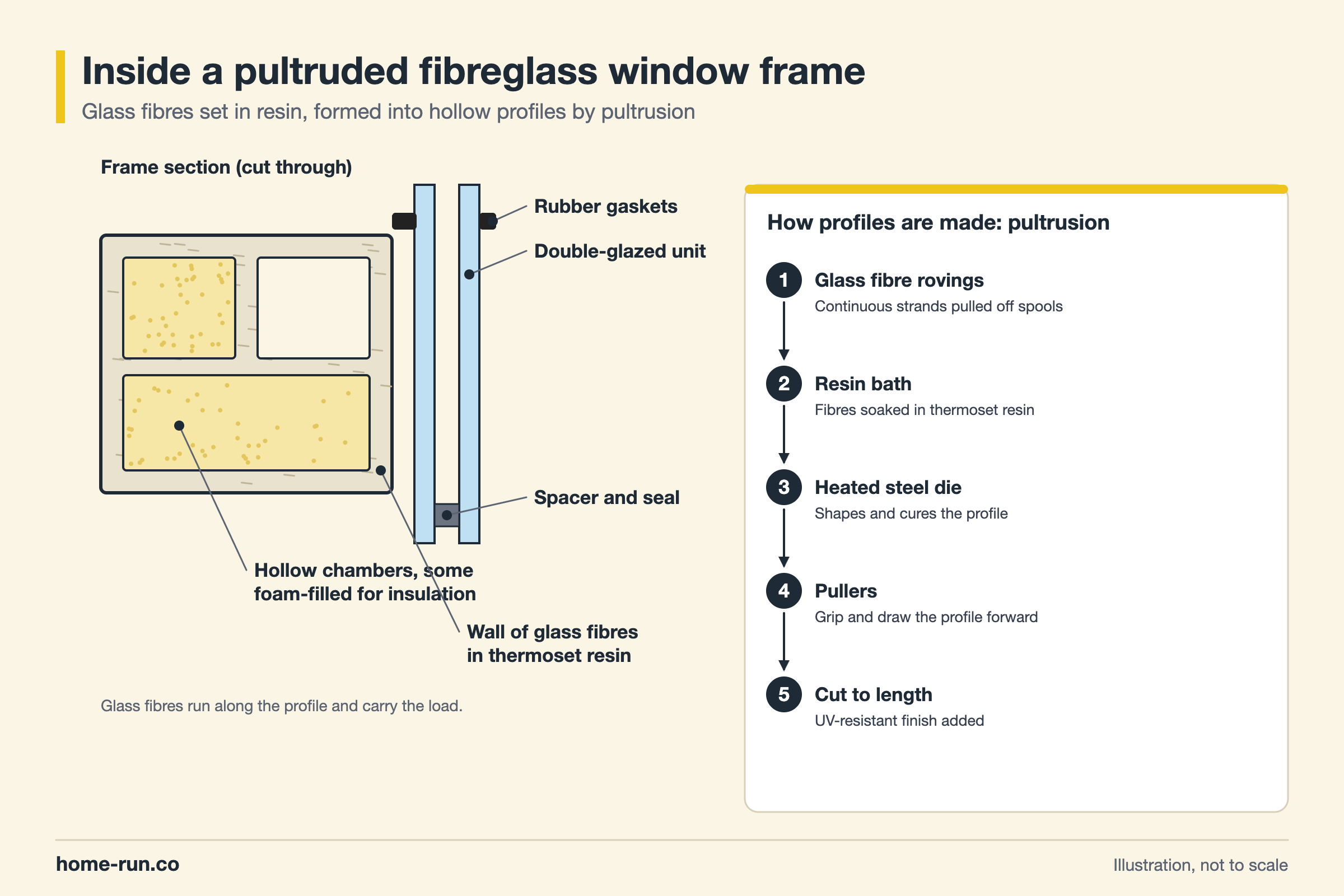
Pultruded fibreglass frames are the premium product described here. Indian listings also use the name for moulded FRP (fibre-reinforced plastic) window units, for windows fitted with fibreglass insect mesh, and for translucent FRP sheets used as roof lights. Ask which one the seller means.
What Makes a Fibreglass Frame Different?
The main features of fibreglass windows are low thermal expansion, high strength, good insulation and very low upkeep. Each one comes from the glass content of the frame.
Fibreglass window features and what they mean for you
Pultruded fibreglass frames| Feature | What it means | Why it matters |
|---|---|---|
| Low expansion Key benefit | Frame grows and shrinks about as much as glass | Less stress on seals, fewer leaks and draughts |
| Strength | Stronger than vinyl and aluminium profiles in maker tests | Slimmer frames and larger glass areas |
| Insulation | Low heat conduction; chambers can be foam-filled | No thermal break needed, unlike aluminium |
| Weather resistance | Does not rot, rust, swell or attract termites | Holds up in monsoon rain and coastal salt air |
AAMA (American Architectural Manufacturers Association) standards are now issued by the Fenestration and Glazing Industry Alliance (FGIA). Ask importers for AAMA 305 test reports.
The glass unit, not the frame, decides most of a window's heat gain. A fibreglass frame with single clear glass will not keep a room cooler than a uPVC frame with a good double-glazed unit.
How Does Fibreglass Compare With uPVC, Aluminium and Wood?
Fibreglass windows beat uPVC (the Indian name for rigid vinyl) on strength and expansion, and beat aluminium on insulation. They lose on price and availability in India.
Fibreglass vs uPVC vs aluminium vs wood windows
Relative comparison for Indian homes| Frame | Heat movement | Insulation | Upkeep | Availability in India |
|---|---|---|---|---|
| Fibreglass | Lowest, close to glass | Good | Very low | Very limited, made to order |
| uPVC Common pick | High | Good | Low | Wide |
| Aluminium | Medium | Poor without thermal break | Low | Wide |
| Wood | Swells with moisture | Good | High: polish, termite care | Wide |
For the metal options in detail, see our guides to the advantages of aluminium windows and steel window types and cost.
What Are the Disadvantages of Fibreglass Windows?
The main disadvantages of fibreglass windows are high cost, very few Indian suppliers and the need for trained installers. This is also why fibreglass windows are not popular in India yet.
Fibreglass is priced above premium uPVC and powder-coated aluminium. Because supply is thin, lead times are long and spares are hard to find, and custom colours add further cost.
Signs of a poor-quality frame
- No maker's name or test report: you cannot confirm the glass content or profile grade.
- Visible fibres or chalky surface: the UV coating is thin or has failed.
- Frame flexes when pressed: thin walls or low glass content.
Fitting or repairing windows?
Hardware, sealants and finishing materials delivered across Bengaluru.
Are Fibreglass Windows Suitable for Indian Homes?
Fibreglass windows suit Indian homes in harsh exposures, such as coastal, very hot or heavy-monsoon sites. In mild climates they are a premium upgrade, not a need.
Bengaluru falls in the temperate zone of the National Building Code of India 2016 (NBC 2016), at roughly 15–30°C. Chennai and the Tiruvallur coast are warm-humid, with salt air that corrodes metal. NBC 2016 was replaced by the National Building Construction Standards 2026 (SP 7:2026) on 30 April 2026, so confirm the current requirement with your architect and local bye-law.
Fibreglass makes sense
Worth the premiumPoint
- Coastal homes with salt air and high humidity
- Large glass openings that need stiff, slim frames
- West-facing walls with strong sun and heat swings
- Owners planning to stay 25 years or more
uPVC or aluminium is enough
Most Bengaluru homesPoint
- Mild inland climate like Bengaluru's
- Standard window sizes and tight budgets
- Need for quick supply and local service
- Rental or resale projects
Still choosing a style? Our guide to window designs for home shows the main opening types and layouts.
What Affects the Cost in India?
The cost of fibreglass windows in India depends mostly on whether the profile is imported, the glass unit and the window size. Fibreglass is priced above premium uPVC and aluminium, but no reliable public price list exists for Indian buyers.
- Profile source: imported profiles add freight, duty and lead time.
- Glass unit: double, toughened or low-e (low-emissivity) glass adds cost.
- Size and opening type: openable casements need more hardware than fixed windows.
- Installation: trained installers add to the quote.
Ask for itemised quotes listing profile maker, glass, hardware, tax and installation. Online "fiber window price per sq ft" figures often describe moulded FRP or mesh windows.
How Should You Install and Care for These Windows?
Install fibreglass windows into a square, level, waterproofed opening using the maker's fixing method, then seal the outer joint. After that, maintenance is mostly cleaning and a yearly seal check.
- Check the opening is square and plastered before measuring; factory-made frames are not cut to fit on site.
- Seal the frame-to-wall joint with a weather-grade sealant and keep weep holes clear.
- Wash frames with mild soap and water; avoid abrasive pads that strip the coating.
- Clear dust from tracks, oil the hardware and check seals before each monsoon.