


0 items
Rs. 0.00
Please enter Pincode to check delivery time & serviceability
Item added to your cart

In stock
Couldn't load pickup availability
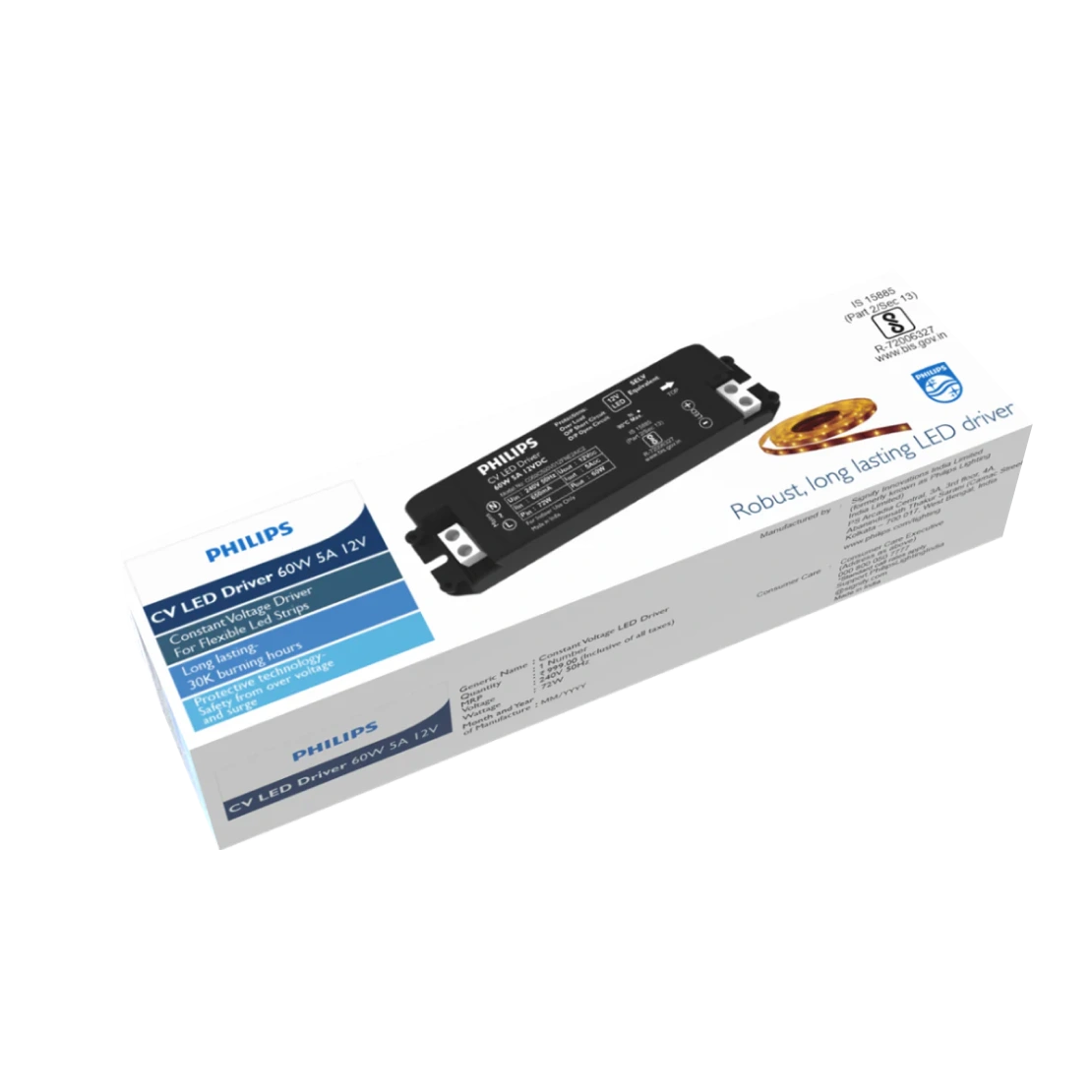
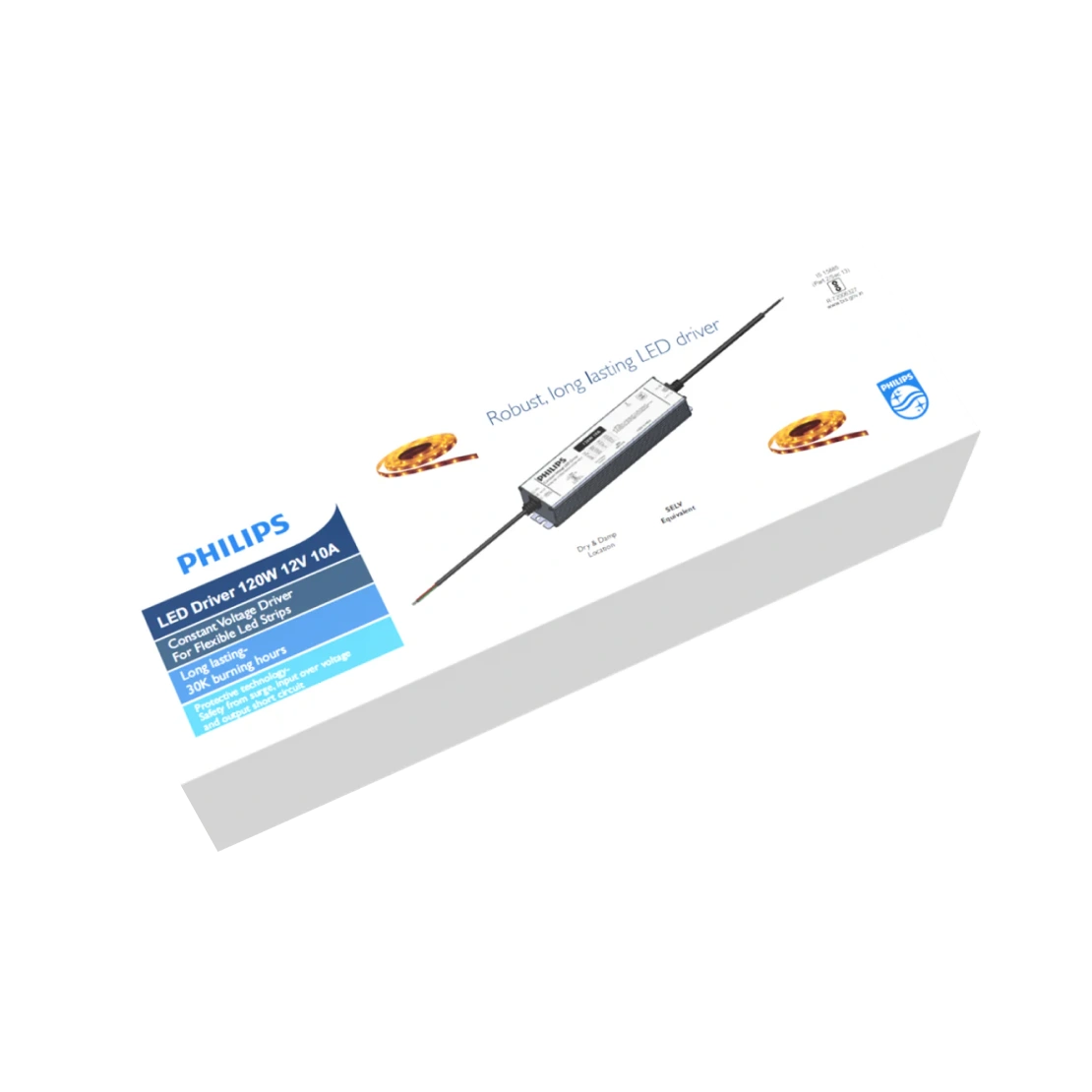
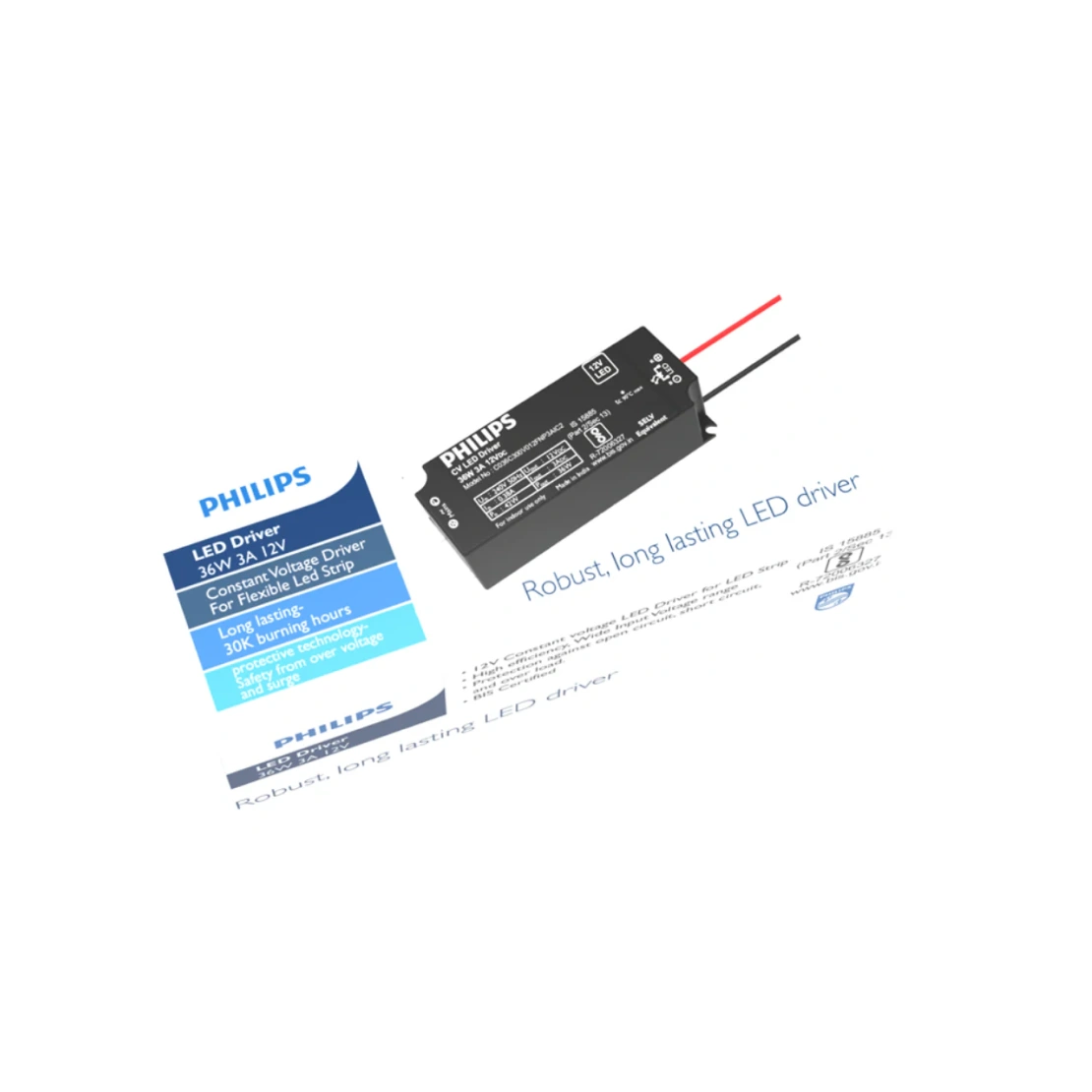
Philips LED Strip Light Driver is a professional-grade constant voltage SMPS (Switched-Mode Power Supply) that converts standard 220–240V AC mains power to stable 12V or 24V DC — the voltage required by LED strip lights for safe, consistent, and efficient operation. Available in 60W (5A) and 120W (10A), it covers the most common residential and commercial LED strip installation scales — from standard room cove lighting to large retail and hospitality ceiling runs. The driver is the critical foundation of any LED strip installation: an undersized, low-quality, or mismatched driver is the single most common cause of LED flickering, premature failure, overheating, and uneven brightness.
Philips drivers are built to professional specifications with >85% efficiency and a power factor of >0.95 — significantly better than the 70–80% efficiency typical of generic SMPS units, which waste more input power as heat and increase operating costs. Comprehensive protection circuitry covers overload, short circuit, over-voltage, and over-temperature conditions — safeguarding both the driver and the LED strips connected to it. With a rated MTBF of 25,000–50,000 hours, a Philips driver installed correctly and sized with an appropriate safety margin will outlast multiple LED strip replacements, making it a one-time investment in the reliability of the entire lighting system.
| Specification | Details |
|---|---|
| Brand | Philips (Signify Innovations India Ltd) |
| Driver Type | Constant Voltage SMPS |
| Input Voltage | 220–240V AC, 50/60Hz |
| Output Voltage | 12V DC or 24V DC (constant voltage) |
| Available Wattages | 60W (5A) and 120W (10A) |
| Efficiency | >85% |
| Power Factor | >0.95 |
| Protection Features | Overload, short circuit, over-voltage, over-temperature |
| Rated Lifespan (MTBF) | 25,000–50,000 hours |
| Material & Finish | Metal housing with ventilation slots |
| Warranty | Philips manufacturer warranty |
| Driver | Max Strip Load | Approx. Strip Length | Best For |
|---|---|---|---|
| 60W / 5A | Up to 48W (80% rule) | 3–5 metres at 8W/m | Living room cove, false ceiling accent, bedroom perimeter |
| 120W / 10A | Up to 96W (80% rule) | 5–10 metres at 8W/m | Large hall cove, commercial retail, hospitality ceiling runs |
Multiply the LED strip's wattage per metre by the total length you are installing to get the total load in watts. Then add a 20% safety margin (multiply total load by 1.2) — this is the minimum driver wattage you should select. Running a driver at 100% of its rated capacity causes overheating and premature failure; the 20% headroom keeps the driver operating at 80% load, which is the recommended maximum for longevity. For example: a 5-metre strip at 8W/m = 40W total load × 1.2 = 48W minimum — select the 60W / 5A driver. For a 10-metre run at 8W/m = 80W × 1.2 = 96W minimum — select the 120W / 10A driver. If your total load exceeds 96W, use two 60W drivers on separate circuits rather than a single unit.
The voltage must match your LED strip exactly — check the strip's specifications before purchasing. As a general guide, 12V strips are more common for short runs (under 5 metres) and DIY residential applications. 24V strips are better for longer runs (above 5 metres) because they experience less voltage drop over distance, maintaining consistent brightness at the far end of the strip. Never connect a 12V strip to a 24V driver or vice versa — this will either destroy the LEDs immediately (over-voltage) or produce very dim output (under-voltage).
Yes — multiple LED strip sections can be connected in parallel from a single constant voltage driver output, provided the total wattage of all strips combined does not exceed 80% of the driver's rated wattage. Parallel connection means both positive terminals connect to the driver's positive output and both negative terminals connect to the negative output — do not connect strips in series on a constant voltage driver. If the combined strip wattage exceeds 80% of the largest available driver, use two separate drivers rather than overloading one.
The driver should be installed in a well-ventilated, dry location with at least 6 inches of free air clearance on all sides. Installing a driver inside a completely sealed false ceiling cavity without ventilation is the most common cause of driver overheating and early failure — heat accumulates with no airflow and the driver's thermal protection repeatedly triggers. If false ceiling installation is unavoidable, ensure the cavity has ventilation openings or use a driver rated for enclosed installation (check the product datasheet). Never install in damp or wet locations unless the driver carries an IP rating for that environment.
Unbranded SMPS units typically use lower-grade capacitors, transformers, and control ICs — the components most responsible for long-term reliability. Their stated efficiency (often 70–75%) and power factor (often 0.6–0.8) are lower than the Philips specification (>85% efficiency, >0.95 PF), meaning they consume more electricity for the same output and run hotter. Protection circuitry in budget units is often absent or unreliable — a power surge or overload that a Philips driver would survive safely can destroy an unbranded unit and the LED strips connected to it. Over a 3–5 year installation lifetime, the replacement cost of failed cheap drivers and damaged LED strips typically exceeds the initial price premium of a quality Philips driver.
0 items
Rs. 0.00
